
Cet article est actuellement disponible uniquement en anglais.
Lire en anglaisFree SOCKS5 IP: Risks, Alternatives & What You Need
The search for a free socks5 ip has become increasingly common as internet users seek ways to enhance privacy, bypass geographical restrictions, and maintain anonymity online. While the appeal of free proxy services is understandable, especially for those testing applications or working with limited budgets, the reality of using free SOCKS5 addresses carries significant risks that many users don't fully comprehend. Understanding what SOCKS5 actually is, how these proxies function, and why "free" options may cost you more than money is essential for anyone considering this route.
Understanding SOCKS5 Protocol and IP Addresses
SOCKS5 represents the fifth version of the Socket Secure protocol, designed to route network packets between client and server through an intermediary proxy server. Unlike HTTP proxies that only handle web traffic, SOCKS5 supports various protocols including TCP and UDP, making it versatile for applications beyond web browsing.
The protocol operates through a straightforward handshake process:
- Client initiates connection to SOCKS5 proxy server
- Authentication negotiation occurs (if required)
- Client sends connection request with destination details
- Proxy establishes connection to target server
- Data transmission begins through the proxy tunnel
A free socks5 ip refers to the IP address of a SOCKS5 proxy server that's publicly accessible without payment. These addresses circulate through forums, proxy listing websites, and automated scraping tools that discover open proxy servers.
Technical Architecture of SOCKS5
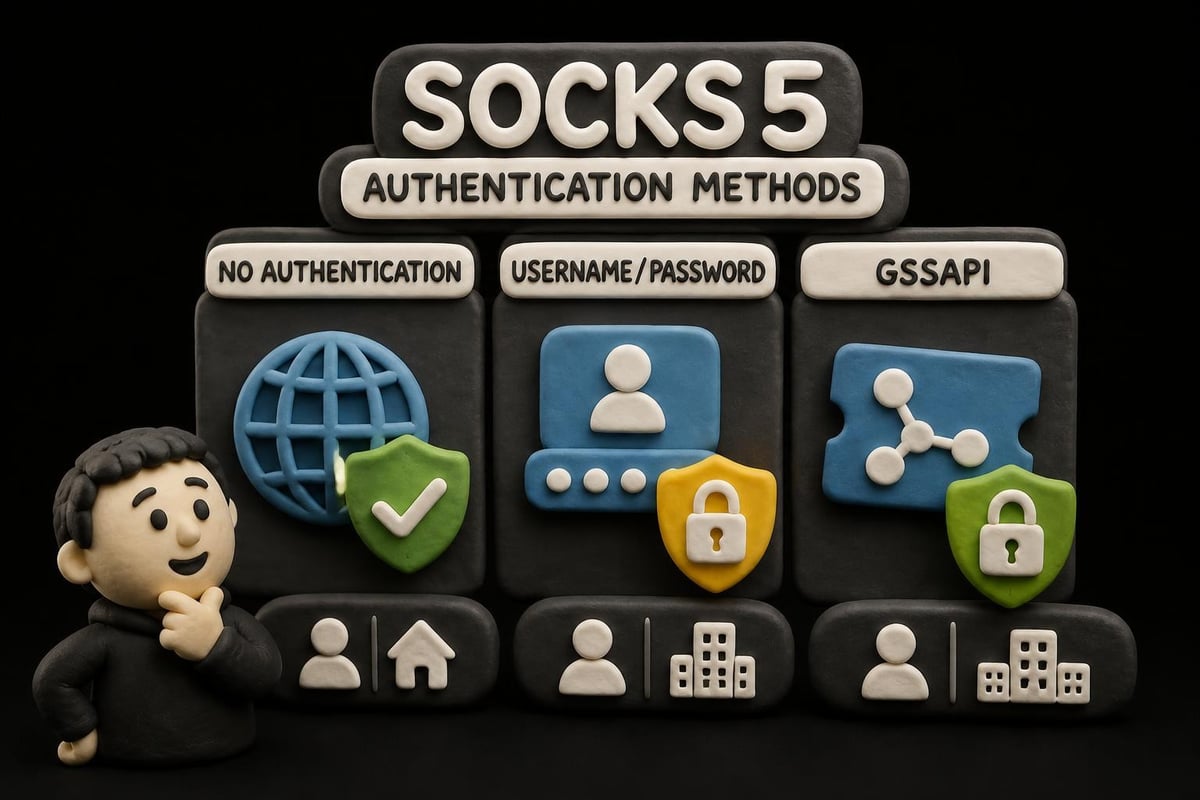
According to the official SOCKS5 RFC specification, the protocol provides flexible authentication methods and supports both IPv4 and IPv6 addressing. The specification defines how clients and servers communicate during the handshake phase and data transfer stages.
| Feature | SOCKS5 | SOCKS4 | HTTP Proxy |
|---|---|---|---|
| Protocol Support | TCP, UDP | TCP only | HTTP/HTTPS only |
| Authentication | Multiple methods | Limited | Basic/Digest |
| IPv6 Support | Yes | No | Yes |
| DNS Resolution | Client or proxy | Client only | Proxy side |
The Hidden Costs of Free SOCKS5 IP Addresses
While searching for a free socks5 ip might seem like a cost-effective solution, research reveals troubling patterns in the free proxy ecosystem. Academic analysis of over 640,000 free proxies uncovered extensive vulnerabilities and reliability issues that compromise both security and performance.
Major security vulnerabilities include:
- Man-in-the-middle attacks through compromised servers
- Traffic interception and data harvesting
- Malware injection into unencrypted connections
- Cookie theft and session hijacking
- DNS leak exposures
Free proxy operators face minimal accountability. Without paying customers to serve, these providers often monetize through alternative means-selling user data, injecting advertisements, or worse, using your connection for illegal activities.
Performance and Reliability Issues
Beyond security concerns, free socks5 ip addresses suffer from practical performance problems. These servers typically operate on limited infrastructure, shared among thousands of users simultaneously.
Connection speeds on free proxies rarely exceed 1-2 Mbps, compared to commercial services offering 10Gbps bandwidth. Uptime remains unpredictable, with servers frequently going offline without notice. Geographic distribution is limited, reducing options for location-specific requirements.
Common reliability problems:
- Frequent disconnections mid-session
- Extreme latency (500ms+ response times)
- Bandwidth throttling during peak hours
- IP address blacklisting by major websites
- Inconsistent availability patterns
For professionals conducting web scraping, managing multiple accounts, or accessing geo-restricted content, these limitations make free options impractical for sustained operations.
Legal and Ethical Considerations
Using a free socks5 ip introduces legal gray areas that many users overlook. The origin of these proxy servers often remains unclear-some are misconfigured legitimate servers, while others may be compromised devices operating without owner consent.
Compliance Risks
Businesses must consider regulatory compliance when routing traffic through proxy servers. GDPR, CCPA, and other data protection frameworks impose strict requirements on how customer data traverses networks. Free proxies provide no guarantees about data handling, jurisdiction, or regulatory compliance.
Potential legal exposures:
- Data breach liability if customer information passes through compromised proxies
- Copyright violation accusations from shared IP activities
- Terms of service violations on platforms detecting proxy usage
- Export control issues when routing through certain jurisdictions
Organizations in healthcare, finance, or other regulated industries face particular risks. Compliance officers increasingly scrutinize network traffic routing to ensure data protection standards.

Enterprise SOCKS5 Implementation
For organizations requiring legitimate SOCKS5 functionality, proper enterprise deployment follows structured protocols with authentication, logging, and security controls. These implementations differ dramatically from public free socks5 ip services.
Corporate SOCKS5 deployments typically include:
- Centralized authentication through LDAP or Active Directory
- Comprehensive traffic logging for security auditing
- Network segmentation to isolate proxy traffic
- Rate limiting and bandwidth allocation policies
- Redundant infrastructure for high availability
| Deployment Aspect | Enterprise SOCKS5 | Free SOCKS5 IP |
|---|---|---|
| Authentication | Required, centralized | Often none |
| Logging | Comprehensive | Unknown/none |
| SLA Guarantees | Contractual | None |
| Technical Support | 24/7 dedicated | Community forums |
| IP Reputation | Managed, clean | Often blacklisted |
These enterprise features ensure compliance, performance, and security-requirements impossible to meet with free public proxies.
Alternatives to Free SOCKS5 IP Services
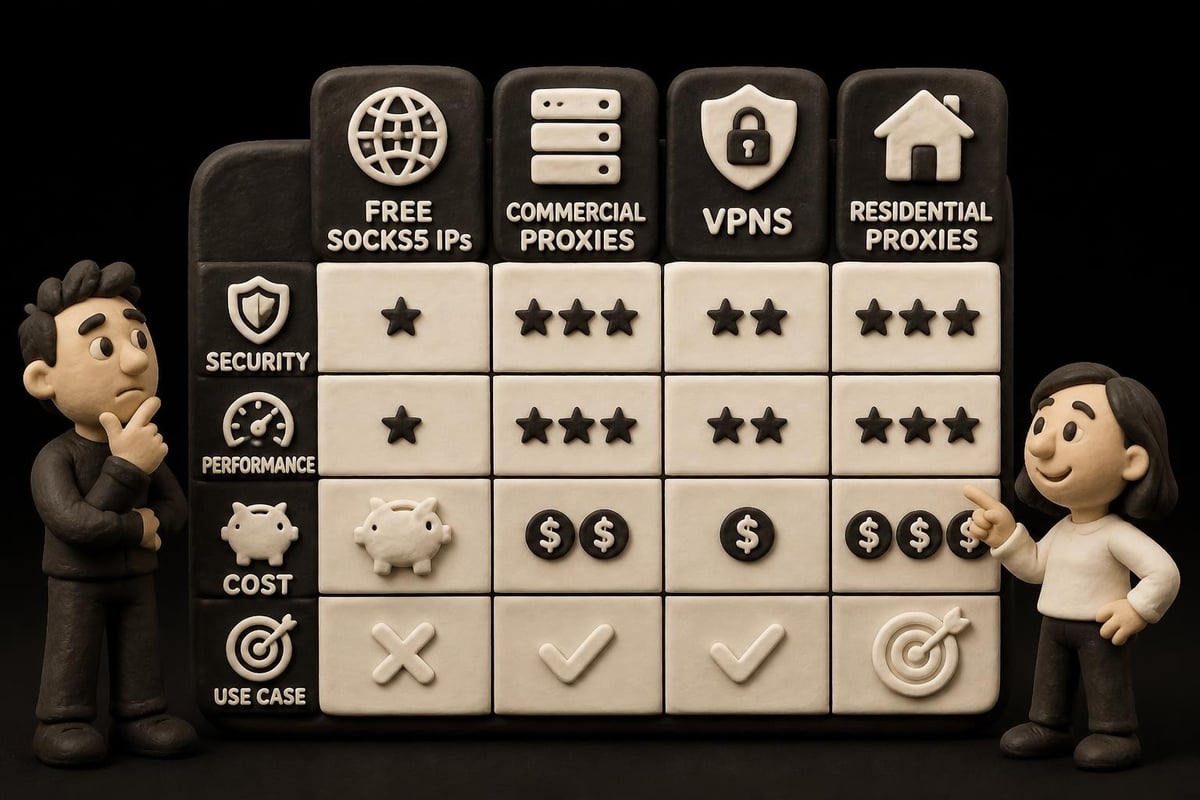
Rather than risking security and reliability with a free socks5 ip, several alternative approaches provide better outcomes for various use cases.
Commercial Proxy Services
Professional proxy providers offer dedicated infrastructure with performance guarantees. These services maintain clean IP pools, implement proper security protocols, and provide customer support when issues arise.
Premium proxy services typically offer:
- Rotating IP pools with millions of addresses across global locations
- Protocol flexibility supporting SOCKS5, HTTP/HTTPS, and custom configurations
- Bandwidth guarantees ensuring consistent throughput for demanding applications
- Geographic targeting down to city-level precision
- Session persistence maintaining connections for extended operations
For those exploring international markets, multilingual proxy documentation helps teams across regions implement solutions effectively.
VPN Services as Proxy Alternatives
Virtual Private Networks provide similar privacy benefits with stronger encryption and easier configuration. Modern VPN protocols like WireGuard offer performance approaching direct connections while maintaining robust security.
VPNs excel for:
- Personal privacy protection across all applications
- Simplified setup without per-application configuration
- Strong encryption standards protecting all traffic
- Established providers with proven track records
However, VPNs lack the granular control and protocol flexibility that SOCKS5 provides for specialized applications like web scraping or automated testing.
Building Your Proxy Strategy
Selecting appropriate proxy solutions requires evaluating specific requirements against available options. Different use cases demand different approaches, making one-size-fits-all recommendations unrealistic.
Assessment criteria include:
- Volume requirements: Daily bandwidth and request counts
- Geographic distribution: Required coverage across countries or cities
- Performance needs: Acceptable latency and minimum speeds
- Security requirements: Data sensitivity and compliance obligations
- Budget constraints: Total cost of ownership including setup and maintenance
Web scraping operations typically need rotating residential proxies with broad geographic coverage. Gaming applications prioritize low latency over IP diversity. Business intelligence gathering requires reliable connections with clean IP reputations.
Scaling Considerations
As operations grow, proxy infrastructure must scale accordingly. What works for testing rarely suffices for production deployments. Free socks5 ip addresses particularly struggle with scaling demands.
Professional proxy services offer API-based management enabling automated provisioning, rotation policies, and monitoring integration. These capabilities become essential when managing hundreds or thousands of concurrent connections.
Organizations serious about privacy, security, and performance eventually migrate from free solutions to commercial providers. The question becomes timing-whether to start with proper infrastructure or waste resources troubleshooting free alternatives.
Performance Optimization Techniques
Even with quality proxy infrastructure, optimization ensures maximum efficiency. Configuration details significantly impact real-world performance beyond raw specifications.
Connection Management
Proper connection handling reduces overhead and improves throughput:
- Connection pooling reuses established proxy connections
- Keep-alive settings maintain persistent connections when beneficial
- Timeout configuration balances retry logic with resource conservation
- Concurrent connection limits prevent overwhelming proxy infrastructure
Applications making hundreds of requests benefit from sophisticated connection management strategies. Simple sequential requests waste resources and extend execution time unnecessarily.
DNS Resolution Strategies
SOCKS5 supports both client-side and proxy-side DNS resolution. The choice impacts privacy, performance, and reliability differently across scenarios.
Proxy-side DNS resolution:
- Prevents DNS leaks exposing intended destinations
- Ensures geographic consistency with proxy location
- May add latency depending on proxy DNS infrastructure
Client-side DNS resolution:
- Reduces proxy server processing overhead
- Enables advanced DNS strategies like split-horizon
- Potentially exposes destination information to ISP
For privacy-focused applications, proxy-side DNS resolution typically provides better protection, though performance-sensitive operations might benefit from client-side resolution with secure DNS providers.
Monitoring and Troubleshooting
Regardless of proxy selection, monitoring remains essential for maintaining reliable operations. Free socks5 ip addresses offer no built-in monitoring, requiring external tools to detect failures.
Critical metrics to track:
- Connection success rates and failure patterns
- Response time percentiles (p50, p95, p99)
- Bandwidth utilization and throttling indicators
- IP reputation scores and blacklist status
- Error types and frequency distributions
Commercial proxy services often include dashboards displaying these metrics. For free alternatives, custom monitoring solutions become necessary-adding complexity that undermines the supposed cost savings.
When troubleshooting proxy issues, systematic approaches identify root causes faster:
- Verify basic connectivity to proxy server
- Confirm authentication credentials if required
- Test direct connection to destination bypassing proxy
- Check for IP blacklisting on target websites
- Monitor for DNS resolution failures
Many apparent proxy failures actually stem from misconfigured applications or network issues unrelated to the proxy itself.
Industry-Specific Proxy Requirements
Different industries face unique proxy challenges requiring specialized solutions. Understanding sector-specific needs helps evaluate whether a free socks5 ip meets requirements.
E-commerce and Price Intelligence
Online retailers monitor competitor pricing across geographies, requiring proxies that mimic residential users. Detection avoidance depends on IP diversity and rotation strategies beyond free proxy capabilities.
Digital Marketing and SEO
Search engine optimization professionals verify rankings across locations and devices. Clean IP addresses without previous abuse history become critical-something free proxies rarely provide. For international SEO campaigns, region-specific proxy configurations ensure accurate ranking verification.
Cybersecurity Research
Security researchers investigating threats need anonymity and attribution control. Compromised free proxies introduce unknown variables invalidating research findings.
| Industry | Primary Need | Free Proxy Suitability |
|---|---|---|
| E-commerce | Price monitoring | Poor - detection risk |
| Digital Marketing | Rank verification | Poor - IP reputation |
| Cybersecurity | Threat research | Dangerous - compromise risk |
| Ad Verification | Campaign validation | Poor - bot detection |
| Market Research | Competitor analysis | Poor - inconsistent access |
The Economics of Proxy Services
Understanding proxy service economics clarifies why truly free options rarely exist sustainably. Operating proxy infrastructure incurs real costs that providers must recover somehow.
Infrastructure costs include:
- Server hardware or cloud instance rental
- Network bandwidth at scale
- IP address acquisition and management
- Staff for maintenance and support
- Security monitoring and incident response
Legitimate free tiers exist as marketing strategies for commercial providers, offering limited access to demonstrate service quality. These differ fundamentally from anonymous free socks5 ip lists with unknown operators and motivations.
The total cost of using free proxies often exceeds commercial alternatives when factoring in:
- Developer time troubleshooting reliability issues
- Security incident response and remediation
- Lost productivity from service disruptions
- Opportunity costs from slower performance
- Potential data breach liabilities
Businesses calculating true cost of ownership typically find commercial proxy services deliver better value despite upfront pricing.
While the attraction of a free socks5 ip is understandable, the security vulnerabilities, performance limitations, and reliability issues make them unsuitable for serious applications. Whether you need proxies for web scraping, market research, or global access, investing in professional infrastructure pays dividends through consistent performance, clean IP reputations, and responsive support. PinguProxy delivers enterprise-grade datacenter, residential, and mobile proxies with 10Gbps bandwidth, unlimited access, and 1ms rotation cycles-providing the speed, security, and reliability that free alternatives simply cannot match.