A Canada residential proxy routes your requests through real home internet connections in Canada, so target sites see an ordinary Canadian visitor instead of a datacenter server. For data engineers collecting web data at scale, it is worth paying for when a target serves location-specific content or blocks datacenter ranges, and it is poor value when plain datacenter IPs already return clean responses.
This review covers what these proxies do, how Canadian coverage and pricing compare across providers, how rotation and sticky sessions affect pipeline design, and where PinguProxy's offerings fit.
What a Canada Residential Proxy Actually Does
A Canadian residential IP address is assigned by a consumer internet provider to a household or mobile subscriber, which is why sites treat it as organic traffic. Datacenter addresses belong to hosting companies, and many anti-bot systems score them as higher risk by default.
For scraping and AI training pipelines, three practical effects matter:
- Geo-accurate content. Pricing, availability, language (English and French), tax display and search results can all change by Canadian region.
- Lower block rates. Residential traffic blends in with real users, so fewer requests hit CAPTCHAs or soft blocks.
- Realistic network paths. Requests originate from consumer ISPs, which matters when you need to verify what an actual Canadian visitor sees.
The trade-off is cost and speed. Residential bandwidth is billed per GB, and home connections are slower and less predictable than datacenter links. Canada's broadband base is strong, though: Statistics Canada reports that 97.3% of households had access to 50 Mbps download and 10 Mbps upload speeds in 2025, which gives residential pools a healthy connection quality floor compared with many other markets.
Key Features to Judge Before You Buy
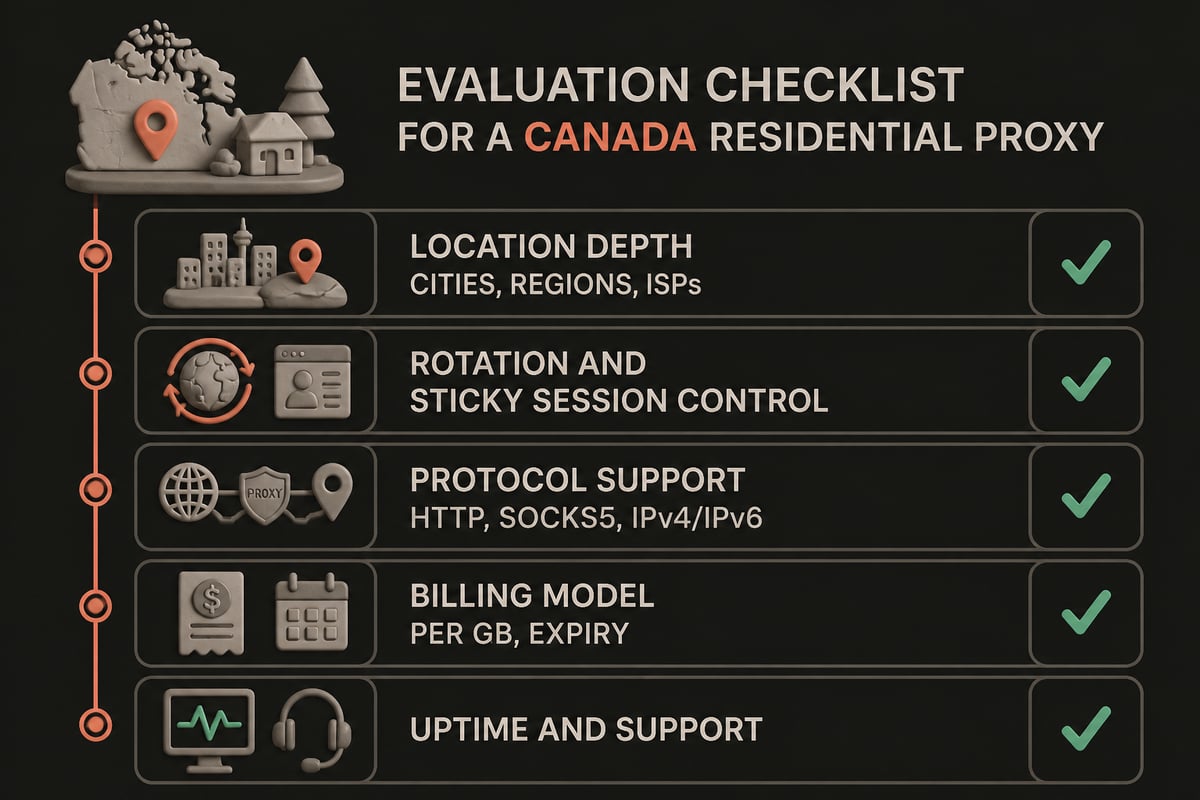
The features that decide whether a Canada residential proxy suits a data pipeline are location depth, rotation control, session length, protocol support and bandwidth billing. Marketing pages tend to lead with pool size, but the following criteria affect your results more.
Location depth
Country-level targeting is the minimum. City and region targeting becomes important when you collect localized listings, store inventory or regional search results. Published catalogues vary widely. Databay lists 481 Canadian cities, 16 regions and 127 postal codes in its location catalogue as of 11 November 2026, while a 2026 comparison from ProxyEmpire cites 556 cities and districts, 85+ fixed-line ISPs and mobile IPs on seven named carriers.
ISP diversity deserves as much attention as city count. A pool concentrated on one or two Canadian ISPs is easier for a target to fingerprint and throttle than one spread across many.
Rotation and sticky sessions
Rotating IPs suit high-volume collection of independent pages, such as product listings or search results. Sticky sessions suit multi-step flows like logins, pagination behind a session token and checkout simulations. Provider terms differ: CleanProxies states that Canadian sessions can rotate per request or stay sticky for 5 minutes to 24 hours.
Protocols, bandwidth and uptime
Check for IPv4 and IPv6 support, HTTP(S) and SOCKS5 compatibility, concurrency limits and whether unused traffic expires. For long-running crawls, a monitored uptime target matters more than headline speed, since a failed proxy mid-job costs retries and duplicated bandwidth.
How Canada Residential Proxy Pricing Compares
Canadian residential proxy pricing is almost always per GB, and published entry rates vary across providers. The figures below come from provider pages and comparisons; prices change often, so treat them as approximate.
| Provider | Residential | Mobile | Datacenter | Source |
|---|---|---|---|---|
| ProxyEmpire | From $1.50/GB | Not listed in the comparison | Not listed | ProxyEmpire |
| Prokso | $1.59/GB | $2.50/GB | $0.65/GB | Prokso |
| CleanProxies | From $11.45 for 5 GB | From $14.95 for 5 GB | Not listed | CleanProxies |
| PinguProxy | €2.00/GB with volume discounts | Available on the account | From €14.99 per 30 days | PinguProxy |
Two things to calculate before comparing sticker prices. First, work out the real cost per successful record: a cheaper GB that triggers more blocks and retries can cost more than a pricier one with a better success rate. Second, check expiry. Subscription traffic that resets monthly punishes bursty workloads such as periodic AI training refreshes, while pay-as-you-go balances that never expire suit irregular crawls.
PinguProxy Residential Proxies
PinguProxy's residential offering is a per-GB product built for geo-targeted scraping, SERP monitoring and localization testing, and as the maker of this site's sponsor I will describe it as fairly as the others. Its Residential Proxies start at €2.00/GB with volume discounts.
What PinguProxy states about the network:
- Unlimited bandwidth on every plan, and unused pay-as-you-go GB never expire.
- Over 500 million IP addresses across a network covering 190+ countries and regions, with residential targeting reaching 221 countries.
- A rotating IP interval of 1 ms on Pro and Enterprise plans.
- A zero-log policy.
- Datacenter, mobile, residential and TOR proxies on one account.
- A 99.9% uptime target, monitored 24/7, with 24/7 support priority on the Enterprise plan.
Strengths for data teams. One account covering several proxy types lets you route easy targets through cheaper datacenter IPs and reserve residential traffic for protected ones. Non-expiring pay-as-you-go GB suit teams whose collection runs in bursts. The 1 ms rotation interval on Pro and Enterprise helps high-concurrency jobs that need a fresh address for each request.
Limitations. The €2.00/GB entry rate sits above the lowest published headline figures from some competitors, although volume discounts narrow the gap. There is no free trial: monthly plans start with a 1-day trial for €1, then move to the regular plan price. Specific Canadian city-level targeting depth, ISP breakdown and sticky session durations are not listed here, so confirm them on the product page or with support before committing a production workload.
PinguProxy Datacenter Proxies as a Cost Companion
A datacenter pool belongs in a Canadian scraping stack as the cheap first tier, not as a replacement for residential IPs. PinguProxy's Datacenter Proxies start from €14.99 per 30 days and target large-scale market research and public data gathering.
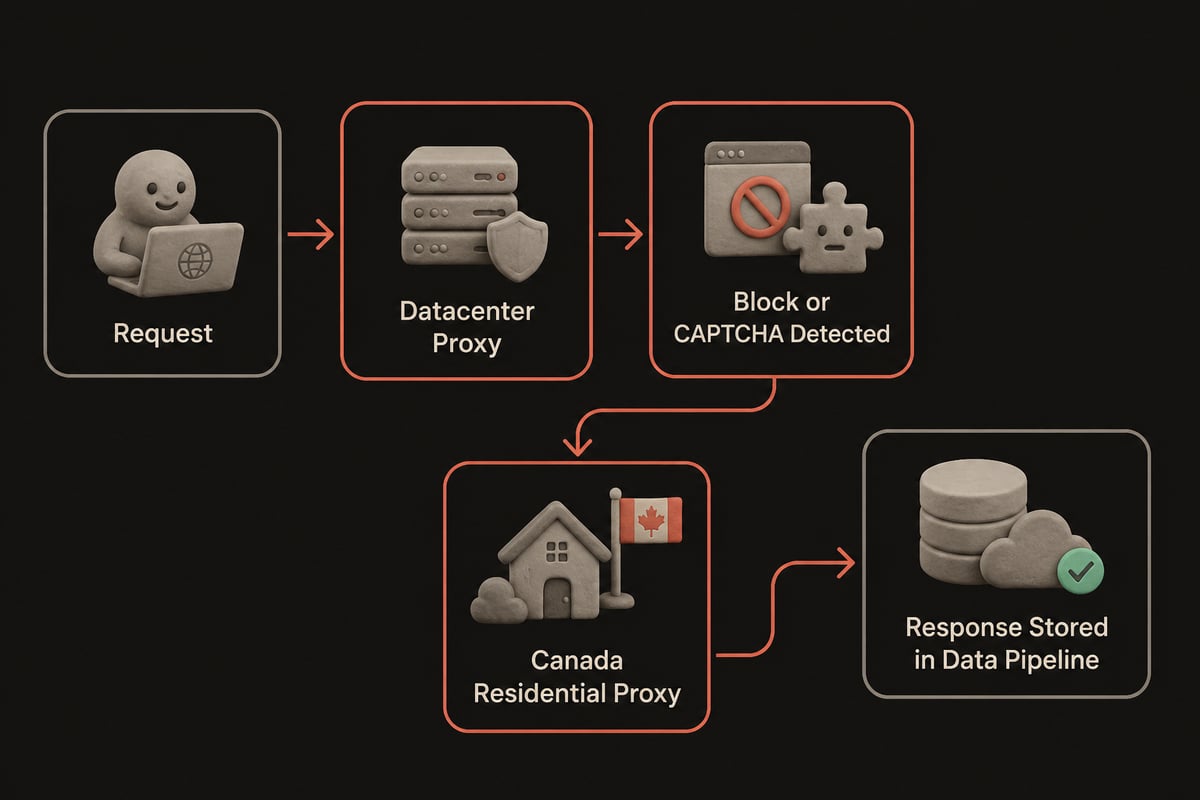
The practical pattern is tiered routing:
- Send requests to tolerant targets (public APIs, static pages, open datasets) through datacenter IPs.
- Detect blocks or CAPTCHAs in the response.
- Retry only the failed requests through Canadian residential IPs.
This keeps residential GB for the requests that need them. It also makes cost predictable, since most volume lands on a flat monthly pool. The limit is obvious: datacenter ranges remain easier for sophisticated anti-bot systems to flag, so they will not carry geo-sensitive pages on protected sites.
Does a Canada Residential Proxy Fit Scraping and AI Training Work?
A Canada residential proxy fits scraping and AI training work when the data you need is location-dependent or sits behind anti-bot protection, and it adds unnecessary cost when it is not. Common data engineering cases include:
- Localized e-commerce data: Canadian prices, shipping options and stock levels, including bilingual English and French listings that differ by province.
- SERP and ad monitoring: Search results and ad placements as seen from Canadian cities.
- Training data with regional balance: Collecting web text, reviews or product data that reflects Canadian usage, rather than a corpus skewed toward US sources.
- Localization QA: Verifying that a site serves correct currency, language and compliance notices to Canadian visitors.
Whatever you collect, confirm the terms of service and legal position of each target, and route only lawful public data collection through any proxy network. Residential proxies are infrastructure, not permission.
Pros and Cons Summary
Pros
- Higher acceptance on protected sites than datacenter IPs.
- Accurate Canadian geolocation for localized content.
- Per-GB billing aligns cost with actual usage.
- Works with rotating and sticky session patterns.
Cons
- Costs more per request than datacenter traffic.
- Speed and latency vary with the underlying home connection.
- Pricing models differ, so comparing plans takes arithmetic, not just reading a headline rate.
- Pool quality and ISP diversity are hard to verify without a trial run.

Who Should Buy and Who Should Skip
Buy a Canada residential proxy if you run recurring crawls against geo-aware or protected targets, need Canadian SERP or pricing data, or must balance a training corpus regionally. Concrete situations include tracking Canadian retail prices and shipping options across provinces, checking how search results and ad placements differ between Canadian cities, and collecting Canadian reviews or product text so a dataset is not dominated by US sources. PinguProxy suits this group when you want residential, datacenter and mobile access under one account, unlimited bandwidth and pay-as-you-go GB that do not expire. That combination fits teams whose collection runs in bursts, such as quarterly corpus refreshes, where expiring monthly traffic would be wasted.
Skip it if your targets accept datacenter traffic without issue, since a flat-rate datacenter plan will cost far less. Public APIs, static pages and open datasets usually fall into this category, and a quick test with datacenter IPs will show whether residential traffic is needed at all. Skip it, too, if you expect free proxy lists to deliver reliable results at scale; they rarely do, and PinguProxy is not built for free-list use. Teams that need confirmed city-level or ISP-level Canadian targeting should verify those details with support first, since they are not listed here. Anyone planning to route illegal traffic should not use PinguProxy at all.
Verdict
For data teams with location-sensitive or protected targets, a Canada residential proxy is worth paying for, provided you meter it carefully and reserve it for requests that cheaper IPs cannot complete. Judge providers on location depth, ISP spread, session control and effective cost per successful record rather than on pool size or the lowest advertised GB rate. A provider advertising $1.50/GB can still cost more than one at $2.00/GB if its success rate is lower and retries consume the difference.
PinguProxy earns a place on the shortlist through its single-account mix of proxy types, non-expiring pay-as-you-go traffic, unlimited bandwidth and zero-log policy, with the caveats of a €2.00/GB entry rate and no free trial. The tiered pattern described earlier is where that account structure pays off: datacenter IPs absorb tolerant traffic, and residential GB are spent only on retries that need them. The €1 first-day trial on monthly plans offers a low-cost way to check performance before committing. Run a small, measured test against your own targets before scaling, and record success rate, latency and GB consumed per thousand records so the decision rests on your own numbers.
Start by sending a few thousand requests to your hardest Canadian target and record the success rate, latency and GB used per thousand records. If you want to run that test on a network with datacenter, residential, mobile and TOR options in one account, try PinguProxy's Residential Proxies, and Get Started with a PinguProxy account to put your first Canadian crawl through it.