The best proxy service for web scraping is the one that matches your target sites, your request volume and your cost model: datacenter IPs for speed on tolerant sites, residential IPs for geo-targeted or heavily protected pages. This comparison weighs PinguProxy against Decodo, formerly Smartproxy, on proxy types, IP pool size, targeting, rotation, pricing structure and operational fit for data engineers and developers collecting data at scale.
Both providers cover datacenter and residential traffic, but they differ in how they charge, how they rotate and how much control they give you over sessions. The sections below compare them criterion by criterion, and the verdict at the end maps each to a specific workload.
PinguProxy vs Decodo at a Glance
The table below summarizes the two services on the attributes that most affect a scraping pipeline. Prices are approximate and may have changed since the sources were checked.
| Criterion | PinguProxy | Decodo (formerly Smartproxy) |
|---|---|---|
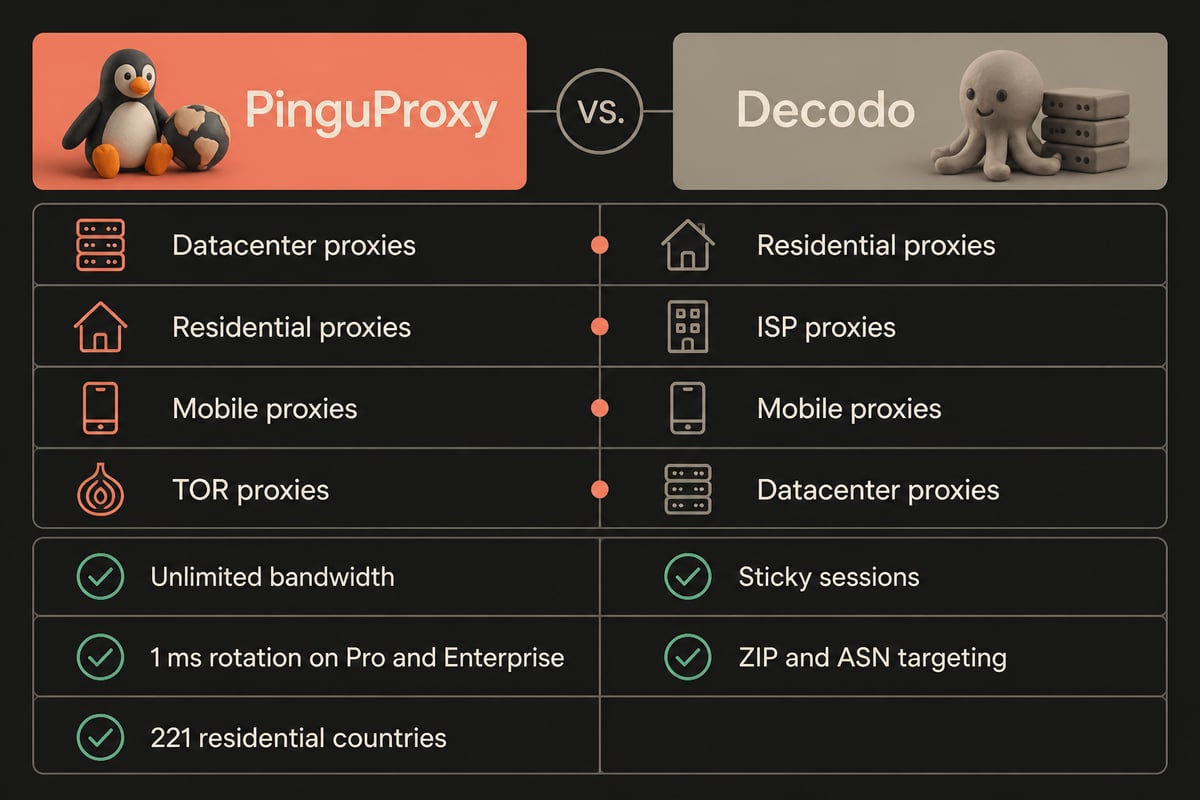
| Proxy types | Datacenter, residential, mobile and TOR on one account | Residential, ISP, mobile and datacenter |
| Network size | 500M+ IP addresses, 190+ countries and regions | 115M+ residential IPs, 195+ locations |
| Residential price | €2.00/GB with volume discounts | From about $2/GB |
| Datacenter price | From €14.99 per 30 days, unlimited bandwidth | Shared plans from about $0.45/GB; IPs from about $0.02 each |
| Bandwidth | Unlimited on every plan | Metered on GB plans |
| Rotation | 1 ms interval on Pro and Enterprise plans | Rotating and sticky sessions |
| Residential targeting | 221 countries | Country, state, city, ZIP code and ASN |
| Uptime | 99.9% target, monitored 24/7 | 99.99% reported |
| Protocols | IPv4 and IPv6 | HTTP(S) and SOCKS5 |
| Logging | Zero logs | Not covered here |
| Support | Enterprise plan includes 24/7 priority | Not covered here |
Read the table as a starting point. The rest of this article explains where each difference shows up in practice.
Proxy Types and Coverage
A proxy service for web scraping should offer the proxy types your targets require, and both services here cover the main categories with different strengths.
PinguProxy puts datacenter, mobile, residential and TOR proxies under one account. For a team running several scrapers with different tolerance levels, that means one billing relationship and one dashboard. The network spans over 500 million IP addresses across 190+ countries and regions. Datacenter proxies suit large-scale market research and public data gathering, while residential IPs suit geo-targeted scraping, SERP monitoring and localization testing.
Decodo lists four categories: residential, ISP, mobile and datacenter. The ISP category is the notable addition. Static IPs hosted on consumer-grade networks sit between datacenter speed and residential trust, which helps with long sessions such as logged-in workflows. Per Decodo's residential pricing page, the residential network includes 115M+ IPs across 195+ locations.
On raw pool size, PinguProxy's stated figure is larger, though the two numbers may count different things, so treat them as indicators rather than a like-for-like measurement. Location counts are close enough that neither wins on geography alone.
Pricing Models: Per GB vs Unlimited Bandwidth
The most consequential pricing difference is that PinguProxy includes unlimited bandwidth on every plan, while Decodo's residential and shared datacenter plans are metered by the gigabyte.
That distinction matters most for AI training collection and large crawls, where page weight is unpredictable. Metered billing makes cost proportional to bytes transferred, so a crawler that starts pulling images, scripts or large JSON payloads can inflate a bill quickly. Unlimited bandwidth turns that variable into a flat monthly figure on the datacenter side.
Current published pricing, as of November 2026:
- PinguProxy Datacenter: from €14.99 per 30 days, with unlimited bandwidth.
- PinguProxy Residential: €2.00/GB with volume discounts. Unused pay-as-you-go GB never expire, which removes the pressure to burn through a balance before a deadline.
- Decodo residential: from about $2/GB, according to Decodo's web scraping proxy page.
- Decodo ISP: from about $0.27 per IP.
- Decodo mobile: from about $2.25/GB.
- Decodo datacenter: from about $0.02 per IP, with shared datacenter plans from about $0.45/GB.
At the residential tier the headline per-GB rates are nearly identical, so the decision turns on volume discounts, balance expiry and your actual consumption. PinguProxy's trial structure is also worth knowing: there is no free trial, but monthly plans start with a 1-day trial for €1 before moving to the regular plan price. That is a low-cost way to test a target site before committing.
IP Rotation and Session Control
Rotation and session behavior decide whether a scraper can sustain high request rates without bans while still completing multi-step flows.
PinguProxy offers a rotating IP interval of 1 ms on its Pro and Enterprise plans. At that cadence, consecutive requests can leave from different addresses, which suits stateless, high-concurrency collection such as product listings, search result pages and public directories. A zero-log policy backs the privacy side of that workflow.
Decodo takes a different approach. Its residential plans include both rotating and sticky sessions. Sticky sessions hold one IP for a defined period, which matters when a site ties a cart, a login or a pagination token to the originating address. If your scraper must maintain state across several requests, session stickiness is a requirement, not a convenience. Check PinguProxy's product pages or contact its team for the specifics of session handling on your plan before building a stateful scraper around it.
A practical rule: use per-request rotation for breadth, sticky sessions for depth.
Geo-Targeting Precision
Targeting granularity determines how accurately you can see localized content, prices and search results.
PinguProxy's residential targeting reaches 221 countries, which covers country-level localization testing and SERP monitoring across many markets. For most pricing and availability scraping, country-level control is enough.
Decodo goes finer. Its residential plans support country, state, city, ZIP-code and ASN-level targeting. City and ZIP targeting matter for local search results, store-level inventory and regional pricing that varies within a country. ASN targeting helps when you need traffic that resembles a particular carrier or network. If your pipeline depends on hyper-local data, that precision is a real advantage.

Reliability, Speed and Performance
Both providers publish uptime targets, and the difference between them is small enough to be irrelevant for most workloads.
PinguProxy states a 99.9% uptime target, monitored 24/7. Decodo reports 99.99% for its residential and datacenter proxies and cites a response time under 0.3 seconds on datacenter proxies. A 99.9% target allows roughly 8.8 hours of downtime per year, while 99.99% allows under an hour. For a scraper with retry logic and a queue, either is workable. For a latency-sensitive pipeline with tight job windows, the higher figure is slightly more comfortable.
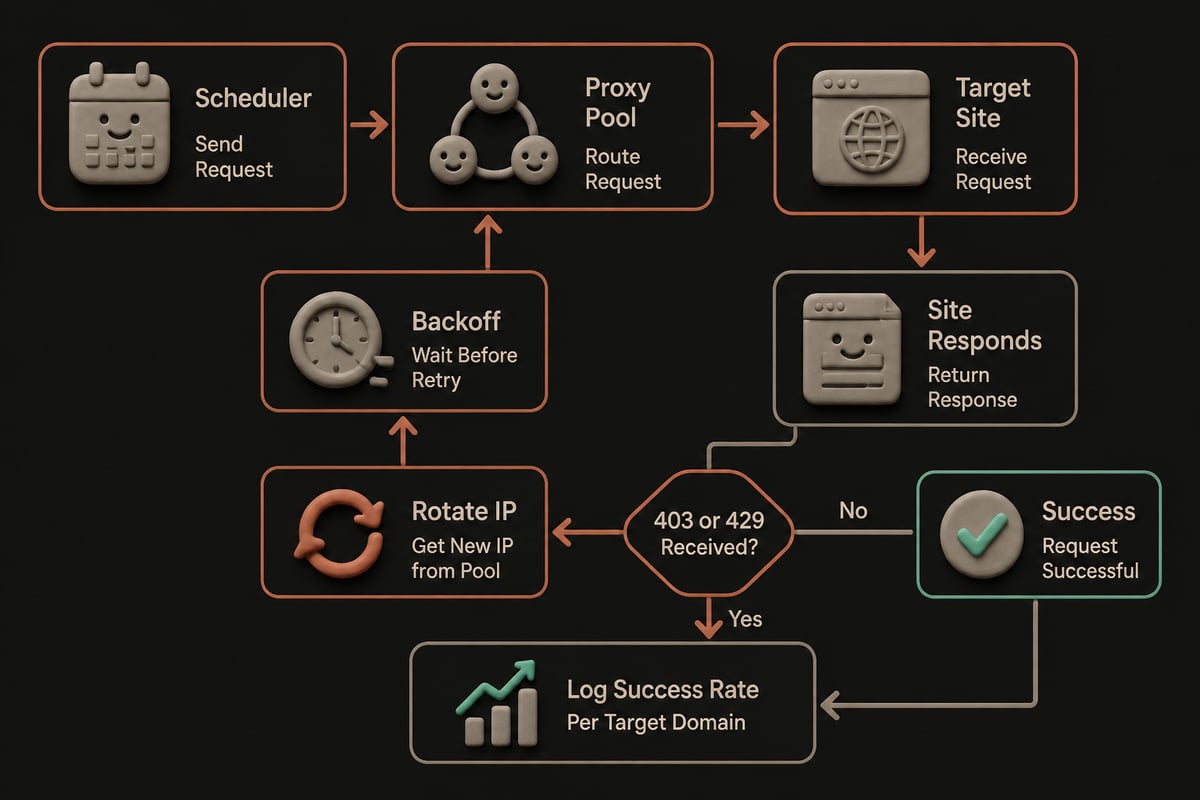
Whatever you choose, build for failure regardless of the published number: implement retries with backoff, rotate on 403 and 429 responses, and track success rate per target domain rather than trusting any vendor's aggregate.
Matching Proxy Type to Scraping Target
A proxy type should be chosen by how aggressively the target site defends itself, not by price alone, and a hybrid setup usually costs less than a single-type one.
- Tolerant sites and APIs (open directories, public datasets): start with datacenter proxies. They are the cheapest per request and the fastest.
- Mid-protection sites (e-commerce listings, news, job boards): try datacenter first, then escalate to residential on the domains that return blocks.
- Heavily defended or geo-gated sites (retail pricing, travel, search engines): use residential IPs with country or city targeting.
- Mobile-first experiences and app-adjacent endpoints: use mobile proxies.
The escalation approach works well with a provider that hosts several proxy types on one account, as PinguProxy does, because you can route by domain without managing separate vendors. It also works with Decodo's four categories. The key is measuring block rates per domain and moving only the failing domains up a tier, which keeps residential spend, the most expensive line item, confined to where it earns its cost.
Compliance and Ethical Collection
Responsible collection protects your pipeline from legal and reputational risk, and it applies to both services equally.
Scrape publicly available data, respect robots.txt where your legal guidance requires it, rate-limit requests to avoid degrading target servers, and avoid collecting personal data without a lawful basis. Rate limiting is a practical control as well as an ethical one. Capping concurrency per domain and adding randomized delays keeps your traffic closer to normal visitor patterns and reduces the number of blocks you pay to retry.
For AI training datasets, document the provenance of each source: the URL pattern, the collection date, the robots.txt state at that time and the license or terms that applied. That record lets you remove a source later if its owner objects or a regulation changes. Strip or hash personal identifiers such as names, emails and account handles at ingestion rather than after storage.
PinguProxy is not intended for routing illegal traffic, and a proxy network does not change your obligations under a site's terms or applicable law. Keep your own logs of what you collected and when, since a zero-log proxy policy covers the provider's side only. Have counsel review any target that sits behind a login or a paywall before it enters the pipeline.
Support and Operations
Support matters most when a scraper breaks at 3 a.m. against a deadline, so the support tier is part of the cost comparison.
PinguProxy's Enterprise plan includes 24/7 priority support, and the network is monitored around the clock against its uptime target. If you run production pipelines with downstream SLAs, that tier is the relevant one to evaluate. For Decodo's support terms, consult its own documentation, since they are not covered in the research here.
Operational fit also depends on how quickly you can start and adjust. PinguProxy's 1-day €1 trial on monthly plans lets you validate a target domain before paying the full plan price, and its pay-as-you-go residential GB never expire, so a paused project does not waste a balance. On the Decodo side, the residential plans carry a reported 99.99% uptime, and its HTTP(S) and SOCKS5 support covers most scraping clients without custom adapters. Before committing, confirm the escalation path for blocked IP ranges, how fast replacement IPs are issued, and whether a named contact exists for plan changes. Log proxy errors per domain from day one, so any ticket you open includes timestamps, status codes and the affected target.
Verdict: Which Option Suits Which Reader
Choose by workload, because neither service is better across every dimension.
Choose PinguProxy if:
- You run high-volume datacenter scraping and want predictable cost through unlimited bandwidth.
- You want datacenter, residential, mobile and TOR proxies on one account.
- You need very fast rotation (1 ms on Pro and Enterprise) for stateless, high-concurrency collection.
- Country-level residential targeting across 221 countries is sufficient.
- You value PAYG balances that do not expire. Review the PinguProxy datacenter and residential pages for current plan details.
Choose Decodo if:
- You need city, ZIP-code or ASN-level targeting for hyper-local data.
- Your workflows depend on sticky sessions for logins, carts or paginated flows.
- You want ISP proxies as a middle tier between datacenter and residential.
- You prioritize the highest published uptime figure.
Use both if your pipeline splits cleanly: bulk, stateless collection on one network and session-dependent, finely targeted jobs on the other. Run a small pilot on your real target domains and compare success rate, cost per thousand successful requests and retry volume before committing a budget.
Start by picking your three highest-volume target domains and running the same 10,000-request test through each provider, recording success rate and cost per thousand successful pages. If you want to run that test on a network built for scale, PinguProxy offers datacenter and residential proxies with unlimited bandwidth, zero logs and 24/7 monitoring, and you can get started with a 1-day €1 trial on a monthly plan.