DataImpulse residential proxy service is a pay-per-GB network of rotating home IPs that suits budget-conscious scraping and AI data collection, provided your team builds its own retry, parsing and CAPTCHA handling. It gives you raw proxy connections, flexible sessions and non-expiring traffic at a low entry price, but reviewer feedback on reliability is mixed, so it deserves a controlled pilot before you commit production volume.
This review is written for data engineers and developers who collect web data at scale. It covers what the network offers, how the session and targeting options work, where the costs rise, what independent reviewers report, and which alternatives belong on the same shortlist.
What DataImpulse Residential Proxy Offers
The service sells residential IPs billed by traffic volume, with a pool that the company advertises at 90 million residential IPs across 195+ locations, country targeting included.
Every residential plan, according to the same page, includes:
- HTTP(S) and SOCKS5 protocol support
- Rotating and sticky sessions
- API access and IP authorization
- 24/7 support
- Traffic that does not expire
The non-expiring traffic matters more than it first appears. Scraping workloads are bursty: a model-training crawl may consume hundreds of gigabytes in a week and nothing the next month. A balance that carries over removes the pressure to burn through a monthly allowance.
The product is a proxy gateway, nothing more. There is no browser rendering, no unblocking layer and no built-in extraction. That keeps the price down and keeps control in your hands, which many engineering teams prefer.
Rotation, Sticky Sessions and Targeting
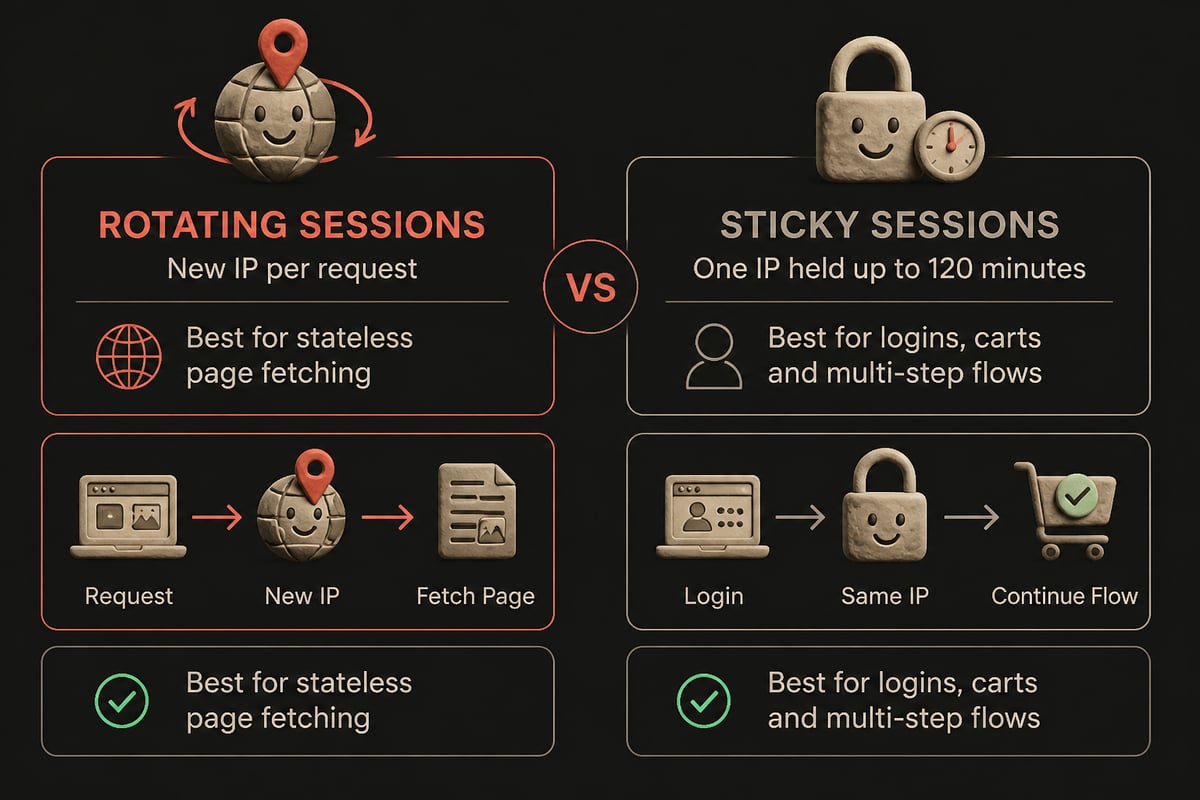
Rotating sessions assign a new IP to each request, while sticky sessions hold one IP for a defined window of up to 120 minutes, according to DataImpulse's own description.
Use rotation when:
- You are fetching many independent pages, such as product listings or search result pages.
- Each request is stateless and any IP will do.
- You want to spread load across as many exit addresses as possible.
Use sticky sessions when:
- The target requires a login or a multi-step flow, such as pagination tied to a cookie.
- You are carrying a shopping cart, a consent state or a CSRF token across requests.
- Switching IPs mid-session would trigger a fraud or bot rule.
Targeting has a cost structure worth reading carefully. Country targeting is included, but city, state, ZIP and ASN targeting are available for an additional fee, and the location page states these options cost twice the basic price. Budget for that before you compare headline prices.
Integration With Scraping Stacks
The provider lists integrations with Scrapy, Selenium and Puppeteer, so wiring it into a common Python or Node pipeline should be straightforward. Because the connection is a standard HTTP(S) or SOCKS5 endpoint, any client that accepts a proxy setting will work.
Two authentication paths are available: username and password credentials, or IP authorization. For containerized crawlers that run on changing addresses, credentials are simpler. For fixed worker fleets, IP allowlisting keeps secrets out of configuration files.
The more important point is what the proxy does not do. TechRadar's review notes that DataImpulse provides raw proxy connections rather than a managed scraping API, so your code must handle requests, parsing, retries and CAPTCHA responses. In practice that means you should plan for:
- Exponential backoff and per-domain concurrency limits
- Response validation, so a block page is not stored as data
- Header and TLS fingerprint management at the client level
- A CAPTCHA strategy, whether solving, avoidance or a separate service
Teams that already run Scrapy middleware for retries and throttling will find this familiar. Teams expecting a one-call unblocker will not.
Pricing and Cost Per Gigabyte
The company publishes an overview comparing starting prices for residential, datacenter and mobile services. Residential traffic is sold per GB, and prices are subject to change, so confirm current rates on the vendor's site.
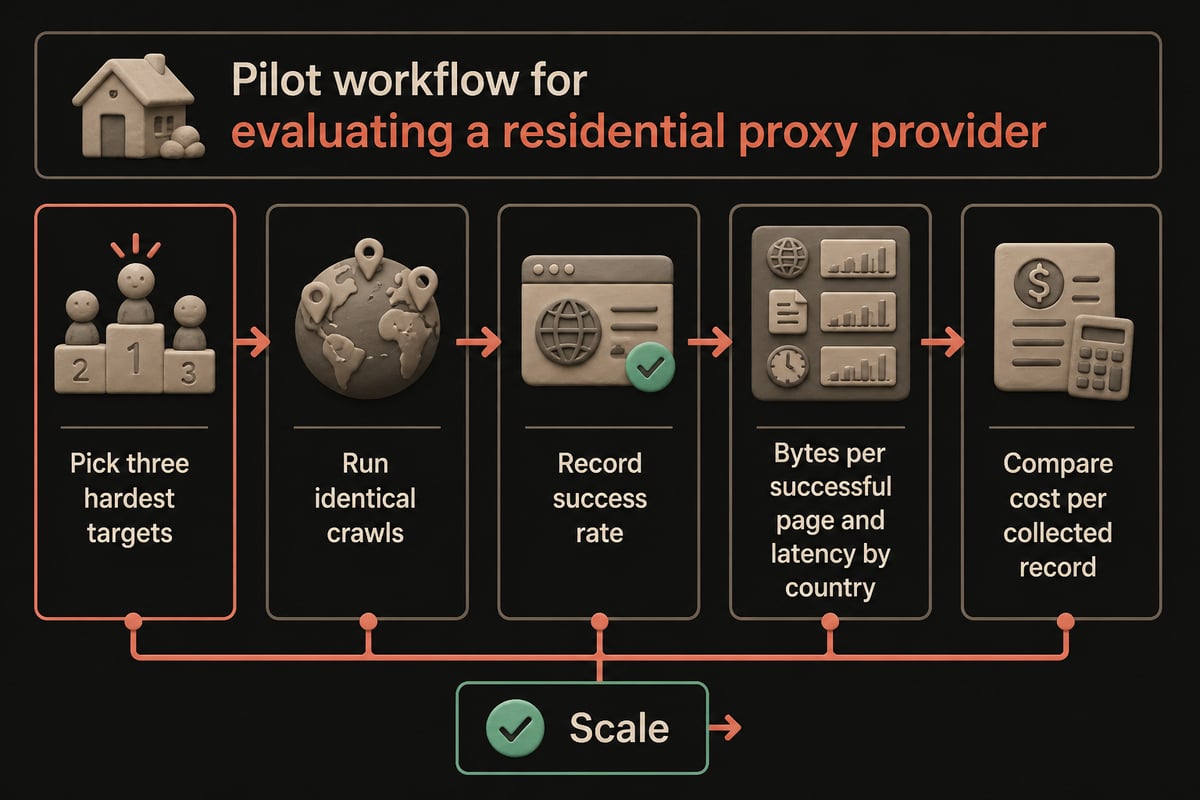
For planning, the figure that matters is cost per successfully collected record, not cost per GB. A cheaper GB with a lower success rate can end up costing more than a pricier GB that works the first time, because retried bytes and block pages are still paid traffic.
Factors that move your real cost:
- Page weight. Block images, fonts and media in headless browsers to cut bytes sharply.
- Success rate. Every retry is paid traffic.
- Targeting tier. City or ASN targeting at twice the base price changes the math.
- Sticky session length. Long sessions on heavy pages consume bandwidth steadily.

What Reviewers and Users Report
Independent feedback is split, and a fair review has to say so. ScrapeOps reports mixed user feedback: some reviewers praise performance, while others report detection, rapid bandwidth consumption, payment problems, and account or refund disputes. TechRadar's review adds a structural point, that the service supplies raw proxy connections and leaves requests, parsing, retries and CAPTCHA responses to the user.
That pattern is common for low-priced residential networks, where IP quality varies by country and by target. The sensible reading is that results depend on your sites, your geography and your client configuration. A proxy that performs well against a retail catalog may struggle against a site with aggressive bot detection.
A short pilot protects you. Run the same crawl against your three hardest targets, record the success rate, the bytes per successful page and the median latency, and only then scale. Track block rate by country, since pool quality is rarely uniform. Start with a small balance rather than a large one, and confirm payment and refund terms in writing before topping up, given the disputes some reviewers describe.
Alternatives Worth Putting on the Shortlist
DataImpulse is one option among several, and the right comparison depends on whether you need a proxy network, a crawling framework or a combined tool. The table below summarizes the three named alternatives and PinguProxy's residential option on the attributes that matter for scraping.
| Option | Type | Approximate price | Best fit |
|---|---|---|---|
| DataImpulse Mobile Proxies | Mobile proxy network | $2/GB | Tasks needing mobile IPs |
| GoLogin | Browser profiles with proxy traffic | Free; paid from $9/month | Browser profiles alongside proxies |
| Scrapy | Crawling framework and cloud | Framework free; cloud from $9/month per unit | Custom crawling pipelines |
| PinguProxy Residential | Residential proxy network | €2.00/GB with volume discounts | Geo-targeted collection at scale |
DataImpulse Mobile Proxies
The same vendor sells a mobile network at $2/GB with pay-per-GB pricing. DataImpulse identifies ad verification and scraping among its use cases. For standard catalog or SERP scraping, residential IPs may be sufficient and cheaper per request.
GoLogin
GoLogin is a browser-profile tool rather than a proxy network, and it fits workflows where each session needs an isolated browser identity. The free plan includes 3 profiles, and paid plans start at about $9/month ($4.50/month billed annually), with Professional tiers of 10, 25, 50 or 100 profiles. Professional plans list 1 concurrent cloud session and 300 API requests per minute, and paid plans include 2 GB of residential proxy traffic. It is useful for account-based workflows, though a high-volume crawler will outgrow 2 GB quickly.
Scrapy
Scrapy is the open-source framework many data teams already use, and it complements a proxy rather than replacing one. The framework is free. Scrapy Cloud offers a free tier with 1 low-resource unit, jobs that run up to 1 hour and data retention up to 7 days. Paid units start at about $9/month per unit, with unlimited job runtime and up to 120 days of data retention. Pair it with any residential provider to get scheduling, retries and storage.
PinguProxy Residential
PinguProxy Residential is billed per GB at €2.00/GB with volume discounts, and is aimed at geo-targeted scraping, SERP monitoring and localization testing. PinguProxy states that residential targeting reaches 221 countries, and that unused pay-as-you-go GB never expire. Every plan includes unlimited bandwidth and a zero-log policy, and a single account covers datacenter, mobile, residential and TOR proxies. It has no free trial: monthly plans begin with a 1-day trial for €1, then move to the regular plan price. As with any provider, test it against your own targets before scaling.
For large datacenter-based jobs on public data, such as broad market research, PinguProxy also offers datacenter proxies from €14.99 per 30 days. Datacenter IPs are often faster and cheaper per request, though they can be detected more often on protected sites.
Who Should Choose DataImpulse and Who Should Look Elsewhere
DataImpulse fits teams that want low-cost, flexible residential bandwidth and already own the retry and parsing layer. It is a reasonable candidate for AI training data collection from permissive sources, price monitoring across many regions, and SERP tracking where country-level targeting is enough.
It is a weaker fit if:
- You need city or ASN targeting at scale and cannot absorb the doubled rate.
- Your targets run strong bot detection and you want a managed unblocker.
- You cannot tolerate variable success rates and need contractual predictability.
- Your team has no capacity to build retry, validation and CAPTCHA handling.
If you fall into the second or third group, evaluate providers on a pilot with your own URLs and compare cost per successful record, including support responsiveness. Check payment and refund terms in writing before loading a large balance, given the account and refund disputes some reviewers describe.
Verdict
The DataImpulse residential proxy offering delivers what a budget raw-proxy service should: an advertised pool of 90 million residential IPs, rotating and sticky modes, HTTP(S) and SOCKS5 support, Scrapy, Selenium and Puppeteer integrations, and traffic that does not expire. Its main costs sit on your side of the connection, since you handle blocks, retries and CAPTCHAs, and its main risk is the uneven reliability some users report. The headline rate of $1/GB, or $0.80/GB at the listed 1 TB tier, is attractive, but city, state, ZIP and ASN targeting at twice the base price changes the calculation for localized work. For engineers who measure success rate and cost per record, it is a sound candidate to pilot, and a poor choice for anyone expecting an unblocking service. Treat it as one of two or three providers in a controlled test, and let your own metrics decide.
Your next step is to build a small benchmark of 1,000 requests across your three hardest targets and run it through every provider on your shortlist, logging success rate and bytes per successful page. If you want a second residential network in that test, PinguProxy Residential offers per-GB billing, unlimited bandwidth and zero logs on one account with datacenter and mobile options, and you can Get Started by registering for an account.