
SOCKS Protocol: Complete Guide for Proxy Users in 2026
The SOCKS protocol has become a cornerstone technology for anyone working with proxy services, web scraping, or privacy-focused browsing in 2026. Whether you're routing traffic through datacenter proxies for competitive intelligence or leveraging residential IPs to access geo-restricted content, understanding how SOCKS works under the hood can dramatically improve your implementation strategy and troubleshooting capabilities. This protocol operates at a lower network level than HTTP proxies, making it versatile enough to handle any TCP or UDP application traffic, from web browsers to gaming clients.
What Makes SOCKS Protocol Different from HTTP Proxies
SOCKS operates at the session layer (Layer 5) of the OSI model, sitting between the application layer and the transport layer. This architectural position gives it significant advantages over application-specific proxies like HTTP or HTTPS proxies that only understand web traffic.
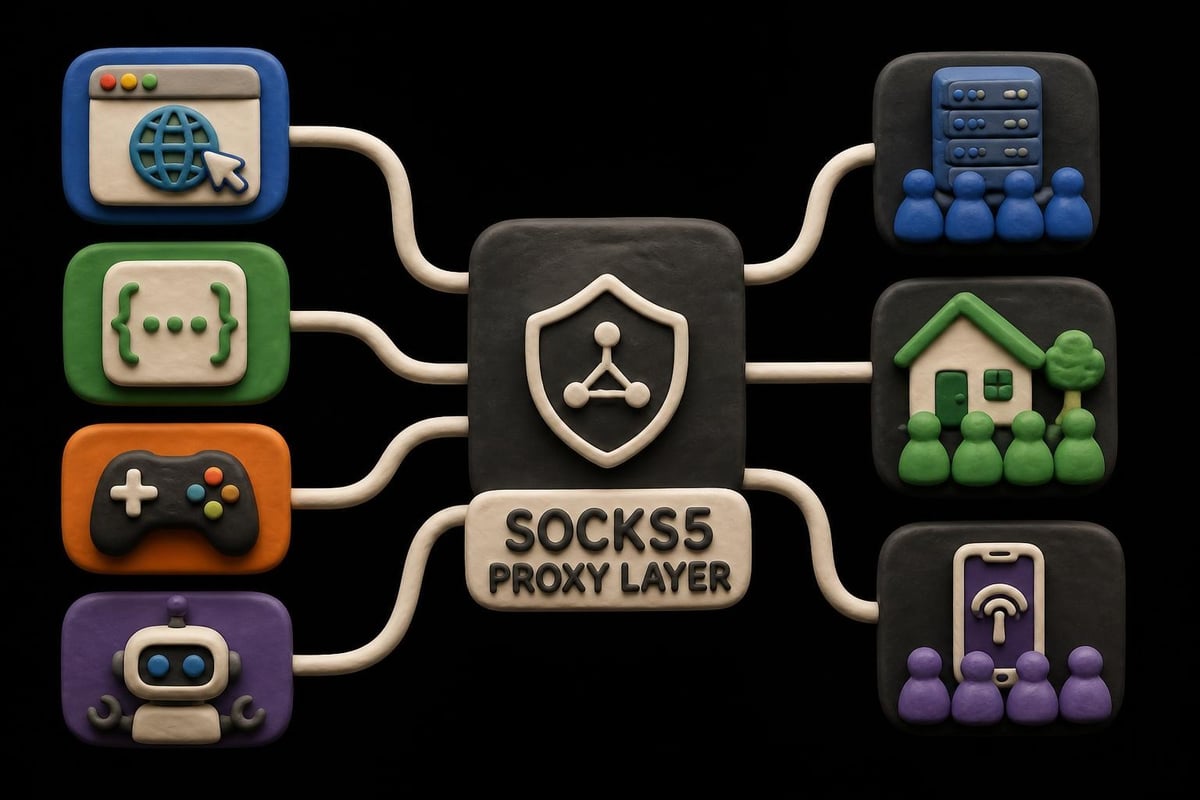
Unlike HTTP proxies, SOCKS can tunnel virtually any protocol, including FTP, SMTP, IRC, and custom application protocols. This versatility makes it the go-to choice for scenarios where you need to route diverse application traffic through a single proxy infrastructure. When you configure an application to use a socks protocol connection, the proxy doesn't need to understand or interpret the application data; it simply forwards packets between the client and destination server.
The protocol-agnostic nature of SOCKS brings specific benefits for proxy users:
- Gaming and P2P applications that use custom protocols work seamlessly
- Email clients can route SMTP/IMAP traffic through the same proxy as web browsing
- Development and testing environments gain consistent routing across all tools
- Lower overhead compared to HTTP proxies that parse and modify requests
SOCKS4 vs SOCKS5: Evolution and Capabilities
The original SOCKS4 protocol, introduced in the early 1990s, supported only TCP connections and IPv4 addresses. While still functional today, it lacks critical features that modern proxy users require.
SOCKS5, defined in RFC 1928, brought substantial improvements that made it the dominant version in 2026. The version 5 specification added UDP support for applications like DNS queries and real-time communication, along with IPv6 addressing to support the modern internet infrastructure.
| Feature | SOCKS4 | SOCKS5 |
|---|---|---|
| IPv6 Support | No | Yes |
| UDP Support | No | Yes |
| Authentication | Basic IDENT | Multiple methods including username/password |
| Domain Name Resolution | Client-side only | Client or proxy-side |
| Connection Commands | CONNECT only | CONNECT, BIND, UDP ASSOCIATE |
The authentication flexibility in SOCKS5 represents a major security advancement. The username/password authentication method allows proxy providers to implement user-specific policies, rate limiting, and access control, essential features for commercial proxy services in 2026.
How the SOCKS Protocol Handshake Works
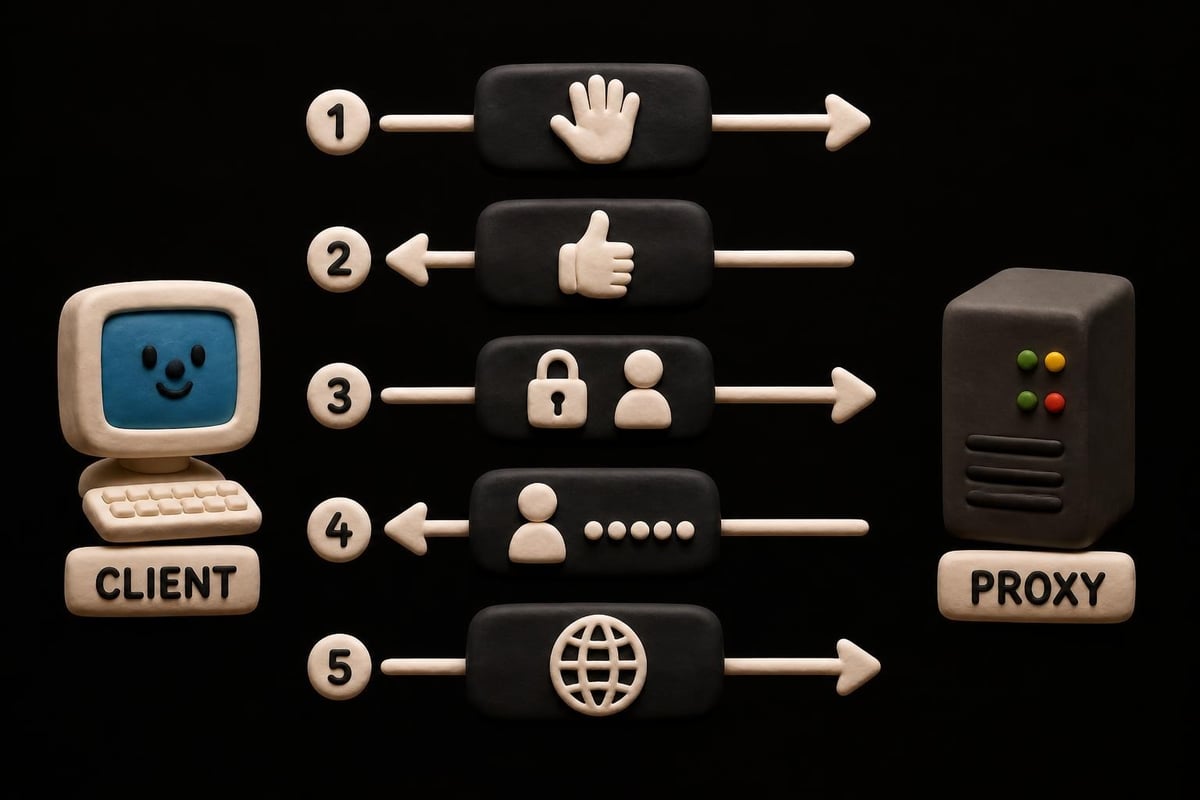
Understanding the socks protocol handshake helps diagnose connection issues and optimize performance. The SOCKS5 handshake occurs in three distinct phases before any application data flows through the proxy.
Phase one begins when the client connects to the proxy server's listening port (typically 1080) and sends a greeting message. This greeting lists the authentication methods the client supports, ranging from no authentication (0x00) to username/password (0x02) or more advanced methods. The proxy responds by selecting one method or rejecting the connection if no acceptable method exists.
During phase two, the selected authentication exchange occurs. For username/password authentication, the client sends credentials, and the proxy validates them against its user database. This step is where commercial proxy services like those implementing zero-log policies ensure they don't retain authentication session details beyond what's necessary for rate limiting and abuse prevention.
The third phase handles the actual connection request. The client tells the proxy what it wants to do:
- CONNECT command: Establish a TCP tunnel to a destination server (most common use case)
- BIND command: Accept incoming connections from a destination server (used for FTP data channels)
- UDP ASSOCIATE command: Set up UDP relay for applications like DNS or VoIP
The client specifies the destination address (IPv4, IPv6, or domain name) and port. The proxy attempts the connection and replies with success or a specific error code indicating why the request failed. Once successful, the proxy begins relaying data bidirectionally between client and destination.
Protocol Messages and Error Handling
SOCKS5 defines specific error codes that help diagnose connection problems. When a connection request fails, the proxy returns one of these status codes:
- 0x00: Request succeeded
- 0x01: General SOCKS server failure
- 0x02: Connection not allowed by ruleset
- 0x03: Network unreachable
- 0x04: Host unreachable
- 0x05: Connection refused by destination
- 0x07: Command not supported
For proxy users troubleshooting issues, these error codes pinpoint whether the problem lies with the proxy server's policies (0x02), network routing (0x03), destination availability (0x05), or the proxy implementation itself (0x01). When using rotating residential proxies, error 0x04 might indicate the selected exit node has limited routing capabilities.
Practical Applications of SOCKS Protocol in 2026
The versatility of the socks protocol makes it indispensable across diverse use cases. Web scraping operations frequently leverage SOCKS5 proxies because they can route browser automation tools, API requests, and even WebSocket connections through the same proxy pool without configuration changes.
Privacy-conscious users rely on SOCKS extensively for anonymous browsing. The Tor network, for instance, exposes a SOCKS port that applications can use to route traffic through its onion routing network. By configuring browsers or other applications to use this local SOCKS proxy, users gain the privacy benefits of Tor without application-specific integrations.
SSH tunneling remains one of the most popular legitimate uses of SOCKS. The OpenSSH dynamic port forwarding feature (ssh -D) creates a local SOCKS proxy that tunnels all traffic through an encrypted SSH connection. This technique allows remote workers to securely access corporate resources or developers to test applications as if they're accessing from different geographic locations.

Web Scraping and Data Collection
Modern web scraping at scale demands proxy solutions that handle both HTTP/HTTPS and WebSocket traffic. The socks protocol excels here because scraping frameworks can route all connection types through a unified proxy pool.
When implementing a scraping infrastructure, SOCKS5 offers specific advantages:
- Session persistence across different request types without protocol switching
- UDP support for DNS lookups performed through the proxy to prevent DNS leaks
- Binary protocol efficiency that reduces overhead compared to HTTP CONNECT tunneling
- Port flexibility enabling connections to non-standard ports without restrictions
For businesses running large-scale data collection operations, the combination of SOCKS5 with 10Gbps bandwidth infrastructure and 1ms rotation capabilities enables seamless proxy switching between requests without connection overhead. This architecture supports the high-throughput demands of competitive intelligence gathering and price monitoring systems.
Security Considerations and Authentication Methods
While SOCKS5 improved security over SOCKS4, proper implementation requires careful attention to authentication and encryption. The protocol itself doesn't encrypt the data tunnel, meaning traffic between client and proxy travels in plaintext unless wrapped in TLS or another encryption layer.
The no-authentication mode (0x00) poses risks in production environments. Any client that can reach the proxy port can use it without credentials, making the proxy vulnerable to abuse. Modern proxy services in 2026 require authentication to implement per-user rate limiting, traffic accounting, and abuse prevention.
| Authentication Method | Security Level | Use Case | Implementation Complexity |
|---|---|---|---|
| No Auth (0x00) | Low | Development/testing | Trivial |
| Username/Password (0x02) | Medium | Commercial proxies | Low |
| GSSAPI (0x01) | High | Enterprise environments | High |
| Custom methods (0x80-0xFE) | Varies | Proprietary systems | Medium-High |
The username/password authentication method strikes a balance between security and ease of implementation for most commercial applications. However, research into proxy abuse patterns shows that even authenticated proxies can be compromised if credentials leak or if providers don't implement proper rate limiting and anomaly detection.
Detecting and Preventing SOCKS Proxy Abuse
Proxy providers and network administrators implement multiple layers of abuse detection for SOCKS infrastructure. Connection rate monitoring catches automated scanning tools that rapidly attempt connections to numerous destinations. Unusual traffic patterns, such as sustained high-bandwidth UDP traffic or connections to known malicious IP ranges, trigger alerts.
Authentication session analysis helps identify credential sharing or stolen account usage. If a single user account connects simultaneously from multiple distinct source IPs with different geographic locations, it likely indicates unauthorized credential sharing. Zero-log policies complicate this analysis, requiring real-time detection rather than historical pattern matching.
Implementing SOCKS Protocol Support in Applications
Developers integrating socks protocol support into applications have multiple implementation approaches. Many programming languages provide built-in or third-party libraries that abstract the handshake complexity, allowing developers to specify a SOCKS proxy with a simple configuration parameter.
Native library support exists across major platforms. Python's socket module supports SOCKS through the PySocks library, while Node.js offers packages like socks and socks-proxy-agent for both HTTP clients and raw socket connections. Java applications can use the java.net.Proxy class with Proxy.Type.SOCKS to route standard socket connections through SOCKS proxies.
For applications requiring custom protocol implementations or debugging capabilities, understanding the wire protocol becomes essential. Tools like Wireshark's SOCKS dissector allow developers to capture and inspect SOCKS traffic at the packet level, verifying that their implementation correctly follows the handshake sequence and properly handles error conditions.
Configuration Best Practices
When configuring applications to use SOCKS proxies, several best practices improve reliability and performance:
- Implement proper timeout handling for both the initial handshake and idle connections
- Handle authentication failures gracefully with appropriate retry logic and user feedback
- Configure DNS resolution to occur through the proxy rather than locally to prevent leaks
- Test UDP functionality separately if your application requires UDP ASSOCIATE
- Monitor connection failures and error codes to detect proxy availability issues
Modern proxy infrastructure often supports both IPv4 and IPv6 through the same SOCKS5 endpoint. Applications should attempt IPv6 connections first when available, falling back to IPv4 if the IPv6 connection fails. This dual-stack approach ensures maximum compatibility while taking advantage of IPv6's expanded address space and improved routing characteristics.
Advanced SOCKS Features and Modern Proxy Architectures
Enterprise proxy deployments in 2026 frequently combine SOCKS protocol support with advanced features like automatic failover, geographic routing, and protocol conversion. Modern SASE implementations often expose a local SOCKS5 interface to applications while the underlying infrastructure handles complex routing decisions based on policy, performance, and security requirements.
The BIND command, though less commonly used, enables sophisticated networking scenarios. FTP's active mode uses BIND to allow the FTP server to establish data connections back to the client through the proxy. While passive FTP has largely superseded this approach, legacy systems and certain firewall traversal scenarios still rely on BIND functionality.
UDP ASSOCIATE enables real-time applications to leverage SOCKS proxies. Voice over IP (VoIP) systems, video conferencing platforms, and online gaming clients use UDP for low-latency communication. The UDP relay feature allows these applications to benefit from proxy routing while maintaining the performance characteristics that UDP provides.
Chain Proxying and Multi-Hop Routing
Advanced users sometimes chain multiple SOCKS proxies to increase anonymity or bypass layered restrictions. The client connects to the first proxy using SOCKS, then sends a SOCKS CONNECT request to the second proxy through the first tunnel, creating a nested proxy chain.
This technique multiplies latency and reduces bandwidth, as data must traverse each hop in the chain. However, it provides enhanced privacy by distributing trust across multiple proxy operators. If the first proxy logs traffic and the second proxy logs traffic, neither alone has a complete picture of both the client's true IP and the final destination.
Performance Optimization and Troubleshooting
Optimizing socks protocol performance requires attention to multiple factors. Connection pooling reduces handshake overhead when applications make numerous sequential requests. Instead of negotiating a new SOCKS connection for each request, the application maintains a pool of established tunnels and reuses them.
TCP tuning parameters significantly impact throughput through SOCKS proxies. Buffer sizes, congestion control algorithms, and maximum segment size (MSS) settings all affect the efficiency of data transfer through the proxy tunnel. When using high-bandwidth connections like 10Gbps infrastructure, ensuring that TCP window sizes can scale appropriately prevents artificial throttling.
Network packet analysis with tools covered in resources like the Wireshark User's Guide helps diagnose performance issues. Capturing SOCKS traffic reveals whether delays occur during the handshake, the application data transfer, or destination server response times. This granular visibility allows operators to pinpoint whether issues stem from proxy infrastructure, network routing, or destination server capacity.
Common Problems and Solutions
Several recurring issues affect SOCKS proxy implementations:
- DNS leaks: Applications perform DNS lookups locally, revealing intended destinations to local DNS servers and ISPs. Solution: Configure applications to send domain names to the proxy rather than IP addresses, letting the proxy handle resolution.
- Authentication loops: Incorrect credential handling causes repeated authentication attempts. Solution: Verify that authentication strings are properly encoded and that the proxy accepts the offered authentication method.
- Connection timeouts: Long-running connections through proxies may timeout due to idle connection limits. Solution: Implement application-level keepalive mechanisms or configure shorter request cycles.
- IPv6 fallback failures: Applications attempt IPv6 connections that the proxy infrastructure doesn't support. Solution: Configure application IPv6 preferences or ensure proxy infrastructure supports dual-stack addressing.
For businesses managing proxy infrastructure, implementing comprehensive monitoring of SOCKS connection success rates, authentication failures, and bandwidth utilization provides early warning of capacity constraints or configuration issues. Automated alerting when error rates exceed thresholds enables rapid response before user impact becomes severe.
Protocol Evolution and Future Developments
While SOCKS5 has remained stable since its 1996 standardization, the broader proxy ecosystem continues evolving around it. The rise of QUIC and HTTP/3 presents interesting challenges for SOCKS implementations, as these protocols multiplex multiple streams over a single UDP connection rather than using traditional TCP connections.
Integration with modern authentication systems represents an area of active development. While the SOCKS5 specification defines multiple authentication methods, most implementations in 2026 still rely on username/password authentication. Integration with OAuth 2.0, SAML, or other federated identity systems would improve security and user experience for enterprise proxy deployments.
The increasing prevalence of TLS encryption everywhere means that SOCKS proxies primarily tunnel encrypted traffic. This shift reduces the protocol-inspection capabilities that proxies once provided but aligns with broader privacy and security trends. Proxy providers focus less on content inspection and more on providing reliable, high-performance routing with strong privacy guarantees including zero-log policies.
Understanding the socks protocol empowers businesses to make informed decisions about proxy infrastructure and implementation strategies. Whether you're routing web scraping traffic, building privacy-focused applications, or enabling secure remote access, SOCKS5 provides the flexible, protocol-agnostic foundation modern applications demand. PinguProxy delivers high-performance SOCKS5 proxy infrastructure with support for datacenter, residential, and mobile IP pools, backed by 10Gbps bandwidth, 1ms rotation capabilities, and 24/7 support to ensure your applications maintain maximum uptime and anonymity across all use cases.