
SOCKS5 Proxy Software: Ultimate Guide for 2026
Modern internet users and businesses face increasing challenges around privacy, access restrictions, and data collection. SOCKS5 proxy software has emerged as a powerful solution that addresses these concerns while offering flexibility that traditional HTTP proxies cannot match. Understanding how this technology works and selecting the right implementation can dramatically improve your online operations, whether you're managing web scraping projects, protecting user privacy, or accessing geo-restricted content.
What Makes SOCKS5 Proxy Software Different
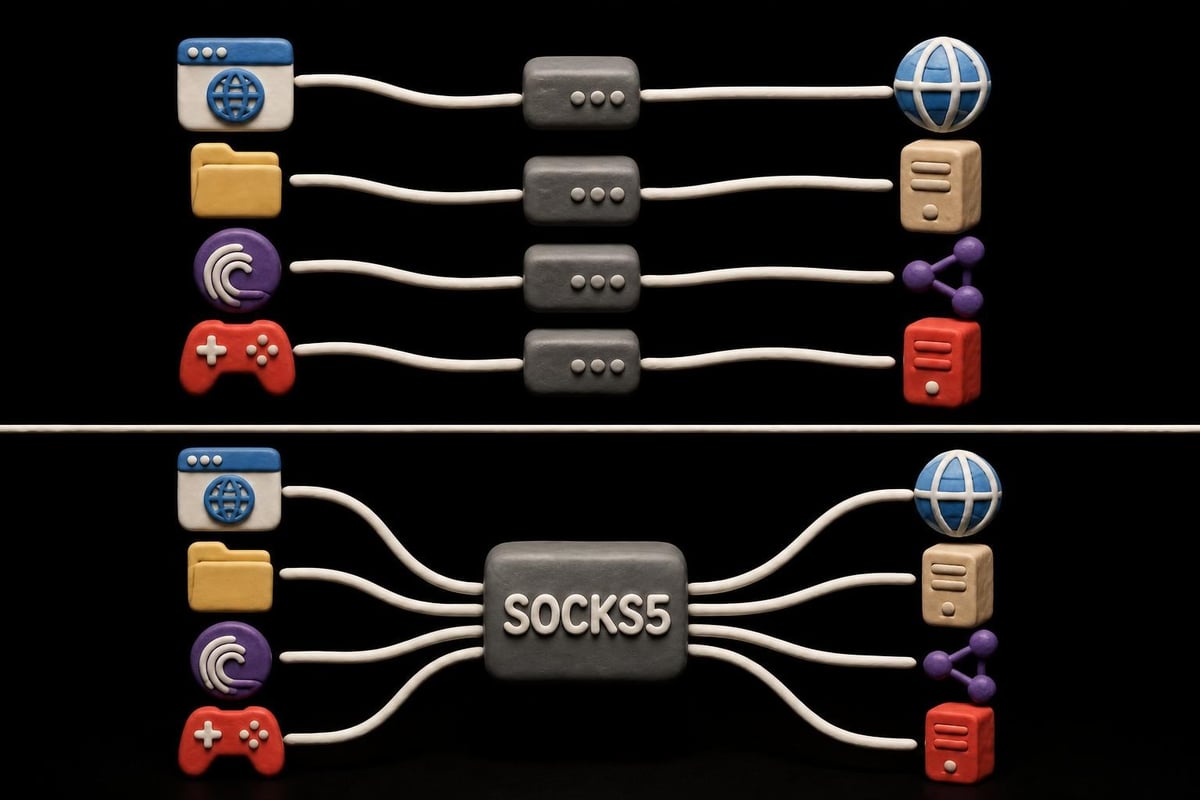
SOCKS5 represents the fifth version of the Socket Secure protocol, and the software built around it operates at a lower network level than HTTP proxies. This fundamental difference means socks5 proxy software can handle any type of internet traffic, not just web browsing.
The protocol works by establishing a connection between a client and a server through a proxy intermediary. When properly configured, applications send their traffic through the SOCKS5 server, which then forwards requests to the destination. The SOCKS5 protocol specification defines how this communication occurs, including authentication methods and command structures.
Key Technical Advantages
- Protocol agnostic: Works with HTTP, FTP, SMTP, torrents, and any TCP/UDP traffic
- Authentication support: Multiple methods including username/password and GSS-API
- UDP protocol support: Unlike SOCKS4, handles both TCP and UDP packets
- IPv6 compatibility: Modern implementations support both IPv4 and IPv6 addressing
The authentication layer adds security that raw proxy connections lack. Software implementations can enforce access controls, log usage patterns, and integrate with existing identity management systems.
Popular SOCKS5 Proxy Software Implementations
Different software solutions cater to various deployment scenarios and technical requirements. Choosing the right platform depends on your infrastructure, security needs, and scale.
| Software | Best For | Authentication | Performance |
|---|---|---|---|
| Dante | Enterprise deployments | PAM, LDAP, native | High |
| 3proxy | Lightweight servers | Text file, SQL | Medium-High |
| Shadowsocks | Censorship circumvention | Password-based | High |
| SSH Dynamic Forward | Ad-hoc tunneling | SSH keys/password | Medium |
Dante stands as one of the most robust enterprise options. It supports sophisticated rule-based routing, multiple authentication backends, and detailed logging. Security-conscious administrators should note vulnerabilities like CVE-2024-54662 and ensure they're running patched versions.
3proxy offers exceptional flexibility in a compact package. It can function as HTTP, SOCKS4, and SOCKS5 proxy simultaneously, making it ideal for environments requiring multiple proxy types. The configuration syntax supports complex access rules based on IP ranges, time windows, and bandwidth limits.
Open Source and Encrypted Alternatives
The Shadowsocks protocol builds on SOCKS5 concepts while adding encryption. While technically a separate protocol, Shadowsocks clients present a local SOCKS5 interface to applications. The shadowsocks-rust implementation demonstrates modern coding practices and offers excellent performance characteristics.
For users already working with SSH infrastructure, OpenSSH's dynamic port forwarding creates an instant SOCKS5 proxy. The -D flag transforms an SSH connection into a secure tunnel without installing additional proxy software. This approach works exceptionally well for developers needing temporary proxy access or secure connections from untrusted networks.
Configuring SOCKS5 Proxy Software for Business Use
Deployment requirements vary significantly between individual users and organizations handling thousands of concurrent connections. Socks5 proxy software configuration should align with your specific use cases and security policies.
Essential Configuration Parameters
- Bind address and port: Define which network interfaces accept connections
- Authentication method: Choose between no auth, username/password, or GSS-API
- Access control lists: Specify which clients can connect and which destinations they can reach
- Logging level: Balance security monitoring with privacy requirements
- Connection limits: Prevent resource exhaustion from too many simultaneous sessions
Most enterprise deployments require authentication. Username/password authentication provides adequate security for controlled environments, but implementations should use secure storage for credentials. PAM integration allows existing system accounts to authenticate, simplifying user management in larger organizations.
Access control rules determine what clients can access through the proxy. Effective policies typically combine source IP restrictions with destination filtering. For example, you might allow internal network clients to access any destination while restricting external connections to specific ports and domains.

Integration Patterns and Use Cases
Modern infrastructure rarely uses socks5 proxy software in isolation. Understanding common integration patterns helps maximize the value of your proxy deployment.
Web Scraping and Data Collection
Data collection projects benefit enormously from SOCKS5 proxies. The protocol-agnostic nature means scraping tools can rotate connections while maintaining support for various data sources. Combining rotating datacenter proxies with proper SOCKS5 software ensures reliable data extraction without blocks.
- Session persistence: Maintain cookies and authentication across requests
- Geographic diversity: Route through different regions automatically
- Protocol flexibility: Handle JavaScript-heavy sites, APIs, and FTP sources
- Connection pooling: Reuse established proxy connections for better performance
Chaining with HTTP Proxies
Some environments require HTTP filtering or caching alongside SOCKS5 routing. Privoxy's SOCKS5 forwarding configuration demonstrates how an HTTP proxy can forward to SOCKS5 backends. This architecture lets you apply HTTP-specific rules (header modification, ad blocking) while leveraging SOCKS5's broader protocol support.
Note that Squid does not natively support SOCKS, which surprises many administrators. If you need Squid's caching alongside SOCKS5 routing, you'll need intermediate tools like Privoxy or custom forwarding rules.
Performance Optimization Strategies
Raw throughput isn't the only performance metric that matters. Socks5 proxy software must balance speed, reliability, and resource utilization.
Connection Management
| Strategy | Impact | Trade-off |
|---|---|---|
| Connection pooling | 30-50% faster setup | Memory usage |
| Keep-alive tuning | Reduced overhead | Idle connections |
| Buffer sizing | Better throughput | RAM consumption |
| Worker threads | Higher concurrency | CPU utilization |
Modern proxy software typically uses asynchronous I/O or thread pools to handle multiple connections efficiently. Dante supports both prefork and threaded models. In high-traffic scenarios, threaded configurations generally outperform process-based approaches due to lower context switching overhead.
Network buffer tuning significantly affects large file transfers and bulk data operations. Operating system defaults often prioritize compatibility over performance. Increasing TCP buffer sizes (both send and receive) can double throughput for large transfers, though this requires careful memory management at scale.
Monitoring and Diagnostics
Production deployments need visibility into proxy operations. Essential metrics include:
- Active connections: Current session count
- Bandwidth utilization: Per-connection and aggregate
- Authentication failures: Potential security issues
- Blocked requests: ACL policy effectiveness
- Response times: Connection establishment latency
Most enterprise socks5 proxy software supports structured logging. Parsing these logs with tools like ELK stack or Splunk provides real-time dashboards and alerting. Connection timeouts and authentication failures often indicate configuration problems or attacks.

Security Considerations and Best Practices
Deploying socks5 proxy software without proper security controls creates vulnerabilities. Proxies naturally sit in the network path, making them attractive attack targets.
Authentication and Access Control
Never deploy open SOCKS5 proxies without authentication. Unauthenticated proxies quickly become abuse targets for spam operations, DDoS attacks, and illegal content distribution. At minimum, implement username/password authentication with strong credential requirements.
Defense in depth requires multiple security layers:
- Network isolation: Place proxies in DMZ or dedicated network segments
- Firewall rules: Restrict proxy access to known client IPs when possible
- Rate limiting: Prevent resource exhaustion from abusive clients
- Audit logging: Track all connections for security investigation
- Regular updates: Apply security patches promptly (reference CVE databases)
Privacy and Compliance
Organizations handling user data must consider privacy implications. SOCKS5 proxies see all traffic passing through them, creating potential exposure. A zero-log policy, like those implemented by premium proxy providers, ensures minimal data retention.
GDPR, CCPA, and other privacy regulations may apply depending on your jurisdiction and data handling practices. Log retention policies should balance security monitoring needs with privacy requirements. Typically, connection metadata (source, destination, timestamp) requires shorter retention than application-level data.
Advanced Features and Customization
Modern socks5 proxy software extends beyond basic proxying with features that enhance functionality and integration capabilities.
Dynamic Routing and Load Balancing
Sophisticated deployments distribute traffic across multiple upstream proxies or direct connections. Dante's rule system allows destination-based routing-for example, directing streaming traffic through residential proxies while routing API calls through datacenter endpoints.
Load balancing improves both performance and reliability. Round-robin distribution spreads load evenly, while least-connections algorithms optimize for varying request durations. Health checking ensures traffic doesn't route to failed backends.
Protocol Extensions and Compatibility
The Tor Project's SOCKS extensions demonstrate how the base protocol can be enhanced. Tor adds commands for DNS resolution and optimistic data transmission, improving performance while maintaining compatibility with standard SOCKS5 clients.
Bandwidth shaping capabilities help manage network resources in shared environments. Quality of service (QoS) rules can prioritize interactive traffic over bulk transfers, or allocate guaranteed bandwidth to specific users or applications.
Selecting the Right Software for Your Needs
Choosing appropriate socks5 proxy software requires evaluating both current requirements and future growth. Consider these decision factors:
For small deployments (under 100 concurrent users):
- 3proxy provides excellent performance with minimal configuration
- SSH dynamic forwarding works for ad-hoc or temporary needs
- Resource requirements remain modest on virtual machines
For enterprise environments (thousands of users):
- Dante offers proven scalability and comprehensive authentication
- Commercial support options exist for business-critical deployments
- Integration with existing identity systems (LDAP/Active Directory) streamlines management
For privacy-focused applications:
- Shadowsocks adds encryption layer beyond basic SOCKS5
- Open-source implementations allow security auditing
- Minimal logging features protect user privacy
The PinguProxy service handles infrastructure complexity so teams can focus on application development rather than proxy management. When building custom solutions makes sense, careful software selection ensures long-term success.
Implementing socks5 proxy software effectively requires understanding both the protocol fundamentals and practical deployment considerations. The right combination of software selection, security configuration, and performance tuning creates infrastructure that scales reliably while protecting privacy. Whether you're managing complex enterprise deployments or need flexible proxy access for specialized applications, PinguProxy delivers high-performance datacenter, residential, and mobile proxies with 10Gbps bandwidth, complete IPv4/IPv6 support, and 24/7 expert assistance to ensure your proxy infrastructure exceeds expectations.