
Unlimited Residential Proxies Guide for 2026
The demand for authentic IP addresses continues to grow as websites deploy increasingly sophisticated bot-detection systems. Businesses need proxy solutions that blend seamlessly into normal internet traffic while providing the scale and flexibility required for data collection, market research, and global operations. Unlimited residential proxies have emerged as a powerful solution, offering genuine home IP addresses with unrestricted bandwidth and rotation capabilities that mirror organic user behavior.
What Are Unlimited Residential Proxies
Residential proxies route your internet traffic through IP addresses assigned by Internet Service Providers (ISPs) to actual households. Unlike datacenter proxies that originate from cloud servers, residential IPs appear as legitimate home users to target websites.
The "unlimited" aspect typically refers to bandwidth consumption, request volume, or both. This means you can send as many requests as needed without hitting artificial caps that interrupt your operations. For businesses running continuous web scraping operations or monitoring multiple markets simultaneously, these limitations would otherwise create operational bottlenecks.
Key characteristics that define unlimited residential proxies:
- Authentic ISP allocation - IPs come from real consumer internet connections
- Geographic diversity - Coverage spans cities, regions, and countries worldwide
- Dynamic rotation - IPs change automatically to prevent detection and blocking
- No bandwidth metering - Send unlimited data without overage charges
- Persistent availability - Access remains constant regardless of usage volume

Research has shown that residential proxy networks have grown significantly, with operators building infrastructure that spans millions of endpoints globally. This expansion reflects the increasing need for genuine residential IPs in business applications.
Core Benefits for Business Operations
Bypassing Geographic Restrictions
Content availability varies dramatically by location. Streaming services, e-commerce platforms, and news sites often restrict access based on the visitor's IP address. Unlimited residential proxies let you access region-specific content without artificial limits on how much data you retrieve.
This capability proves essential for competitive intelligence teams monitoring international markets. You can view pricing variations across countries, track product availability in different regions, and understand how brands position themselves globally.
Enhanced Web Scraping Success Rates
Modern websites employ sophisticated anti-bot measures that flag and block datacenter IP ranges. Residential IPs bypass these filters because they're indistinguishable from regular users.
| Challenge | Datacenter Proxies | Residential Proxies |
|---|---|---|
| Detection Rate | High (60-80%) | Low (5-15%) |
| CAPTCHA Frequency | Very High | Minimal |
| Success on Protected Sites | Limited | Excellent |
| Request Speed | Very Fast | Fast |
| Cost per GB | Low | Higher |
The unlimited model becomes crucial when scraping large e-commerce catalogs or extracting historical data. Without bandwidth restrictions, you can collect comprehensive datasets over extended periods.
Maintaining Multiple Account Operations
Social media management, ad verification, and market research often require operating multiple accounts from different apparent locations. Cloudflare's machine learning systems detect patterns that suggest bot activity, making IP diversity essential.
With unlimited residential proxies, each account appears to originate from a distinct household in different locations. The unlimited aspect ensures you won't hit caps during high-volume campaigns or scheduled posting across time zones.
Technical Implementation Considerations
IPv4 and IPv6 Protocol Support
The internet continues transitioning from IPv4 to IPv6, with both protocols coexisting during this extended migration period. Complete support for both standards ensures compatibility across all target websites and services.
IPv4 advantages:
- Universal compatibility with legacy systems
- Familiar address format for troubleshooting
- Wider availability in residential pools
IPv6 advantages:
- Massive address space enabling finer rotation
- Native support in modern infrastructure
- Better performance on updated networks
IETF standards address privacy considerations around IP addressing and correlation risks. Services offering both protocols provide flexibility to match your specific use case requirements.
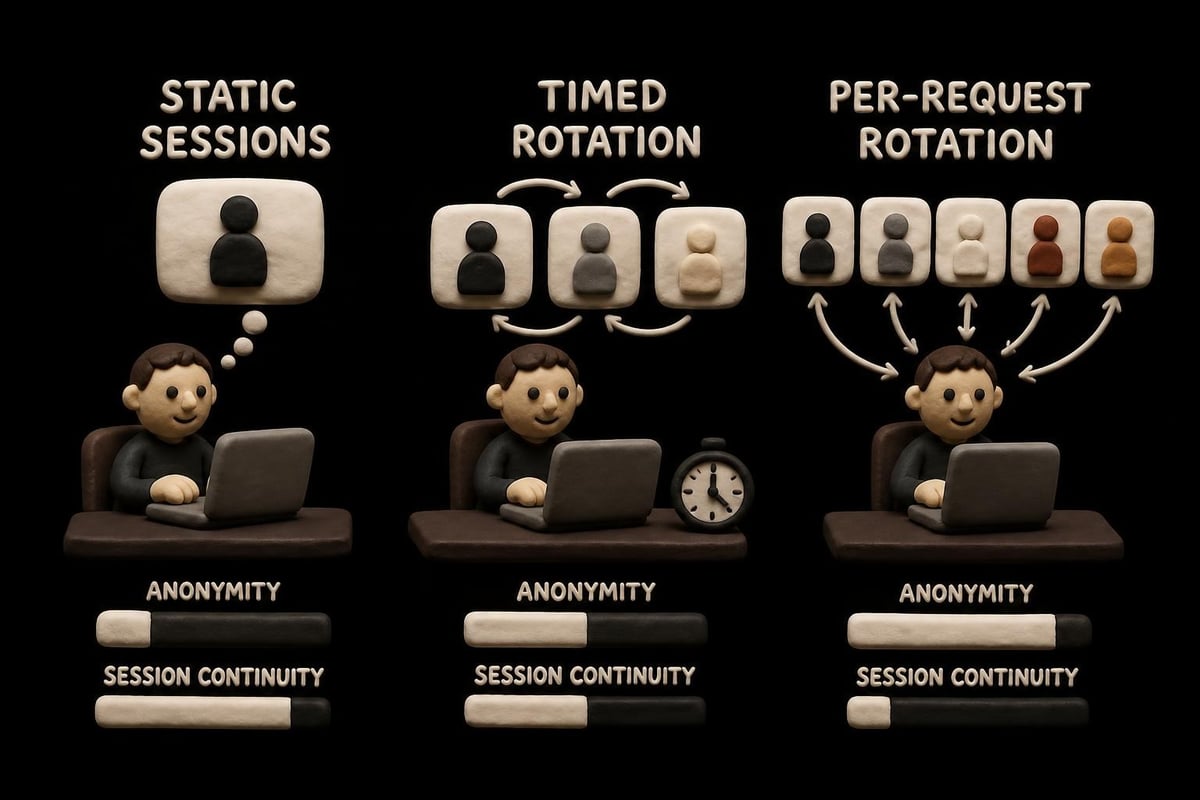
Rotation Speed and Session Management
The 1ms rotation capability represents a critical technical achievement. Traditional proxy services might rotate IPs every few minutes or hours, creating patterns that sophisticated detection systems flag.
Rapid rotation provides several advantages:
- Reduced fingerprinting risk - Each request appears from a different source
- Higher success rates - Blocked IPs are immediately replaced
- Better load distribution - Traffic spreads across the full proxy pool
- Enhanced privacy - Minimal correlation between sequential requests
However, some applications require session persistence. E-commerce checkout flows, authenticated API access, and multi-step workflows need the same IP throughout the interaction. Quality providers offer configurable rotation that balances anonymity with functional requirements.
Bandwidth Requirements and Infrastructure
Ten gigabit-per-second (10Gbps) bandwidth represents enterprise-grade infrastructure capable of handling massive concurrent operations. This capacity matters when running operations that include:
- Video content analysis - Streaming and processing high-definition content
- Large-scale scraping - Collecting millions of product listings or search results
- Real-time monitoring - Tracking price changes across hundreds of competitors
- Ad verification - Loading and capturing ad creatives from multiple sources
The underlying infrastructure must support this throughput while maintaining low latency. Network architecture, peering arrangements, and edge presence all contribute to actual performance.
Privacy and Security Architecture
Zero-Log Policies and Data Protection
A zero-log policy means the proxy provider doesn't record your browsing activity, target URLs, or transmitted data. This commitment protects both your competitive intelligence and your customers' privacy when conducting research.
Critical elements of robust privacy:
- No request logging or storage
- No DNS query recording
- Encrypted connections between client and proxy
- Regular security audits and compliance verification
- Clear data retention policies (or lack thereof)
Analysis of chargeback data reveals patterns that can expose proxy usage for malicious purposes. Legitimate business use requires providers who maintain strict security while preventing abuse of their infrastructure.
Regulatory Compliance and Ethical Sourcing
The residential proxy industry faces increasing scrutiny from governments and regulatory bodies. Government reports highlight concerns about infrastructure abuse, making transparency and ethical operation essential.
Responsible providers ensure:
- Residential IP sources involve informed user consent
- Network participants understand how their bandwidth is used
- Compensation models fairly reward network contributors
- Prohibited use cases are actively monitored and prevented
- Compliance with local laws in all operating jurisdictions
Practical Applications Across Industries
E-commerce and Price Intelligence
Online retailers need accurate competitor pricing across markets. Unlimited residential proxies enable continuous monitoring without triggering rate limits or bans.
Your scraping infrastructure can collect:
- Real-time pricing updates from competitor websites
- Product availability and inventory levels
- Customer review sentiment across platforms
- Promotional offers and discount patterns
- Search ranking positions for target keywords
The unlimited model eliminates the common problem of mid-month bandwidth depletion that interrupts intelligence gathering during critical sales periods.
Digital Marketing and Ad Verification
Advertisers spend billions on digital campaigns, making verification of ad placement and presentation crucial. Residential proxies let you view ads exactly as they appear to real users in specific locations.
| Verification Type | Why Residential IPs Matter |
|---|---|
| Geographic Targeting | Confirm ads show in intended regions only |
| Ad Placement | Verify positioning on publisher sites |
| Creative Rendering | Check visual display across devices |
| Click Fraud Detection | Identify suspicious traffic patterns |
| Compliance Checking | Ensure regulatory adherence |
Marketing teams use unlimited residential proxies to continuously audit campaigns without manual intervention or bandwidth concerns.
Social Media Management
Managing multiple brand accounts or client profiles requires appearing as distinct users from different locations. Platforms actively detect and suspend accounts that show suspicious IP patterns.
Social media managers benefit from:
- Unique residential IPs for each managed account
- Location-appropriate IP addresses matching account geography
- Unlimited posting and engagement without throttling
- Reduced account flagging and suspension risk
- Authentic-looking activity patterns
Market Research and Competitive Analysis
Understanding how competitors position themselves globally requires viewing their content as local users would see it. Product offerings, pricing, and messaging often vary dramatically by region.
Research applications include:
- Localized search result tracking - Monitor SERP positions across cities
- Website version comparison - Document regional content variations
- Availability monitoring - Track when products launch in different markets
- Customer experience audits - Experience checkout flows as local users
- Sentiment analysis - Collect region-specific reviews and feedback

Technical Performance Metrics
Connection Speed and Latency
Residential proxies typically experience slightly higher latency than datacenter alternatives because traffic routes through actual consumer connections. However, modern infrastructure minimizes this difference.
Performance benchmarks to evaluate:
- Average response time for initial connection
- Throughput for sustained data transfer
- Latency to target regions you frequently access
- Success rate for connection establishment
- Consistency of performance across time periods
Ten-gigabit bandwidth ensures the provider's infrastructure won't bottleneck your operations, but the residential endpoints themselves have varying speeds based on the homeowner's internet plan.
Success Rates and Reliability
Academic research on residential proxy detection demonstrates that websites continue improving their identification methods. Provider quality directly impacts whether your requests succeed or get blocked.
Monitor these metrics:
- Connection success percentage - How often requests complete
- CAPTCHA frequency - How often you face verification challenges
- Block rate - Percentage of IPs flagged or banned
- Uptime percentage - Service availability over time
- Support responsiveness - Time to resolve technical issues
Premium providers offering 24/7 customer support ensure problems get resolved quickly, minimizing downtime for business-critical operations.
Choosing the Right Provider
Essential Features and Capabilities
Not all unlimited residential proxies deliver equivalent value. Evaluate providers based on concrete technical capabilities rather than marketing claims.
Must-have features:
- Extensive geographic coverage matching your target markets
- Both IPv4 and IPv6 protocol support
- Configurable rotation intervals
- Session persistence options
- Authentication methods (user/pass and IP whitelist)
- API access for automated management
- Usage analytics and reporting
Cost Structure and Value Assessment
Pricing models for unlimited residential proxies vary significantly. Some providers charge per port, others per GB (despite claiming "unlimited"), and some offer true unlimited plans with reasonable fair-use policies.
Calculate your total cost by considering:
- Base subscription or monthly fee
- Any per-GB overage charges
- Number of concurrent connections needed
- Geographic targeting premium costs
- Minimum commitment periods
- Refund or trial policies
For context on how different providers structure their offerings, reviewing comparisons like SOAX proxies can illuminate industry standards and pricing approaches.
Support and Documentation Quality
Technical challenges inevitably arise when implementing proxy infrastructure. Provider support quality directly impacts your time to resolution and operational continuity.
Assess support through:
- Response time commitments - Guaranteed reply within specific timeframes
- Availability hours - 24/7 support versus business-hours-only
- Communication channels - Live chat, email, phone, ticketing systems
- Documentation completeness - Setup guides, API references, troubleshooting
- Community resources - Forums, knowledge bases, video tutorials
Security Best Practices
Implementing Proper Authentication
Even with trusted proxy providers, implement additional security layers in your infrastructure. Authentication prevents unauthorized access to your proxy allocation and protects against credential theft.
Recommended security measures:
- Use IP whitelisting when operating from fixed locations
- Rotate authentication credentials regularly
- Implement least-privilege access for team members
- Monitor usage logs for anomalous patterns
- Enable two-factor authentication where available
Avoiding Detection and Maintaining Anonymity
Research examining residential proxy usage patterns from network operators' perspectives reveals detection signals that can compromise anonymity. Stay undetected by following these practices:
- Randomize user agents across requests
- Respect robots.txt and crawl-delay directives
- Implement human-like timing between actions
- Vary request patterns rather than systematic crawling
- Handle cookies and sessions appropriately
The goal is mimicking organic user behavior rather than obvious automated patterns.
Integration and Implementation
API and Protocol Support
Modern business applications require programmatic access to proxy resources. Quality providers offer RESTful APIs that enable:
- Dynamic IP rotation control
- Geographic targeting selection
- Connection pool management
- Usage statistics retrieval
- Real-time health monitoring
Protocol support should include HTTP/HTTPS for web traffic and SOCKS5 for applications requiring lower-level networking control.
Scaling Operations Efficiently
As your data needs grow, your proxy infrastructure must scale proportionally. Unlimited residential proxies remove bandwidth constraints, but other factors influence scaling success.
Scaling considerations:
| Factor | Impact on Scaling | Optimization Strategy |
|---|---|---|
| Request concurrency | Higher parallelism needs more IPs | Increase concurrent connection limits |
| Geographic distribution | More regions require broader coverage | Select providers with global presence |
| Rotation frequency | Faster rotation needs larger pools | Choose providers with millions of IPs |
| Session persistence | Long sessions reduce available IPs | Balance rotation with session length |
| Error handling | Failures multiply at scale | Implement robust retry logic |
Begin with conservative concurrency and gradually increase while monitoring success rates and target site responses.
Unlimited residential proxies provide the authentic IP diversity and bandwidth flexibility that modern businesses require for data collection, market research, and global operations. Understanding the technical architecture, security implications, and implementation best practices ensures you maximize value while maintaining ethical standards. PinguProxy delivers high-speed residential and mobile proxies with complete IPv4 and IPv6 support, 1ms rotation capabilities, and 10Gbps bandwidth backed by 24/7 support. Whether you're scaling web scraping operations, managing global social media presence, or conducting competitive intelligence, PinguProxy's zero-log infrastructure and unlimited access model provide the foundation for secure, reliable proxy operations.