
Best Free Web Proxy: What You Need to Know in 2026
Finding the best free web proxy seems like an easy way to browse privately or access geo-restricted content. However, the reality behind free proxy services is far more complex than most users realize. While these tools promise anonymity and unrestricted access, they often come with hidden costs that can compromise your security, privacy, and overall online safety. Understanding what makes a proxy service truly valuable requires looking beyond the "free" label and examining the infrastructure, policies, and trade-offs involved.
Understanding Web Proxy Fundamentals
A web proxy acts as an intermediary between your device and the internet, routing your requests through a server before they reach their final destination. This process masks your original IP address and can help bypass certain restrictions.
The basic proxy workflow involves:
- Your browser sends a request to the proxy server
- The proxy forwards that request to the target website
- The website responds to the proxy
- The proxy sends the response back to you
Cloudflare's primer on proxy types explains the technical differences between forward proxies (which serve clients) and reverse proxies (which serve servers). Most free web proxies operate as forward proxies, positioning themselves between you and the websites you want to visit.
Types of Proxy Services
| Proxy Type | Speed | Anonymity | Cost Range | Best Use Case |
|---|---|---|---|---|
| Datacenter | Very High | Medium | Free-Paid | General browsing |
| Residential | High | Very High | Paid | Web scraping |
| Mobile | Medium | Highest | Paid | App testing |
| Public/Free | Low-Medium | Very Low | Free | Casual use only |
The best free web proxy options typically fall into the datacenter category, but they sacrifice privacy and reliability for their zero-cost model. Understanding these trade-offs helps you make informed decisions about your online security.

Security Risks of Free Proxy Services
Free proxy services must generate revenue somehow, and that "how" should concern every user. Research from academic analysis of free web proxies reveals alarming patterns of data manipulation, malware injection, and credential harvesting across thousands of free proxy servers.
Common Security Vulnerabilities
Man-in-the-middle attacks represent the most serious threat. When you connect through a free proxy without encryption, the proxy operator can intercept, read, and modify all your traffic. This includes:
- Login credentials for email and banking
- Personal messages and communications
- Credit card information entered on websites
- Session cookies that could grant access to your accounts
Many free proxies inject advertisements into the pages you visit, fundamentally altering the content you receive. While annoying, this also demonstrates their technical capability to manipulate any data passing through their servers.
Malware distribution occurs when unscrupulous proxy operators inject malicious scripts into legitimate websites. Users think they're visiting a trusted site, but the proxy has modified the page to include keyloggers, ransomware downloaders, or cryptomining scripts.
The EFF's Surveillance Self-Defense guide emphasizes that using untrusted intermediaries contradicts basic privacy hygiene. Free proxies often log extensive data about your browsing habits, creating a detailed profile that can be sold to advertisers or worse, handed over to authorities without your knowledge.
Browser and Application Security
Even when searching for the best free web proxy, users should understand how these services interact with browser security features. Mozilla's proxy configuration guide shows how to set up proxies in Firefox, but it's important to note that browser security features like HTTPS-only mode become critical when using any proxy service.
The OWASP Web Application Security reference highlights how proxies can bypass security headers and expose users to attacks that would normally be prevented by modern web application defenses.
Privacy Concerns and Data Logging
Privacy represents another critical dimension where free proxies fail spectacularly. The business model of free proxy services typically depends on data monetization, making comprehensive logging essential to their operations.
What Free Proxies Track
- Complete browsing history - Every URL you visit
- Timestamps and duration - When and how long you access sites
- Device information - Browser type, operating system, screen resolution
- Search queries - Everything you type into search engines
- Form submissions - Potentially including passwords if unencrypted
This data collection creates a more complete profile of your online activity than your ISP typically maintains. While ISPs face regulatory requirements and public scrutiny, free proxy operators often operate in jurisdictions with minimal oversight.
Zero-log policies are frequently advertised but rarely verified. Without independent audits or transparency reports, users have no way to confirm whether the best free web proxy they've chosen actually deletes logs as claimed.
Comparing Privacy Features
| Feature | Free Proxy | Paid Proxy | PinguProxy |
|---|---|---|---|
| Logging Policy | Often logs everything | Varies | Zero-log policy |
| Data Encryption | Rarely | Usually | Full encryption |
| IP Rotation | Manual/Limited | Available | 1ms rotation |
| Jurisdiction | Unknown | Disclosed | Privacy-focused |
The CISA exposure reduction guidance warns about the risks of using internet-exposed services without proper security controls. Free proxies epitomize these risks, offering public access without the security hardening that professional services provide.
Performance and Reliability Issues
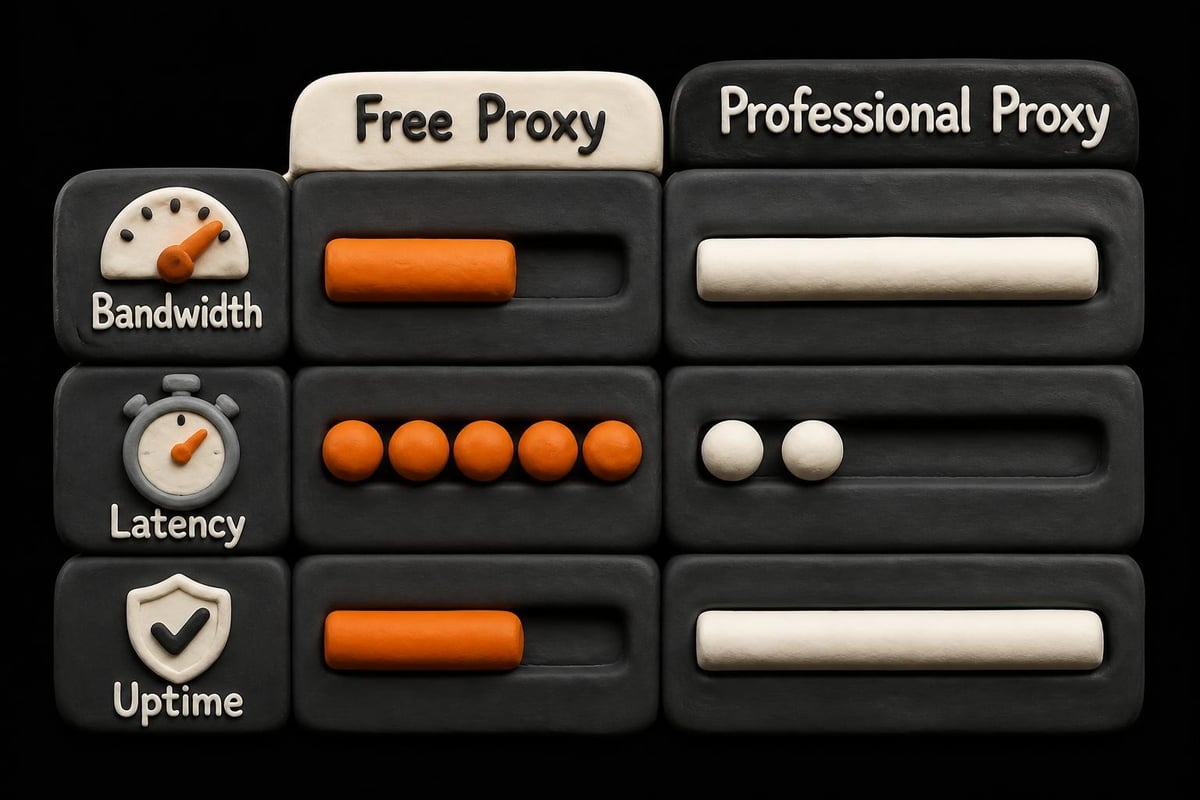
Speed and uptime matter, especially for users who depend on proxies for regular tasks. Free proxy services typically suffer from severe performance limitations that make them unsuitable for any serious use.
Bandwidth Throttling
Free proxies deliberately limit speed to encourage upgrades to paid tiers. You might experience:
- Download speeds capped at 1-2 Mbps
- High latency causing delays of 500ms or more
- Connection drops during large transfers
- Video buffering even at low quality settings
Concurrent user limitations mean that during peak hours, hundreds or thousands of users share the same proxy server. This creates congestion similar to rush hour traffic, making even basic browsing frustratingly slow.
Uptime and Availability
The best free web proxy still faces reliability challenges that paid services avoid through proper infrastructure investment:
- Server outages happen frequently without notice or communication
- IP address blacklisting occurs when too many users abuse the same IP
- Geographic limitations restrict which regions you can access
- Protocol restrictions often block P2P, streaming, or other bandwidth-intensive activities
For web scraping operations, unreliable proxies can derail entire projects. When a proxy goes down mid-scrape, you lose progress and may trigger rate limiting or blocks on target websites.
Safer Alternatives to Free Proxies
Users seeking the best free web proxy usually have specific needs: privacy, access to restricted content, or bypassing network filters. Understanding these needs helps identify better solutions.
When Free Proxies Make Sense
Limited scenarios exist where free proxies provide acceptable risk-reward ratios:
- One-time access to a blocked news article
- Quick testing of how a website appears from different locations
- Bypassing school or library restrictions for educational content
- Temporary solution while researching paid alternatives
Even in these cases, users should avoid entering credentials, accessing sensitive accounts, or transmitting personal information.
Professional Proxy Solutions
Paid proxy services offer substantial advantages that justify their costs:
- Verified security through encryption and audited practices
- Guaranteed uptime with SLA-backed availability targets
- High-speed connections supporting bandwidth-intensive tasks
- Multiple proxy types including datacenter, residential, and mobile options
- Customer support available when issues arise
Features like IPv4 and IPv6 support, 10Gbps bandwidth, and rapid IP rotation transform proxies from simple privacy tools into powerful platforms for business applications.
VPNs vs. Proxies
| Aspect | VPN | Proxy | Best Use |
|---|---|---|---|
| Encryption | Full device | App-specific | VPN for privacy |
| Speed | Medium | High | Proxy for speed |
| Cost | $5-15/month | Varies widely | Depends on use |
| Setup | Very easy | Moderate | VPN for beginners |
| Flexibility | Limited | Highly customizable | Proxy for advanced users |
Virtual Private Networks (VPNs) encrypt all traffic from your device, while proxies work at the application level. For most privacy-focused users, a reputable VPN service offers better protection than the best free web proxy.
Evaluating Proxy Service Providers
Making informed choices about proxy services requires examining several key factors beyond price. The IETF RFC 9484 specification outlines standards for how proxies should handle IP-related headers, providing a technical benchmark for evaluating implementations.
Essential Provider Criteria
Infrastructure quality determines everything from speed to reliability. Look for providers who disclose:
- Server locations and total proxy pool size
- Network capacity and bandwidth allocations
- Hardware specifications and redundancy
- CDN integration for improved performance
Security certifications and compliance frameworks signal serious commitment to user protection. ISO certifications, SOC 2 compliance, and GDPR adherence all indicate professional operations.
Transparent pricing without hidden fees or automatic renewals builds trust. The best services offer clear tier structures with features explicitly listed for each plan level.
Red Flags to Avoid
- Unlimited everything claims that defy technical reality
- No contact information or anonymous operators
- Excessive permissions requested during setup
- Negative reviews citing security incidents or data breaches
- Unclear business model with no obvious revenue source
Google Safe Browsing identifies many free proxy domains as potentially malicious, demonstrating how frequently these services engage in harmful practices.

Use Cases Requiring Professional Proxies
Certain applications demand the reliability and features that only professional proxy services can provide. Understanding these use cases helps explain why the best free web proxy remains inadequate for serious work.
Web Scraping and Data Collection
Large-scale scraping requires rotating thousands of IP addresses to avoid detection and blocking. Features needed include:
- Automatic rotation on every request or set intervals
- Session persistence for maintaining login states
- Geographic targeting for location-specific content
- High concurrent connection limits
Free proxies cannot sustain the volume and variety needed for effective scraping operations. Their limited IP pools get blacklisted quickly, and slow speeds make large projects impractical.
E-commerce and Sneaker Bots
Competitive purchasing for limited-release products demands speed and reliability beyond free proxy capabilities. Success requires:
- Low-latency connections under 100ms
- Residential IPs that appear as regular consumers
- Dedicated bandwidth to avoid competition with other users
- Instant failover when proxies get blocked
Gaming and Account Management
Multi-accounting and region-specific gaming access need stable connections with consistent IPs. Frequent disconnections or IP changes disrupt gameplay and can trigger anti-cheat systems or account suspensions.
Market Research and Ad Verification
Competitive intelligence gathering depends on seeing content exactly as it appears to users in different regions. Free proxies often cache content or modify pages, providing inaccurate views that lead to flawed business decisions.
For businesses exploring proxy solutions for various applications, professional services offer the consistency and support necessary for critical operations.
Technical Specifications That Matter
Beyond marketing claims, specific technical capabilities separate effective proxy services from inadequate ones. Understanding these specifications helps identify the best free web proxy alternatives when free options prove insufficient.
Protocol Support
HTTP, HTTPS, and SOCKS5 each serve different purposes:
- HTTP/HTTPS proxies work for web browsing and API calls
- SOCKS5 proxies handle any traffic type including email and P2P
- Support for both IPv4 and IPv6 ensures compatibility with modern networks
Most free proxies support only basic HTTP, limiting their utility for advanced applications.
Authentication Methods
| Method | Security Level | Ease of Use | Best For |
|---|---|---|---|
| IP Whitelist | High | Medium | Fixed locations |
| Username/Password | Medium | High | Multiple users |
| API Tokens | Very High | Medium | Automated systems |
| SSL Certificates | Highest | Low | Enterprise needs |
Secure authentication prevents unauthorized access to your proxy allocation and ensures that traffic comes from verified sources.
Rotation Capabilities
Smart rotation algorithms distribute requests across IP pools to maximize effectiveness:
- Sticky sessions maintain the same IP for a user session
- Random rotation changes IPs on every request
- Timed rotation switches at set intervals
- Geographic rotation cycles through specific regions
Professional services offer millisecond-level rotation speeds, while free proxies typically require manual IP changes or offer rotation only on new sessions.
Connection Limits and Concurrency
Simultaneous connections determine how many requests you can make at once. Free proxies typically limit users to 1-5 concurrent connections, while professional services support hundreds or thousands.
Future of Proxy Technology
The proxy landscape continues evolving as privacy concerns grow and web security improves. Several trends will shape how users approach proxy services in coming years.
Emerging Standards
Privacy-enhancing protocols are being developed to provide better anonymity without sacrificing performance. Technologies like Encrypted Client Hello (ECH) make it harder for network observers to detect proxy usage.
Decentralized proxy networks using blockchain and peer-to-peer architectures promise to eliminate single points of control. However, these systems still struggle with the same economic realities that make running free proxies challenging.
Regulatory Changes
Data protection laws increasingly require transparency about how intermediaries handle user data. Services operating in the EU must comply with GDPR, while California's CCPA extends similar protections to U.S. residents.
Cybersecurity requirements may eventually mandate minimum security standards for proxy operators, potentially eliminating the least secure free options from the market.
Integration with AI and Automation
Intelligent routing using machine learning can optimize proxy selection based on target website, user location, and real-time performance metrics. This makes proxy services more effective while remaining transparent to end users.
While the search for the best free web proxy is understandable given budget constraints, the security risks and performance limitations make free options unsuitable for anything beyond casual, non-sensitive browsing. Whether you need reliable access for web scraping, secure connections for privacy protection, or high-speed infrastructure for competitive tasks, professional proxy solutions deliver the features and guarantees that free services cannot match. PinguProxy provides enterprise-grade datacenter, residential, and mobile proxies with complete IPv4 and IPv6 support, zero-log privacy protection, 1ms IP rotation, and 10Gbps bandwidth backed by 24/7 support-offering the security and performance your projects deserve without the compromises inherent in free alternatives.