
USA Rotating Proxy: Benefits, Risks, and Best Practices
A usa rotating proxy automatically switches between multiple IP addresses from a pool of US-based servers, distributing your web requests across different endpoints to maintain anonymity and avoid detection. As online restrictions tighten and anti-bot systems become more sophisticated in 2026, businesses and individuals increasingly rely on these services for web scraping, market research, ad verification, and accessing geo-restricted content. Understanding how rotating proxies work and the specific advantages of USA-based infrastructure helps you make informed decisions about protecting your privacy and achieving your online objectives.
Understanding USA Rotating Proxy Infrastructure
The fundamental architecture of a usa rotating proxy system involves maintaining a large pool of IP addresses assigned to servers located across the United States. Each time you make a request through the proxy service, the system routes your traffic through a different IP address from this pool. This rotation can happen on every request, at timed intervals, or based on specific triggers like website changes or error responses.
USA-based infrastructure offers distinct advantages for several reasons:
- Geographic proximity to major content delivery networks and services
- Lower latency when accessing US-based websites and platforms
- Compliance with data routing preferences for American companies
- Access to region-specific content only available to US IP addresses
The rotation mechanism itself relies on sophisticated load balancing and session management. When you connect through a rotating proxy, the service maintains your session state while presenting different external IP addresses to target websites. This technical capability separates rotating proxies from simple static proxies where you maintain the same IP throughout your session.
Technical Implementation Methods
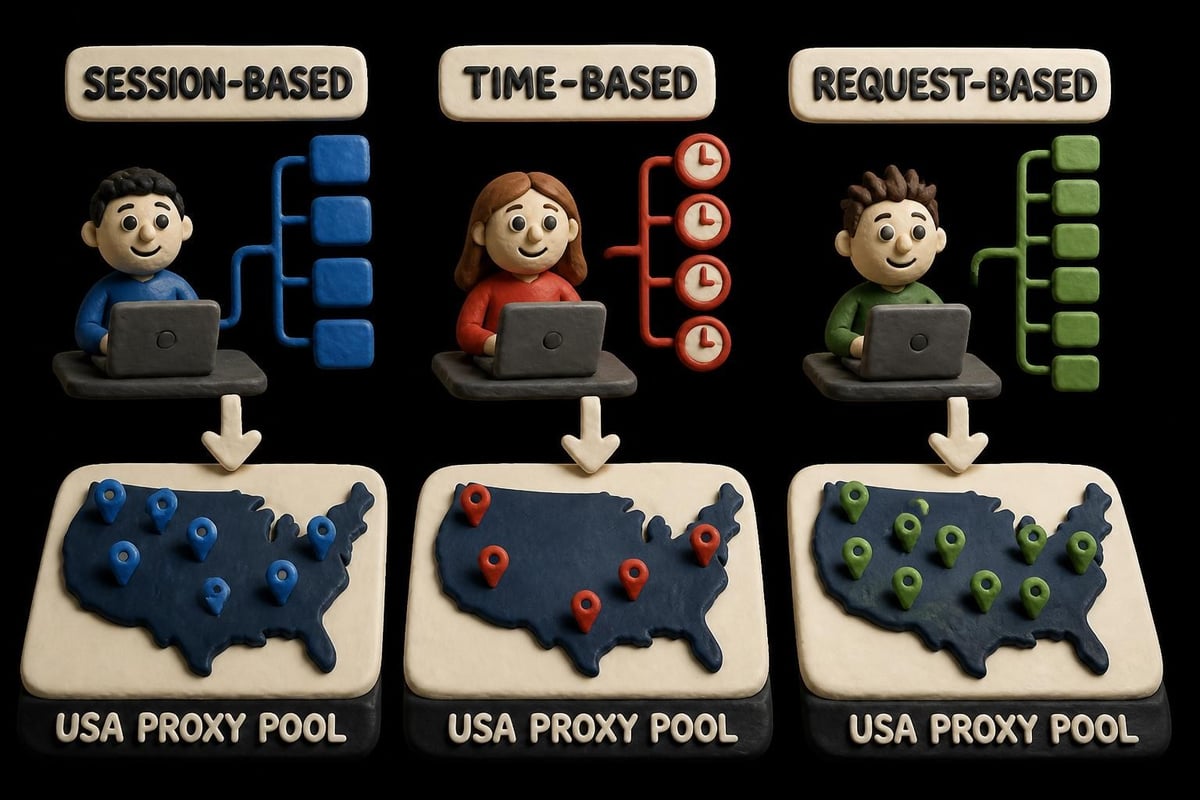
Modern usa rotating proxy services implement rotation through several distinct methods. Session-based rotation maintains the same IP for the duration of a browsing session, then switches to a new address when you start a fresh session. Time-based rotation changes your IP at predetermined intervals-every 5 minutes, 10 minutes, or custom timeframes you configure. Request-based rotation provides a new IP with every single HTTP request, offering maximum distribution across the IP pool.
According to the official HTTP/1.1 standard, proxies act as intermediaries that can forward, modify, or respond to messages while maintaining proper protocol behavior. Rotating proxy systems leverage this standardized infrastructure while adding automated IP management layers.
Primary Use Cases for USA Rotating Proxies
Organizations deploy usa rotating proxy infrastructure across numerous business-critical applications. Web scraping remains the most common use case, where companies extract publicly available data from websites for competitive intelligence, price monitoring, or market research. Rotating IPs prevents target sites from identifying and blocking your scraping activities based on request volume from a single address.
E-commerce and Price Intelligence
Retail businesses monitor competitor pricing across hundreds or thousands of product listings daily. A usa rotating proxy enables automated price comparison tools to gather this information without triggering anti-bot measures. The distributed IP approach mimics organic traffic patterns from different customer locations across the United States.
| Use Case | Rotation Frequency | Typical IP Pool Size |
|---|---|---|
| Price monitoring | Per request | 1,000-10,000+ |
| Ad verification | Per session | 500-5,000 |
| SEO monitoring | Time-based (10 min) | 100-1,000 |
| Social media management | Per account | 50-500 |
Ad verification represents another critical application where advertisers confirm their campaigns display correctly across different geographic regions and demographics. Using USA-based rotating IPs, verification teams can check ad placements as they appear to real users throughout different American cities and states.
SEO and Market Research Applications
Search engine optimization professionals rely on rotating proxies to track keyword rankings without personalization bias. When you search from the same IP repeatedly, search engines tailor results based on your perceived location and search history. Rotating through different USA IP addresses provides cleaner, more representative ranking data that reflects what diverse users actually see.
Market researchers access region-specific content and pricing that varies by state or metropolitan area. Airlines, hotels, and e-commerce platforms often display different prices based on the visitor's IP address. A usa rotating proxy allows researchers to sample these variations systematically across multiple locations.
Security and Privacy Considerations
The privacy benefits of rotating proxies extend beyond simple IP masking. By constantly changing your external IP address, these services make it exponentially harder for websites, advertisers, or malicious actors to build comprehensive profiles of your online behavior. Each rotated IP appears as a distinct visitor with no connection to previous sessions or requests.
Key privacy advantages include:
- Prevention of long-term tracking across websites and sessions
- Protection against IP-based user fingerprinting techniques
- Reduced risk of targeted attacks on a known static IP
- Obfuscation of actual geographic location and ISP details
However, rotating proxies don't provide complete anonymity by themselves. Websites employ multiple tracking mechanisms beyond IP addresses-cookies, browser fingerprinting, login credentials, and behavioral analysis all contribute to user identification. Understanding the security aspects of proxy services helps you implement comprehensive privacy strategies.
Zero-Log Policies and Data Protection
When evaluating usa rotating proxy providers, their data retention and logging practices directly impact your privacy. Services with zero-log policies don't record which websites you visit, what data you transmit, or mapping between your account and specific IP addresses. This policy becomes particularly important given the legal considerations around automated data collection in the United States.
Premium providers implement technical measures to enforce zero-log commitments. Memory-only session handling ensures no request data persists on disk. Automated log deletion removes any temporary operational logs within hours. Independent audits verify these practices, giving users confidence their activities remain private.

Residential vs. Datacenter USA Rotating Proxies
The source of IP addresses fundamentally shapes how a usa rotating proxy performs and how websites perceive your traffic. Datacenter proxies originate from server farms and cloud hosting providers, offering exceptional speed and reliability at lower costs. These IPs typically fall within recognized datacenter IP ranges, making them easier for sophisticated systems to identify as proxy traffic.
Residential proxies use IP addresses assigned to real homes by internet service providers like Comcast, AT&T, or Verizon. Websites view these connections as regular consumer traffic, making them significantly harder to detect and block. The trade-off comes in higher costs and occasionally slower speeds due to the distributed nature of residential networks.
Performance and Detection Differences
| Proxy Type | Speed | Detection Risk | Cost | Best For |
|---|---|---|---|---|
| Datacenter | Very High (10Gbps+) | Moderate-High | Lower | High-volume scraping, testing |
| Residential | Moderate-High | Very Low | Higher | Social media, sneaker sites, strict targets |
| Mobile | Moderate | Lowest | Highest | Mobile app testing, location-based services |
Large platforms like social networks, streaming services, and e-commerce sites with advanced bot detection systems often flag datacenter IPs. Cloudflare's bot management approaches and IP validation techniques specifically identify datacenter ranges and apply stricter scrutiny to requests originating from these addresses.
Recent research on residential IP proxy ecosystems reveals both the power and complexity of these networks. Residential proxies provide legitimate-looking traffic patterns but require careful provider selection to avoid networks built on compromised devices or questionable consent practices.
Speed and Bandwidth Requirements
A usa rotating proxy service's performance characteristics directly impact your operational efficiency. Speed measures how quickly the proxy server processes and forwards your requests, typically ranging from 100 Mbps to 10 Gbps for premium providers. Higher speeds enable faster data collection, reduced scraping timeframes, and better user experience when browsing through proxies.
Bandwidth determines your data transfer capacity-how much information you can send and receive through the proxy infrastructure. Unlimited bandwidth plans remove concerns about overage charges or throttling when conducting large-scale operations. For businesses scraping thousands of pages daily or streaming video content through proxies, unlimited bandwidth becomes essential.
Connection Stability and Rotation Speed
The time required to rotate between IP addresses affects your workflow. Advanced systems complete rotation in 1 millisecond, making the switch imperceptible to your applications. Slower rotation mechanisms might take several seconds, creating delays between requests that can significantly extend total operation time.
Connection stability ensures your proxy maintains reliable uptime and consistent performance. Quality providers achieve 99.9% uptime by maintaining redundant infrastructure and actively monitoring proxy pool health. When individual IPs encounter issues, the system automatically removes them from rotation and replaces them with fresh addresses.
Avoiding Detection and Bans
Even with a usa rotating proxy, certain behaviors trigger anti-bot systems and lead to blocks. Request rate represents one of the most common detection signals-sending hundreds of requests per second from rotating IPs still creates suspicious patterns. Implementing realistic delays between requests and varying request timing mimics human browsing behavior.
Behavioral Patterns and Headers
Websites analyze more than just IP addresses. They examine user agents, accept-language headers, referer information, and dozens of other HTTP header fields. Using consistent browser fingerprints across rotating IPs helps maintain believability. Randomizing some elements while keeping others constant creates realistic diversity without obvious automation signatures.
Major CDN providers like Akamai employ sophisticated detection methods that combine behavioral analysis, active challenges, and transparent detection techniques. Their systems identify rotating proxy traffic through inconsistencies between IP geolocation and other signals like timezone, language preferences, or browsing patterns.
Common detection triggers to avoid:
- Identical cookie sets across different IP addresses
- Perfect request timing intervals (exactly 1 second, 2 seconds, etc.)
- Outdated or rare user agent strings
- Missing or incorrect HTTP headers for the claimed browser
- JavaScript fingerprints that don't match the stated browser version

IPv4 vs. IPv6 Considerations
Most usa rotating proxy services primarily offer IPv4 addresses due to widespread compatibility and availability. The IPv4 address space provides approximately 4.3 billion unique addresses, with a substantial portion allocated to US-based networks. These addresses work with virtually all websites and services without compatibility issues.
IPv6 adoption continues growing but remains incomplete across many platforms. IPv6's vastly larger address space (340 undecillion addresses) offers interesting advantages for proxy rotation-providers can allocate enormous IP pools without exhaustion concerns. However, not all websites properly support IPv6, and some users lack IPv6 connectivity through their ISPs.
Dual-Stack Support Benefits
Services supporting both IPv4 and IPv6 provide maximum flexibility. Your applications can rotate through IPv4 addresses when targeting legacy systems while leveraging IPv6 pools for modern platforms that support it. This dual-protocol approach ensures compatibility across the broadest possible range of targets.
Geographic distribution of IPv6 adoption varies significantly across the United States. Some regions and ISPs have achieved high IPv6 deployment, while others lag behind. When selecting a usa rotating proxy provider, verify their IPv6 coverage aligns with your target websites and use cases.
Legal and Ethical Usage
Using a usa rotating proxy for legitimate purposes remains legal in the United States, but how you employ the technology matters significantly. Accessing public information that anyone could view in a browser falls within acceptable use. Scraping publicly available data for competitive intelligence, research, or price monitoring generally complies with legal standards when done ethically.
Prohibited activities include circumventing access controls, violating terms of service in ways that constitute unauthorized access, or using proxies to commit fraud or harassment. While rotating your IP isn't illegal, using that capability to bypass security measures on protected systems could violate the Computer Fraud and Abuse Act or similar statutes.
Terms of service violations occupy a gray area. Most websites prohibit automated access or scraping in their terms, but courts have recently limited the enforceability of ToS violations as a basis for criminal or civil liability. The legal landscape around automated data collection continues evolving through ongoing litigation and regulatory developments.
Free vs. Premium USA Rotating Proxies
The proxy market includes both free public services and premium commercial offerings. Free rotating proxies might seem appealing, but they carry substantial risks. Research into free proxy service vulnerabilities demonstrates these networks often suffer from poor security, unreliable performance, and questionable privacy practices.
Free proxies frequently log user traffic and sell browsing data to third parties. They may inject ads or malicious code into your traffic. Connection speeds are typically slow and unreliable, with frequent downtime and limited IP pool sizes that offer minimal rotation benefits.
Premium Service Advantages
Commercial providers invest in infrastructure, security, and support that free services can't match. Premium usa rotating proxy services deliver consistent high-speed connections, extensive IP pools, responsive customer support, and strong privacy protections through verified zero-log policies.
| Feature | Free Proxies | Premium Proxies |
|---|---|---|
| Speed | 1-10 Mbps | 100 Mbps-10 Gbps |
| IP Pool Size | 10-100 | 1,000-1,000,000+ |
| Uptime | 50-80% | 99%+ |
| Privacy | Poor (logging common) | Strong (zero-log policies) |
| Support | None | 24/7 technical assistance |
When evaluating providers, look for transparent pricing, clear documentation, flexible rotation options, and protocol support that matches your needs. Services offering both residential and datacenter options provide versatility across different use cases and target websites.
Setting Up and Configuring Rotation
Implementing a usa rotating proxy requires configuration at the application or system level. Most providers offer multiple connection methods: HTTP/HTTPS proxies work through standard proxy settings in browsers or applications, SOCKS5 proxies provide greater flexibility for non-HTTP traffic, and API-based access enables programmatic proxy management for custom applications.
Configuration Best Practices
Authentication typically uses username-password combinations or IP whitelisting. Username-based auth lets you connect from any location, while IP whitelisting restricts proxy access to specific origin addresses for enhanced security. Some providers encode rotation preferences directly in the username field-using credentials like "rotation-5min-username" automatically enables 5-minute rotation intervals.
Session management determines how long you maintain the same exit IP. Sticky sessions preserve your IP across multiple requests, useful for workflows requiring consistent identity like shopping cart checkouts or logged-in browsing. Session IDs in your connection credentials signal the proxy system to maintain IP consistency for all requests using that session identifier.
Testing your configuration before deploying production workloads prevents issues. Verify the proxy rotates IPs as expected, check that your actual IP remains hidden, and confirm the exit IPs match your expected geographic region. Many providers offer API endpoints that return your current exit IP, simplifying verification.
Monitoring and Optimization
Effective usa rotating proxy usage requires ongoing monitoring and optimization. Track success rates to identify when target websites implement new blocking measures or when specific IPs in your pool become flagged. If success rates drop below acceptable thresholds, adjusting rotation frequency or switching between datacenter and residential IP pools often resolves issues.
Request timing analysis reveals whether your current configuration mimics natural user behavior. Plotting request timestamps helps identify patterns that might trigger detection-perfectly regular intervals, bursts of activity, or timing that doesn't align with human browsing patterns all create red flags.
Performance metrics like response time, bandwidth utilization, and error rates indicate infrastructure health. Sudden increases in response times might signal network issues, overloaded proxies, or problems at target websites. Tracking these metrics over time establishes baselines that help you quickly identify anomalies requiring investigation.
Many premium providers include analytics dashboards showing your proxy usage, success rates by domain, geographic distribution of exit IPs, and bandwidth consumption. Leveraging these insights helps optimize your proxy configuration for better performance and lower detection risk.
Selecting the right usa rotating proxy infrastructure requires balancing speed, anonymity, cost, and reliability based on your specific requirements. Whether you're conducting market research, verifying ads, or accessing geo-restricted content, understanding rotation mechanisms, detection risks, and provider differences ensures successful implementation. PinguProxy delivers the high-speed rotating proxy capabilities you need with 10Gbps bandwidth, 1ms rotation, comprehensive IPv4 and IPv6 support, and zero-log privacy protection backed by 24/7 expert assistance.