A fast proxy UK setup means low latency, stable uptime and enough IP diversity to avoid blocks, and public lists rarely deliver all three at scale. This article compares the UK proxy sources that searchers most often land on, from free list databases to a paid browser-profile platform, and shows where each one breaks down for data engineers collecting web data for scraping and AI training pipelines.
Public lists are useful for quick checks, not for production crawlers. Median response times on free lists can run well above one second, and entries can disappear quickly. If your pipeline depends on predictable throughput, treat the free options below as a benchmark for what you are replacing.
How to judge a fast UK proxy before you commit
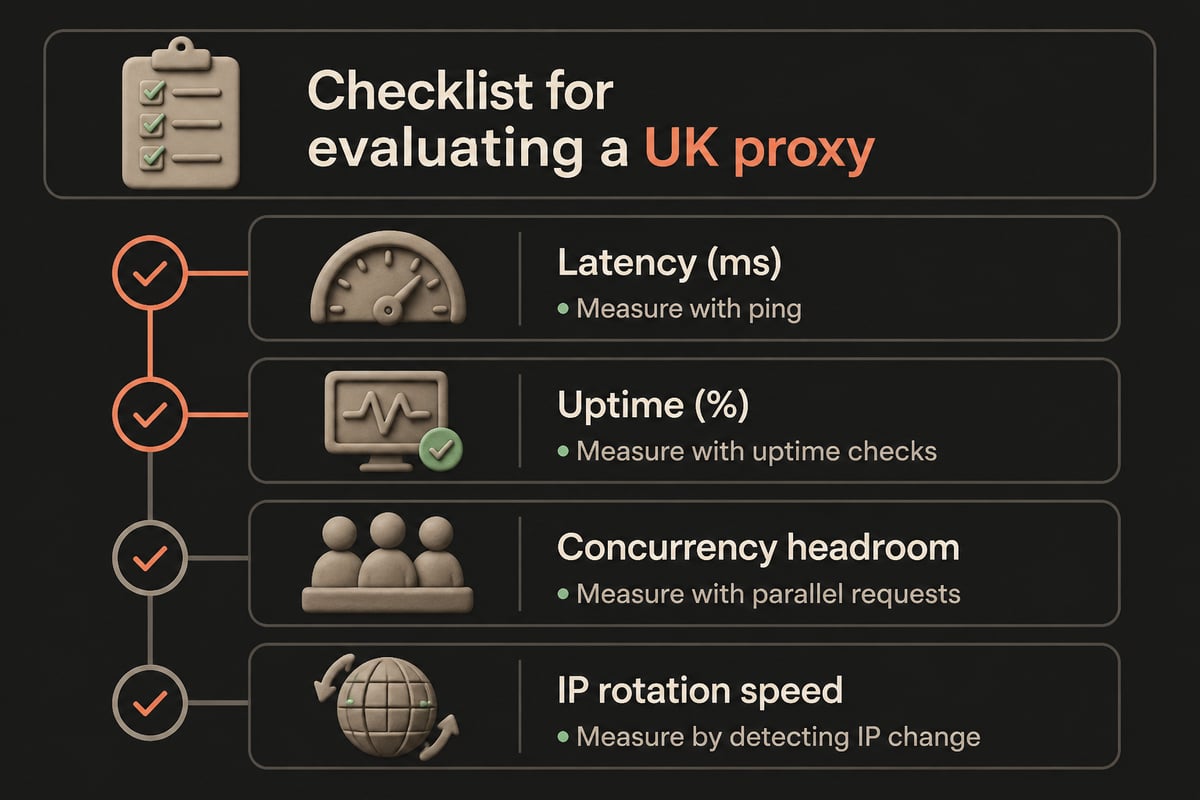
Speed for a scraping workload is a combination of four measurable properties, not a single number on a list page.
- Latency: round-trip time to the proxy, ideally measured from the region where your crawler runs.
- Uptime: the share of checks a proxy answers. A fast endpoint that is down 40% of the time costs more than a slower stable one.
- Concurrency headroom: whether bandwidth caps or connection limits throttle parallel requests.
- IP rotation behavior: how quickly you can obtain a fresh UK address after a block or a rate limit.
Measure these yourself. Send a few hundred requests to a neutral endpoint through each candidate, record time to first byte and error rate, and repeat at different hours. Published list statistics are a starting point, nothing more.
1. Free-Proxy.cz proxy list database
The Free-Proxy.cz database is a public directory of free proxy entries. It is a free reference source, and its current page layout and numeric specifications for UK listings could not be verified, so treat anything you see there as unvetted.
- Key specs: public proxy list database; no verified protocol counts or latency figures available.
- Approximate price: free.
- Suits: one-off connectivity tests or checking whether a target site responds to a UK-looking address, on a zero budget and with no production dependency.
- Verdict: fine for a quick experiment, unsuitable for any crawler you need to run unattended.
2. Free-Proxy.cz statistics view
The statistics-oriented section of Free-Proxy.cz is meant to summarize recent activity across its listed proxies. The exact page contents could not be verified, so use it as a rough indicator of list churn rather than a source of benchmarks.
- Key specs: short-window proxy-list statistics; no verified numeric specs.
- Approximate price: free.
- Suits: gauging how quickly a free pool turns over before you decide whether to build tooling around it.
- Verdict: useful for confirming that free lists decay fast, which is the main reason to look elsewhere.
3. HProxy free United Kingdom proxies
HProxy publishes a free UK list with response-time statistics for the pool. It reported 191 UK proxies across 34 networks and a median response time of 1,291 ms, with HTTP, HTTPS, SOCKS4 and SOCKS5 lists available.
- Key specs: 191 UK proxies, 34 networks, 1,291 ms median response, four protocol lists.
- Approximate price: free.
- Suits: comparing free-tier latency against a paid baseline, or smoke-testing a parser against UK-served content at low volume.
- Verdict: the reported median response time above one second shows why free pools can struggle with throughput-sensitive work.
4. FreeProxyUpdate United Kingdom list
FreeProxyUpdate lists public UK endpoints with anonymity and speed labels. The page reported 146 fresh UK proxies and covers HTTP/SSL, SOCKS, SOCKS4 and SOCKS5.
- Key specs: 146 fresh UK proxies, four protocol categories, anonymity and speed labels.
- Approximate price: free.
- Suits: collecting a small set of public UK endpoints for short, low-stakes tests, with the understanding that availability changes frequently.
- Verdict: a reasonable free source for protocol variety, but speed labels are self-reported snapshots and should be re-measured.
5. Geonode United Kingdom free proxy list
Geonode's UK list is one of the more technically detailed free sources, with filters for anonymity and speed and latency, uptime and last-checked fields per entry. At the time shown, Geonode's UK list displayed a proxy with 13.4 ms latency and 100% uptime, which illustrates that individual entries can be quick.
- Key specs: HTTP/HTTPS and SOCKS entries; per-entry latency, uptime and last-checked data; filters by anonymity and speed.
- Approximate price: free.
- Suits: inspecting public UK endpoints by technical attributes and building a short-lived candidate pool for benchmarking.
- Verdict: useful for data engineers because the per-entry metrics let you filter before testing.
6. PinguProxy Datacenter Proxies
For speed-critical collection, datacenter IPs are usually the fastest tier because they sit on high-capacity server networks rather than consumer connections. PinguProxy Datacenter Proxies are built for large-scale market research and public data gathering, and every plan includes unlimited bandwidth, so throughput is not capped by a data allowance. The network spans 190+ countries and regions with over 500 million IP addresses, and PinguProxy states a 99.9% uptime target monitored 24/7.
- Key specs: unlimited bandwidth, zero logs, IPv4 and IPv6 support, 1 ms rotating IP interval on Pro and Enterprise plans.
- Approximate price: from €14.99 per 30 days.
- Suits: high-volume crawling where cost per request and raw speed matter more than residential-grade trust, such as bulk collection of public pages for training corpora.
- Verdict: the practical upgrade from free lists when you need sustained throughput and predictable cost.
PinguProxy has no free trial: monthly plans start with a 1-day trial for €1, then the regular plan price, which is enough time to run your own latency and error-rate benchmark.
7. PinguProxy Residential Proxies
When a target site flags datacenter ranges, residential IPs carry more trust. PinguProxy Residential Proxies are suited to geo-targeted scraping, SERP monitoring and localization testing, with targeting that reaches 221 countries, which includes UK-specific collection. They are billed per GB, and unused pay-as-you-go GB never expire, which helps when UK crawl volume is uneven from week to week.
- Key specs: per-GB billing, 221-country targeting, zero logs, rotation available through the network's pool.
- Approximate price: €2.00/GB with volume discounts.
- Suits: UK-localized SERP and content checks where a consumer-grade IP reduces block rates, at moderate data volumes.
- Verdict: a good fit when success rate matters more than raw speed, with the cost scaling by traffic rather than time.
8. GoLogin paid plans
GoLogin is a browser-profile manager rather than a standalone proxy service, and it appears in UK proxy searches because paid plans bundle residential traffic. GoLogin's pricing page lists paid plans from $9 per month, or $4.50 per month billed annually. According to the GoLogin Help Center, paid plans include 2 GB of residential proxies, with 10 to 100 profiles on Professional, 300 or 500 on Business, and 1,000 on Enterprise.
- Key specs: 2 GB residential proxy traffic on paid plans; 10, 25, 50 or 100 profiles (Professional); 300 or 500 (Business); 1,000 (Enterprise).
- Approximate price: from $9/month, or $4.50/month billed annually.
- Suits: managing multiple browser fingerprints with a small included UK-capable residential allowance, rather than sustained bulk collection.
- Verdict: the 2 GB allowance is small for scraping or AI training volumes, so it works better as a profile tool than as a data pipeline backbone.
Side-by-side comparison
| Option | Type | Protocols or targeting | Notable listed data | Best use |
|---|---|---|---|---|
| Free-Proxy.cz database | Free list | Not verified | None verified | Quick experiments |
| Free-Proxy.cz statistics | Free list stats | Not verified | None verified | Gauging list churn |
| HProxy UK list | Free list | HTTP, HTTPS, SOCKS4, SOCKS5 | 191 proxies, 1,291 ms median | Free-tier latency baseline |
| FreeProxyUpdate UK | Free list | HTTP/SSL, SOCKS, SOCKS4, SOCKS5 | 146 fresh proxies | Low-stakes protocol testing |
| Geonode UK list | Free list | HTTP/HTTPS, SOCKS | Per-entry latency and uptime | Filtered benchmarking |
| PinguProxy Datacenter | Paid datacenter | IPv4 and IPv6 | Unlimited bandwidth | High-volume crawling |
| PinguProxy Residential | Paid residential | 221-country targeting | Per-GB billing | Geo-targeted collection |
| GoLogin paid plans | Browser profiles | Residential included | 2 GB included | Profile management |
Why a fast proxy UK pool needs more than low latency
A fast proxy UK pool for scraping is judged by success rate per gigabyte, not ping alone. A 15 ms proxy that returns a block page on 30% of requests wastes more bandwidth and engineering time than a 60 ms proxy that returns clean responses.
Three practical habits protect throughput:
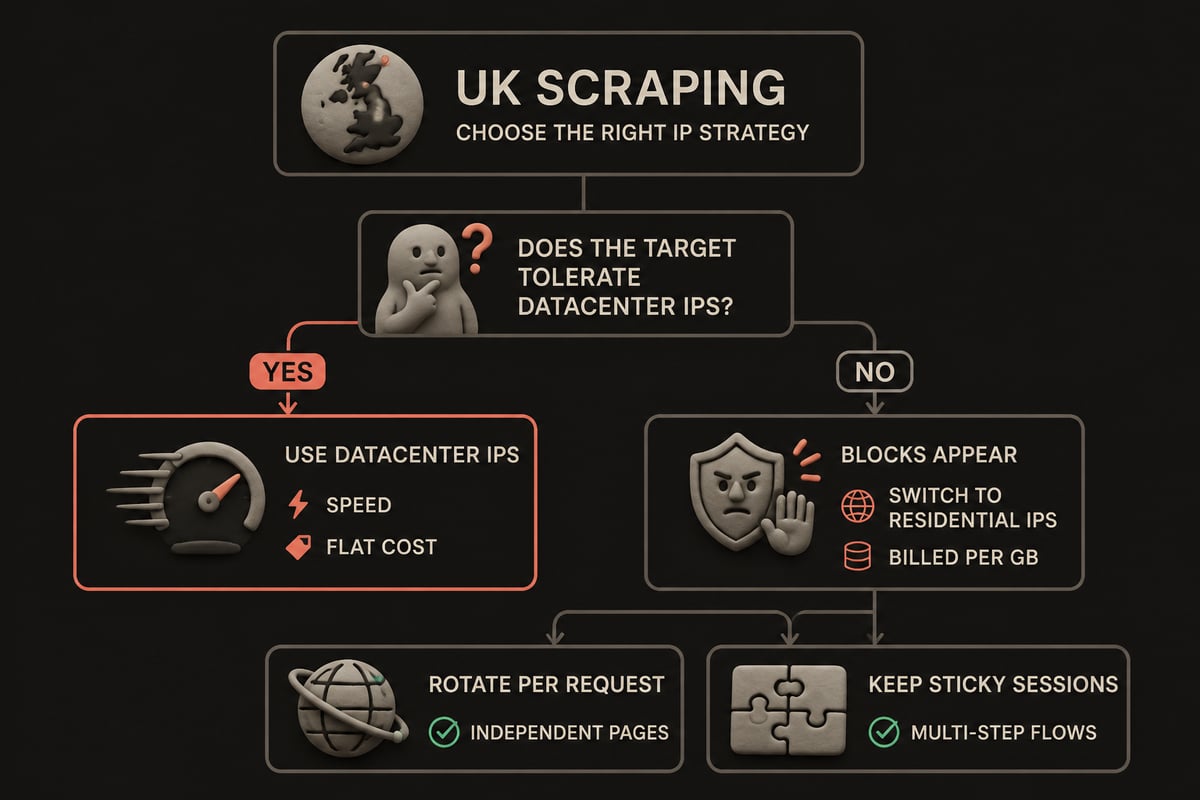
- Match the tier to the target. Use datacenter IPs for tolerant sites and residential IPs for protected ones. PinguProxy's guide to the fastest proxies covers how proxy types trade speed against trust.
- Rotate deliberately. Sticky sessions suit multi-page flows, while per-request rotation suits independent page fetches. A rotating proxy setup lets you change this per job instead of per account.
- Remove bandwidth ceilings. AI-training crawls can move terabytes, and per-GB caps change the economics quickly. An unlimited bandwidth plan makes cost predictable for large jobs.
For a broader primer on what makes a connection quick, PinguProxy also publishes an overview of fast proxy fundamentals.
Testing a UK proxy yourself
A short benchmark takes less than an hour and removes guesswork.
- Pick a stable, neutral URL you are permitted to request, and a representative target page.
- Send 200 to 500 requests through each candidate at your intended concurrency.
- Record median and 95th percentile time to first byte, error rate, and block rate.
- Repeat at peak and off-peak hours, since UK evening traffic changes results.
- Divide total cost by successful responses to get a cost per usable page.
Cost per usable page is the number to compare. It exposes the hidden price of free lists, where low sticker cost hides high failure rates, and it shows when a paid datacenter or residential plan is actually cheaper.

What free UK proxy lists cannot do
Free lists are acceptable for learning and for single requests, and they fail on the requirements that define production scraping:
- No accountability: nobody owns uptime, so entries vanish without notice.
- Unknown logging: you cannot verify what an operator records about your traffic, which matters when requests carry research queries or proprietary targets.
- Shared abuse history: public IPs are reused by many users and often already flagged.
- No concurrency guarantees: one slow node can stall an entire worker pool.
Paid providers address these with monitored networks and defined policies. PinguProxy, for example, operates a zero-log policy and a monitored 99.9% uptime target. If you are building pipelines for training data, those properties matter more than shaving a few milliseconds off a free endpoint's ping. A larger proxy pool also reduces the chance that your crawler reuses an already-flagged address.
For per-plan limits, rotation settings and UK availability, check PinguProxy's product pages or contact page rather than assuming defaults.
Run the benchmark above against one free list entry and one paid plan this week, and compare cost per usable page before you scale a crawler. If the numbers favor a paid network, PinguProxy's Datacenter Proxies and Residential Proxies put unlimited bandwidth, zero logs and 24/7 monitored uptime behind your UK traffic. PinguProxy offers high-speed datacenter, residential and mobile proxies with IPv4 and IPv6 support, so you can get started with a €1 one-day trial and test it against your own targets.