
Dieser Artikel ist derzeit nur auf Englisch verfügbar.
Auf Englisch lesenHTTP Proxies: A Complete Guide for 2026
HTTP proxies serve as intermediaries between your device and the internet, routing your web traffic through a separate server before it reaches its destination. These powerful tools have become essential for businesses and individuals who need enhanced privacy, security, or the ability to access geo-restricted content. Whether you're managing large-scale web scraping operations, protecting sensitive data, or simply browsing with greater anonymity, understanding how http proxies function can unlock new possibilities for your online activities.
What Are HTTP Proxies and How Do They Work
An HTTP proxy is a server that acts as a gateway between your computer and the websites you visit. When you configure your browser or application to use an HTTP proxy, all your web requests are first sent to the proxy server, which then forwards them to the target website. The response from the website follows the same path in reverse, passing through the proxy before reaching your device.
This process offers several advantages. Your real IP address remains hidden from the websites you visit, as they only see the proxy server's IP address. The proxy can also cache frequently accessed content, potentially speeding up load times for repeated requests. Additionally, proxies can filter or modify requests and responses, enabling content control and security scanning.
The technical implementation involves proxy servers and HTTP tunneling mechanisms that handle request forwarding and response routing. The proxy server receives HTTP requests on behalf of clients and processes them according to configured rules before establishing connections with destination servers.
Forward vs. Reverse Proxies
Understanding the distinction between proxy types is crucial. Forward proxies sit between clients and the internet, serving user requests to external servers. This is the most common type used for privacy and access control. Reverse proxies, conversely, sit in front of web servers and handle incoming requests from the internet, often used for load balancing and security.

Key Benefits of Using HTTP Proxies
Organizations and individuals rely on http proxies for a diverse range of applications. The benefits extend far beyond simple anonymity, offering practical solutions for common internet challenges.
Privacy and Anonymity Protection
IP masking stands as the primary privacy benefit. When you connect through an HTTP proxy, websites cannot identify your actual location or device. This proves invaluable for competitive research, market analysis, and protecting corporate identities during data gathering operations.
Modern proxy services implement zero-log policies that ensure no records of your browsing activity are retained. Combined with rapid IP rotation capabilities, this creates a robust privacy framework that protects sensitive business operations from detection and tracking.
Access to Geo-Restricted Content
Many websites and services implement geographical restrictions based on IP addresses. HTTP proxies enable you to:
- Access region-specific content libraries
- Test website functionality from different geographical locations
- Verify international advertising campaigns
- Conduct market research across global markets
- Bypass corporate or educational network restrictions
Web Scraping and Data Collection
For businesses engaged in competitive intelligence or market research, http proxies are indispensable. Web scraping operations require rotating through multiple IP addresses to avoid rate limiting and blocking. Professional proxy services provide thousands of IP addresses across different subnets, ensuring uninterrupted data collection.
| Use Case | Proxy Benefit | Business Impact |
|---|---|---|
| Price Monitoring | Avoid detection | Real-time competitive pricing |
| SEO Analysis | Multiple locations | Accurate search rankings |
| Social Media Management | Account safety | Reduced ban risk |
| Ad Verification | Geo-targeting | Campaign accuracy |
The technical specifications for proxying IP in HTTP provide standardized approaches that ensure compatibility across different platforms and applications.
Types of HTTP Proxies Available
Not all http proxies are created equal. Understanding the different types helps you select the right solution for your specific requirements.
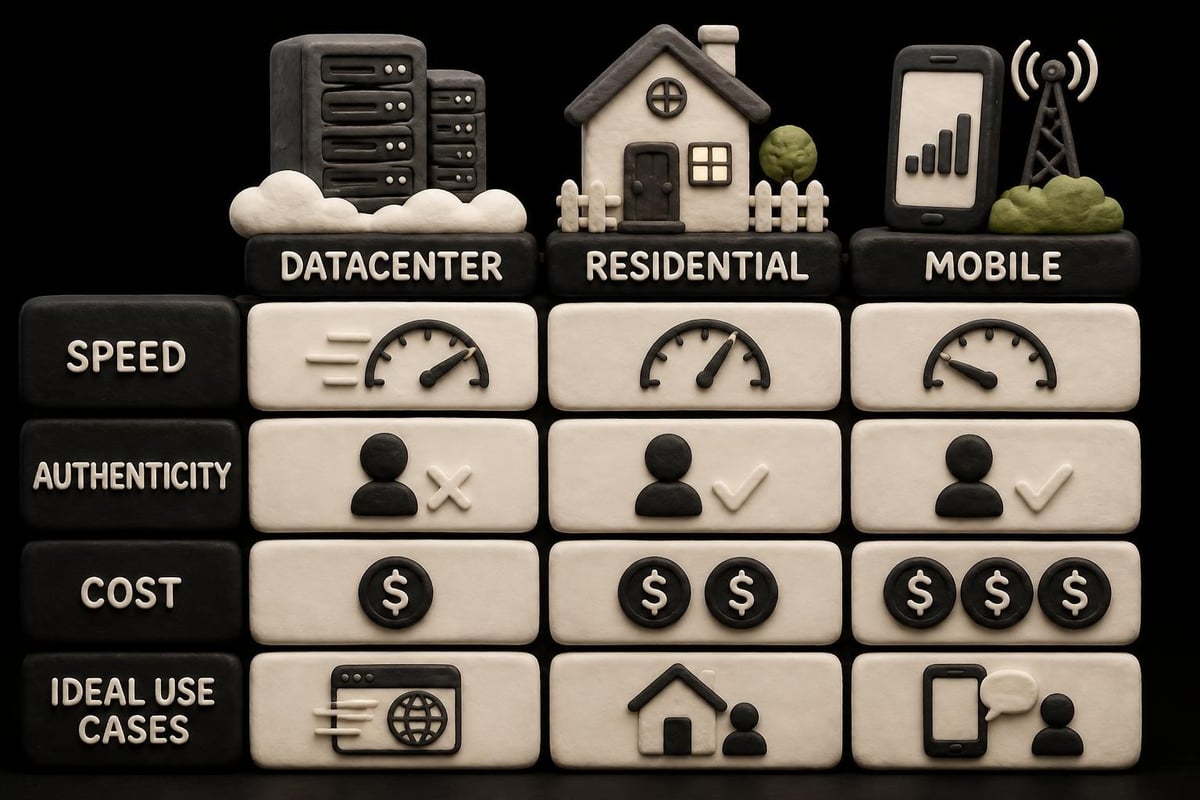
Datacenter Proxies
Datacenter proxies originate from cloud service providers and data centers rather than internet service providers. These proxies offer exceptional speed and reliability, often featuring 10Gbps bandwidth capabilities. They're ideal for high-volume tasks that prioritize speed over residential authenticity.
Advantages include:
- High-speed connections with minimal latency
- Cost-effective pricing for bulk operations
- Stable uptime backed by enterprise infrastructure
- Unlimited bandwidth for demanding applications
Residential Proxies
Residential proxies use IP addresses assigned by legitimate internet service providers to real residential locations. Websites view these connections as genuine user traffic, making them harder to detect and block. This authenticity comes with higher costs but delivers superior success rates for sensitive operations.
Mobile Proxies
Mobile proxies route traffic through cellular networks, utilizing IP addresses from mobile carriers. These prove exceptionally difficult for websites to block since mobile IPs are frequently shared among many users and change regularly. Social media management and mobile app testing benefit significantly from mobile proxy infrastructure.
Setting Up and Configuring HTTP Proxies
Implementing http proxies requires proper configuration across your applications and systems. The setup process varies depending on your operating system and specific use case.
Browser Configuration
Modern web browsers support proxy configuration through their network settings. Navigate to your browser's connection settings and input the proxy server address and port number. Most HTTP proxies operate on ports 80, 8080, or 3128, though custom ports are common.
Authentication credentials may be required for secured proxy services. Enter your username and password when prompted to establish the connection. Some services provide authentication directly in the proxy URL using the format http://username:password@proxy-server:port.
Application-Level Setup
Many applications support proxy configuration through environment variables or dedicated settings menus. Command-line tools like curl support various proxy types through simple flags and parameters, making them versatile for automated workflows.
- Identify proxy requirements for your specific application
- Configure authentication using provided credentials
- Test connectivity with a simple request
- Verify IP masking by checking your apparent IP address
- Monitor performance to ensure optimal routing
API and Script Integration
For developers, integrating http proxies into scripts and applications provides automated anonymity. Most HTTP client libraries support proxy configuration through simple parameters. This enables rotation strategies that switch between multiple proxies automatically, distributing requests to avoid detection.
Security Considerations and Best Practices
While http proxies offer numerous benefits, implementing them securely requires attention to potential vulnerabilities and best practices.
Encryption and HTTPS Support
Standard HTTP proxies transmit data without encryption, potentially exposing sensitive information to interception. For secure browsing, ensure your proxy service supports HTTPS connections. The debate around TLS proxies and their security implications highlights the importance of understanding encryption at the proxy level.
End-to-end encryption between your device and destination websites provides the strongest security. Even if the proxy server is compromised, encrypted traffic remains protected. Always verify SSL certificates when connecting to sensitive services.
Avoiding Free Proxy Risks
Research shows that free HTTP proxy ecosystems often present significant security and reliability concerns. Free proxies may:
- Log and sell your browsing data
- Inject advertisements into web pages
- Contain malware that compromises devices
- Provide unreliable connections with frequent downtime
Professional services with transparent privacy policies offer superior security guarantees compared to free alternatives.
IP Rotation Strategies
Rapid IP rotation enhances anonymity by preventing pattern recognition. Services offering 1ms proxy rotation enable you to switch IP addresses between requests, making it virtually impossible for websites to track your activity across sessions. This proves essential for large-scale operations requiring sustained access.
| Rotation Strategy | Use Case | Detection Risk |
|---|---|---|
| Fixed IP | Account management | Low (consistent) |
| Session rotation | General browsing | Medium |
| Request rotation | Web scraping | Very low |
| Time-based rotation | Long sessions | Low-medium |
Performance Optimization for HTTP Proxies
Maximizing proxy performance requires strategic configuration and resource allocation. Understanding performance factors helps you achieve optimal results for your specific applications.
Bandwidth and Speed Considerations
Connection speed directly impacts productivity, especially for data-intensive operations. Professional proxy services offering 10Gbps bandwidth ensure that the proxy itself never becomes a bottleneck. Test proxy speeds regularly to verify performance meets your requirements.
Geographic proximity between the proxy server and target websites affects latency. Selecting proxy locations closer to your destinations reduces round-trip time and improves response speeds. For global operations, distributed proxy networks provide optimal performance across regions.
Load Distribution
Distributing requests across multiple proxies prevents overloading individual servers and reduces the risk of IP-based throttling. Proxy pooling strategies maintain a rotation of active IPs, automatically switching when one becomes slow or blocked.
When comparing different proxy recommendations, consider both individual proxy performance and the service's overall infrastructure capacity. Dedicated support teams can help optimize configurations for your specific workload.
Monitoring and Troubleshooting
Continuous monitoring identifies performance degradation before it impacts operations:
- Response time tracking alerts you to slowdowns
- Success rate monitoring reveals blocked IPs
- Bandwidth usage analysis prevents quota surprises
- Error logging facilitates quick troubleshooting
Most enterprise proxy services provide dashboards showing real-time metrics and historical performance data. This visibility enables proactive management and rapid issue resolution.

Choosing the Right HTTP Proxy Service
Selecting an appropriate proxy provider requires evaluating several critical factors beyond simple pricing comparisons. Your specific use cases and volume requirements should guide your decision.
Essential Features to Evaluate
Protocol support determines compatibility with your applications. While this article focuses on HTTP proxies, many modern services also support SOCKS proxies for applications requiring lower-level network access. Dual protocol support provides flexibility as your needs evolve.
Look for providers offering:
- Multiple proxy types (datacenter, residential, mobile)
- IPv4 and IPv6 support for maximum compatibility
- Unlimited bandwidth or generous allocation
- Geographic diversity with global server locations
- 24/7 customer support for critical operations
Privacy and Compliance
Zero-log policies ensure that your browsing activities aren't recorded or monetized. Review privacy policies carefully to understand data handling practices. Transparent providers clearly document what information they collect and how it's used.
Compliance with data protection regulations becomes crucial for businesses operating in regulated industries. Verify that your proxy provider adheres to relevant standards like GDPR or CCPA if handling user data through proxied connections.
Scalability and Reliability
Your proxy solution should grow with your needs. Services offering unlimited access eliminate concerns about hitting usage caps during critical operations. Evaluate the provider's infrastructure capacity and redundancy measures to ensure consistent availability.
Understanding comprehensive evaluations of open proxy performance helps contextualize the importance of choosing premium services over unreliable free alternatives.
Advanced Use Cases and Applications
Beyond basic anonymity, http proxies enable sophisticated applications across various industries and scenarios.
Competitive Intelligence
Marketing teams use proxies to monitor competitor pricing, advertising campaigns, and product launches without revealing their interest. Anonymous market research provides unbiased data collection, as websites display standard content rather than modified versions based on detected corporate IP addresses.
Price aggregation services rely on proxies to gather accurate pricing data from multiple retailers simultaneously. Without proxies, many retailers detect automated access attempts and block collection efforts or display misleading prices.
Ad Verification and Testing
Digital advertisers use http proxies to verify that their campaigns display correctly across different geographic regions. Geo-targeted ad verification ensures marketing spend reaches intended audiences and appears as designed. Testing from multiple locations simultaneously accelerates campaign optimization cycles.
Gaming and Entertainment
Gamers utilize proxies to access servers in different regions, reducing latency or accessing exclusive content. Some gaming services restrict access based on location, and proxies provide legitimate workarounds for global players.
Streaming service testing benefits from proxy networks that verify content availability and quality across international markets. This proves essential for content delivery networks validating global distribution.
Academic and Security Research
Researchers studying internet censorship, regional content restrictions, and security vulnerabilities rely on http proxies to observe how systems behave in different contexts. Academic studies on proxy ecosystems themselves contribute to improved security and performance standards across the industry.
Integration with Development Workflows
Modern development practices increasingly incorporate proxy infrastructure for testing, debugging, and security analysis.
API Development and Testing
Developers building APIs that serve global audiences need to test behavior from various geographic locations. HTTP proxies enable comprehensive testing without requiring physical infrastructure in every target region. This accelerates development cycles and improves product quality before launch.
Rate limiting verification becomes simpler with proxy rotation. Developers can test how their systems handle traffic from multiple sources without coordinating distributed testing infrastructure.
Continuous Integration Pipelines
Incorporating proxy services into CI/CD workflows enables automated testing from multiple perspectives. Build systems can verify that applications function correctly regardless of user location or network characteristics. This catches region-specific bugs before they reach production.
Security Penetration Testing
Security professionals use http proxies to test application defenses from external perspectives. Controlled penetration testing through various IP addresses validates that security measures effectively protect against distributed attacks and suspicious activity patterns.
HTTP proxies have evolved from simple privacy tools into essential infrastructure for modern internet operations, offering solutions for everything from web scraping to global testing. Understanding the technical fundamentals, security considerations, and strategic implementations enables businesses to leverage proxies effectively while avoiding common pitfalls. Whether you need datacenter speed, residential authenticity, or mobile carrier routing, selecting a reliable provider ensures your operations run smoothly with maximum privacy and performance. PinguProxy delivers enterprise-grade proxy solutions with high-speed datacenter, residential, and mobile options, complete IPv4/IPv6 support, zero-log privacy, 1ms rotation, and 24/7 support to power your most demanding applications.