
Questo articolo è attualmente disponibile solo in inglese.
Leggi in ingleseSOCKS Proxies: Complete Guide for Business & Privacy
Network privacy and security have become critical concerns for businesses and individuals navigating the digital landscape in 2026. Among the various proxy technologies available, socks proxies stand out as a versatile solution that offers flexibility and performance for a wide range of applications. Unlike traditional HTTP proxies that only handle web traffic, socks proxies operate at a lower network level, enabling them to handle any type of traffic protocol. This fundamental difference makes them invaluable for tasks ranging from web scraping and automated data collection to secure gaming connections and accessing geo-restricted content. Understanding how socks proxies work and when to deploy them can significantly enhance your online operations while maintaining robust privacy protections.
Understanding SOCKS Protocol Architecture
The SOCKS protocol functions as an intermediary layer between client applications and the broader internet. When you configure an application to use socks proxies, all network requests from that application are routed through the proxy server before reaching their final destination.
This routing mechanism provides several distinct advantages. First, it masks your original IP address, replacing it with the proxy server's IP. Second, it allows applications that might not natively support proxies to utilize them seamlessly. Third, it provides a unified approach to handling multiple protocols through a single proxy connection.
Evolution from SOCKS4 to SOCKS5
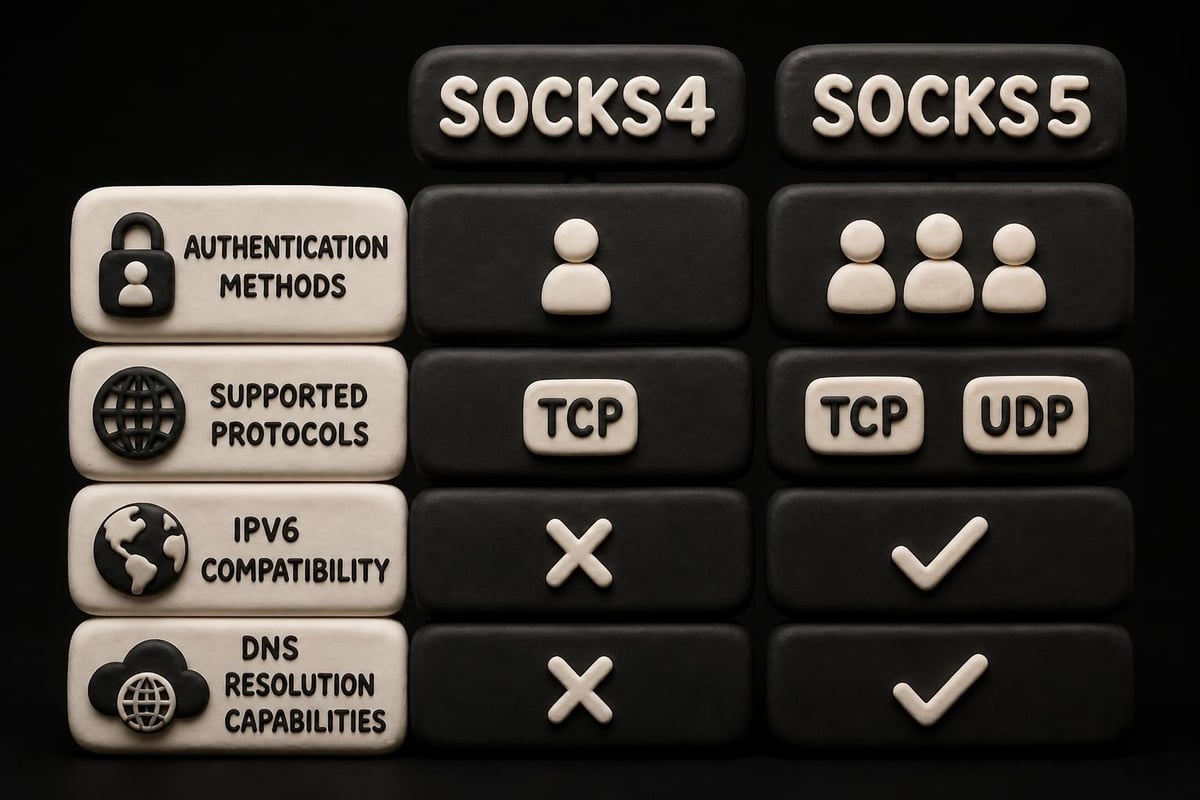
The SOCKS protocol has evolved significantly since its inception. SOCKS4, the earlier version, provided basic proxy functionality but lacked authentication mechanisms and IPv6 support. The protocol could only handle TCP connections, limiting its versatility for modern applications.
SOCKS5 represents a substantial upgrade with several key enhancements:
- Authentication support for username/password and GSS-API methods
- UDP protocol support enabling real-time applications
- IPv6 compatibility for modern network infrastructures
- DNS resolution performed by the proxy server rather than the client
- Enhanced error handling with more detailed response codes
Understanding the technical workings of SOCKS5 proxies reveals why this version has become the industry standard for professional applications. The authentication layer prevents unauthorized access, while UDP support enables applications like video streaming and VoIP services to function smoothly through the proxy.
Key Advantages of SOCKS Proxies for Business Applications
Businesses across industries leverage socks proxies for their unique combination of speed, flexibility, and security. The protocol-agnostic nature of these proxies makes them suitable for specialized use cases that traditional HTTP proxies cannot accommodate.
Performance characteristics set socks proxies apart from other proxy types. Because they operate at the session layer without interpreting or modifying packet headers, they introduce minimal latency. This efficiency proves crucial for time-sensitive operations like high-frequency data collection or competitive gaming.
Protocol Versatility and Application Support
The ability to handle any protocol represents one of the most compelling reasons to choose socks proxies. Whether you're running SMTP email clients, FTP file transfers, or BitTorrent applications, socks proxies maintain full compatibility.
For datacenter proxy deployments, this versatility becomes particularly valuable. Development teams can standardize on a single proxy infrastructure rather than maintaining separate solutions for different protocols. This consolidation reduces complexity and operational overhead while improving security consistency across the organization.
| Use Case | Protocol Required | SOCKS Support | HTTP Proxy Support |
|---|---|---|---|
| Web Scraping | HTTP/HTTPS | Yes | Yes |
| Email Clients | SMTP/POP3/IMAP | Yes | No |
| Gaming | UDP/TCP Custom | Yes | No |
| File Transfer | FTP/SFTP | Yes | Limited |
| Torrenting | BitTorrent | Yes | No |
| VoIP Services | UDP/SIP | Yes | No |
Enhanced Anonymity and Security Features
Socks proxies excel at maintaining user anonymity through their transparent proxy mechanism. Unlike some HTTP proxies that add headers revealing proxy usage, properly configured socks proxies leave minimal digital footprints.
The zero-log policies implemented by professional providers ensure that connection records, timestamps, and traffic data remain private. When combined with rapid IP rotation capabilities, this approach creates robust anonymity for sensitive business operations.
Authentication mechanisms in SOCKS5 add another security layer. By requiring credentials before establishing connections, businesses can control proxy access, monitor usage patterns, and prevent unauthorized utilization of their proxy infrastructure.
Implementing SOCKS Proxies in Your Workflow
Successfully deploying socks proxies requires understanding configuration requirements and selecting the right proxy type for your specific needs. The implementation process varies depending on your application environment and technical requirements.
Residential vs Datacenter SOCKS Proxies
Choosing between residential and datacenter socks proxies depends on your specific use case and budget considerations. Each type offers distinct advantages suited to different scenarios.
Datacenter proxies deliver exceptional speed and reliability at competitive price points. These proxies originate from data centers and cloud hosting providers, offering:
- High-bandwidth connections (often 10Gbps or higher)
- Consistent uptime and performance
- Cost-effective scaling for large operations
- Predictable latency profiles
When exploring best datacenter proxies for your operations, consider the geographic distribution of proxy servers and the provider's network infrastructure. PinguProxy's datacenter network provides global coverage with enterprise-grade performance characteristics.
Residential proxies route traffic through real residential IP addresses, making them appear as legitimate home internet connections. This authenticity provides advantages for:
- Accessing platforms with strict bot detection
- Gathering market research data without triggering rate limits
- Testing localized content and pricing variations
- Bypassing geographic restrictions on sensitive platforms

Configuration Best Practices
Properly configuring your applications to use socks proxies ensures optimal performance and security. Most modern applications support SOCKS proxy configuration through settings menus or environment variables.
For command-line tools and scripting environments, setting proxy parameters typically involves specifying the protocol, host, port, and authentication credentials. When working with curl and proxy configurations, you can leverage environment variables or command-line flags to route traffic through your SOCKS infrastructure.
Essential configuration steps include:
- Verify SOCKS5 support in your target application
- Configure the proxy host and port (typically 1080 or 1081)
- Set up authentication credentials if required
- Test DNS resolution behavior (local vs remote)
- Implement error handling and fallback mechanisms
- Monitor connection performance and success rates
Applications like web browsers, torrent clients, and development tools each have specific configuration interfaces. Documentation and support resources from your proxy provider can streamline this setup process.
SOCKS Proxies for Specialized Use Cases
Beyond general web browsing and data collection, socks proxies enable specialized applications that require low-level network control and protocol flexibility.
Web Scraping and Data Collection
Web scraping operations benefit enormously from socks proxies due to their speed and ability to handle large-scale concurrent connections. When extracting data from websites, retailers, or public APIs, socks proxies help avoid IP blocks and rate limiting.
The combination of fast connection speeds and IP rotation creates an ideal environment for scraping operations. With 1ms rotation capabilities, you can distribute requests across thousands of IP addresses, making detection and blocking virtually impossible.
Modern scraping frameworks integrate seamlessly with SOCKS proxy configurations, allowing developers to specify proxy pools, rotation strategies, and failover behavior directly in their code. This integration simplifies large-scale data collection while maintaining robust error handling.
Gaming and Low-Latency Applications
Competitive gamers and gaming networks increasingly rely on socks proxies to reduce latency, access region-locked content, and protect against DDoS attacks. The UDP support in SOCKS5 proves essential for real-time gaming traffic.
By connecting through socks proxies strategically positioned near game servers, players can sometimes achieve better routing than their standard ISP connection provides. This optimization can reduce ping times and improve gameplay responsiveness.
Gaming proxy requirements differ from other use cases:
- Minimal latency (sub-20ms additional overhead preferred)
- Stable connections without packet loss
- UDP protocol support for game traffic
- DDoS protection at the proxy level
- Geographic flexibility for server access
Privacy-Focused Communication
Applications like messaging services, email clients, and VoIP platforms can route traffic through socks proxies to enhance privacy and bypass network restrictions. The advantages of SOCKS proxies for these applications include their ability to handle encrypted traffic without interference.
When privacy represents the primary concern, combining socks proxies with end-to-end encrypted communication tools creates multiple protection layers. The proxy obscures your IP address and geographic location, while encryption protects message content from interception.
Comparing SOCKS to Other Proxy Types
Understanding how socks proxies differ from HTTP, HTTPS, and other proxy protocols helps you select the right tool for each task. Each proxy type has specific strengths suited to particular applications.
SOCKS vs HTTP Proxies
The fundamental architectural difference between these proxy types determines their respective capabilities and limitations.
| Feature | SOCKS Proxies | HTTP Proxies |
|---|---|---|
| Protocol Support | Any (TCP/UDP) | HTTP/HTTPS only |
| Operating Layer | Session (Layer 5) | Application (Layer 7) |
| Speed | Faster | Moderate |
| Header Modification | None | Adds X-Forwarded headers |
| Authentication | SOCKS5: Yes | Yes |
| Caching | No | Yes |
| SSL Handling | Transparent tunnel | Can decrypt/inspect |
For tasks requiring protocol flexibility or minimal overhead, socks proxies prove superior. However, HTTP proxies offer advantages when caching web content or when detailed request/response inspection is necessary.
Integration with Other Privacy Tools
Socks proxies complement other privacy technologies rather than replacing them. Many users combine socks proxies with VPNs, Tor, or SSH tunnels to create layered security approaches.
The relationship between Tor and SOCKS demonstrates how these technologies can work together. Tor exposes a SOCKS interface that applications can connect to, routing traffic through the Tor network's onion routing system. This combination provides both the protocol flexibility of SOCKS and the anonymity features of Tor.

Selecting a SOCKS Proxy Provider
Choosing the right provider requires evaluating multiple factors beyond simple pricing considerations. The quality, performance, and support characteristics of your proxy infrastructure directly impact operational success.
Critical Evaluation Criteria
When assessing potential providers, focus on these key differentiators:
Network Infrastructure Quality
- Geographic distribution of proxy servers
- Bandwidth availability per connection
- IPv4 and IPv6 protocol support
- Network uptime guarantees and historical performance
- Redundancy and failover capabilities
Privacy and Security Standards
- Zero-log policies with third-party audits
- Data encryption in transit
- Authentication mechanisms
- IP rotation speed and methodology
- Compliance certifications (SOC 2, GDPR, etc.)
Performance Metrics
- Connection establishment time
- Throughput speeds under load
- Concurrent connection limits
- Success rates for target destinations
- Latency to major internet exchanges
For businesses seeking SOCKS5 residential proxy solutions, verify the provider's IP acquisition methods and rotation pool size. Larger pools provide better distribution and lower detection rates.
Pricing Models and Value Assessment
Proxy providers use various pricing structures, from pay-per-gigabyte to unlimited access subscriptions. Understanding these models helps optimize costs for your specific usage pattern.
Common pricing approaches include:
- Bandwidth-based: Charged per GB transferred
- Time-based: Monthly or annual subscription periods
- Port-based: Pricing per concurrent connection
- Tiered access: Different speeds/features at each level
Unlimited access models provide predictable costs and eliminate overage concerns, making them ideal for high-volume operations like web scraping or continuous monitoring. These plans typically offer the best value for businesses with consistent, heavy proxy usage.
Support and Documentation Quality
Technical support quality separates professional proxy providers from budget alternatives. When issues arise with proxy configuration, authentication, or performance, responsive support teams minimize downtime.
Evaluate support offerings based on:
- Availability: 24/7 coverage vs business hours
- Response times: Guaranteed SLAs for critical issues
- Expertise: Technical depth of support staff
- Documentation: Comprehensive guides and code examples
- Communication channels: Email, chat, phone options
Providers offering comprehensive proxy solutions with extensive documentation enable faster implementation and troubleshooting. Self-service resources like knowledge bases, API documentation, and integration guides reduce dependency on support tickets.
Advanced SOCKS Proxy Techniques
Power users and enterprise deployments can leverage advanced configurations to maximize the benefits of socks proxies while addressing complex requirements.
Proxy Chaining and Cascading
Routing traffic through multiple proxy servers in sequence creates additional anonymity layers and enables sophisticated network architectures. Proxy chaining with socks proxies allows you to:
- Distribute trust across multiple providers
- Add geographic diversity to your routing path
- Implement custom routing logic based on destination
- Create failover chains for high availability
When implementing proxy chains, monitor latency carefully as each hop adds overhead. For most applications, limiting chains to 2-3 proxies balances anonymity with acceptable performance.
Automated Rotation and Pool Management
Enterprise-scale proxy usage demands automated rotation strategies to distribute requests across IP pools effectively. Smart rotation logic considers factors like:
- Request volume per IP to avoid rate limiting
- Success rates for specific destinations
- Geographic targeting requirements
- Session persistence needs for multi-request workflows
Modern proxy management systems expose APIs for programmatic control over rotation policies, IP whitelisting, and performance monitoring. Integration with your application code enables dynamic proxy selection based on real-time conditions.
Performance Optimization Strategies
Maximizing throughput and minimizing latency requires attention to configuration details and network architecture.
Key optimization techniques:
- Connection pooling: Reuse established proxy connections
- Parallel requests: Leverage concurrent connections within limits
- Geographic optimization: Select proxies near target servers
- Protocol tuning: Adjust TCP window sizes and timeouts
- Compression: Enable when supported by applications
- Caching: Implement application-level caching to reduce proxy load
Monitoring tools that track proxy performance metrics help identify bottlenecks and optimization opportunities. Metrics worth tracking include connection success rates, average response times, bandwidth utilization, and error frequencies.
Security Considerations and Best Practices
While socks proxies enhance privacy, improper configuration or usage can create security vulnerabilities. Following security best practices protects your operations and data.
Authentication and Access Control
Never deploy socks proxies without authentication in production environments. Username/password authentication provides basic access control, while more sophisticated implementations might integrate with enterprise identity systems.
Authentication best practices:
- Use strong, unique credentials for each proxy or user
- Rotate passwords regularly on a defined schedule
- Implement IP whitelisting alongside credential authentication
- Monitor authentication logs for suspicious access patterns
- Revoke credentials immediately when access is no longer needed
Encryption and Data Protection
SOCKS5 proxies do not inherently encrypt traffic between the client and proxy server. For sensitive applications, layer additional encryption through:
- SSH tunneling: Create encrypted tunnels to proxy servers
- VPN overlay: Route proxy connections through VPN tunnels
- Application-level encryption: Use HTTPS, TLS, or application-specific encryption
- Private network deployment: Host proxies on isolated networks
When handling sensitive data or credentials through socks proxies, always verify end-to-end encryption exists between your application and the final destination.
Leak Prevention and Testing
DNS leaks and IPv6 leaks can inadvertently expose your real IP address even when using socks proxies. Regular testing ensures your proxy configuration maintains anonymity.
Testing procedures should verify:
- DNS queries route through the proxy (not local DNS)
- IPv6 traffic is disabled or properly proxied
- WebRTC doesn't leak local IP addresses
- Connections fail properly when proxy is unavailable
- Application metadata doesn't reveal identity
Automated testing tools can continuously monitor for leaks and alert when proxy configurations fail to provide expected anonymity levels.
Understanding the architecture, capabilities, and optimal deployment strategies for socks proxies enables businesses to leverage this powerful technology for enhanced privacy, performance, and operational flexibility. Whether you're scaling web scraping operations, securing gaming connections, or building privacy-focused applications, socks proxies provide the protocol versatility and speed modern use cases demand. PinguProxy delivers enterprise-grade SOCKS proxy solutions with high-speed datacenter and residential options, complete IPv4/IPv6 support, zero-log privacy guarantees, and 1ms rotation capabilities backed by 24/7 expert support to ensure your operations run smoothly and securely.