
यह लेख वर्तमान में केवल अंग्रेज़ी में उपलब्ध है।
अंग्रेज़ी में पढ़ेंHTTP Proxy: Complete Guide to Web Traffic Routing
An http proxy acts as an intermediary gateway between your device and the internet, intercepting and forwarding web traffic on your behalf. In 2026, these servers have become essential tools for businesses and individuals seeking enhanced privacy, improved security, and access to geo-restricted content. Whether you're scraping data, managing multiple accounts, or protecting your online identity, understanding how http proxy technology works can transform your web operations and unlock new possibilities for digital efficiency.
Understanding HTTP Proxy Fundamentals
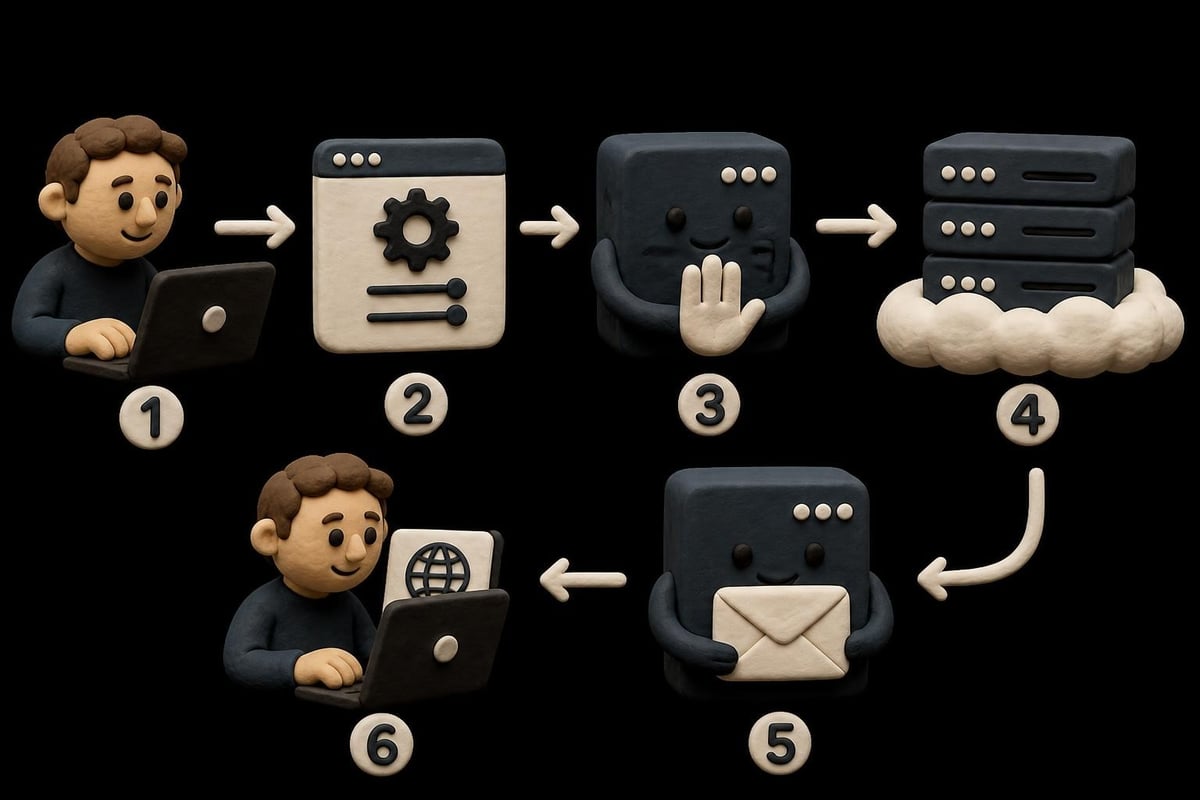
At its core, an http proxy operates at the application layer, specifically handling HTTP and HTTPS traffic between clients and servers. When you configure a proxy connection, your browser or application sends requests to the proxy server instead of directly to the destination website. The proxy then forwards these requests to the target server, receives the response, and sends it back to you.
This intermediary position creates several advantages. The target website sees the proxy's IP address rather than yours, providing anonymity and enabling geographic flexibility. Additionally, proxies can cache frequently accessed content, reducing bandwidth usage and improving load times for repeated requests.
Forward vs. Reverse Proxies
The term "http proxy" typically refers to forward proxies, which sit between clients and the internet. These proxies handle outbound requests from users seeking to access external resources. Understanding proxy servers and tunneling helps clarify the distinctions between different proxy architectures.
Reverse proxies, conversely, sit in front of web servers and handle inbound requests from the internet. They're commonly used for load balancing, caching, and security purposes. While both types operate on HTTP protocols, their positioning and use cases differ significantly.
Key differences include:
- Direction of traffic: Forward proxies serve clients; reverse proxies serve servers
- Primary users: Forward proxies benefit end-users; reverse proxies benefit website operators
- Common applications: Forward proxies enable privacy and access; reverse proxies optimize performance and security
- Configuration location: Forward proxies are configured on client devices; reverse proxies are configured on server infrastructure
Types of HTTP Proxies Available
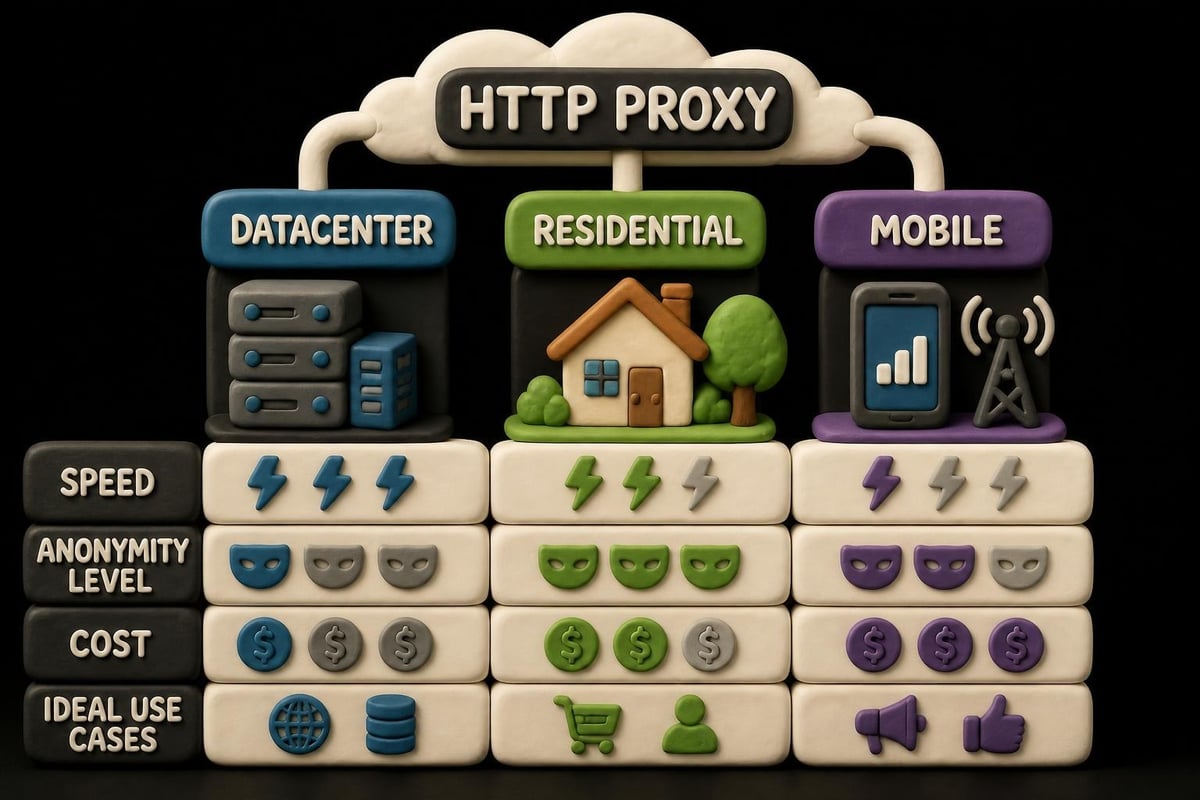
The http proxy landscape offers multiple implementation options, each suited to specific requirements and budgets. Understanding these variations helps you select the right solution for your needs.
Datacenter Proxies
Datacenter proxies originate from cloud hosting providers and data centers rather than residential ISPs. They offer exceptional speed and reliability, often featuring 10Gbps bandwidth capabilities that make them ideal for high-volume operations.
These proxies excel at tasks requiring rapid response times and consistent uptime. Datacenter proxies provide the foundation for enterprise-level web scraping, automated testing, and market research applications where performance matters most.
| Feature | Datacenter | Residential | Mobile |
|---|---|---|---|
| Speed | Very High | Medium | Medium-Low |
| Anonymity | Moderate | High | Very High |
| Cost | Low | High | Very High |
| Detection Risk | Moderate | Low | Very Low |
Residential and Mobile Proxies
Residential proxies route traffic through actual home internet connections, providing legitimate IP addresses that websites rarely flag or block. Mobile proxies take this further by using cellular networks, offering the highest level of trust and authenticity.
The trade-off comes in cost and speed. While residential and mobile proxies provide superior anonymity, they typically operate at lower speeds and command premium pricing compared to datacenter alternatives.
Common HTTP Proxy Use Cases
Organizations and individuals deploy http proxy infrastructure for diverse purposes, each leveraging the technology's unique capabilities to solve specific challenges.
Web Scraping and Data Collection
Modern businesses require vast amounts of web data for competitive intelligence, pricing monitoring, and market analysis. An http proxy enables scalable data extraction by distributing requests across multiple IP addresses, preventing rate limiting and IP bans.
Successful scraping operations typically involve:
- Rotating proxy pools with hundreds or thousands of IPs
- Geographic distribution matching target website locations
- Request throttling to mimic human browsing patterns
- Session persistence for multi-page scraping workflows
The best datacenter proxies can handle millions of requests daily while maintaining low latency and high success rates, making them invaluable for enterprise data operations.
Privacy and Security Enhancement
Privacy-conscious users deploy http proxy connections to mask their real IP addresses and locations. This prevents websites from tracking browsing habits, building detailed user profiles, or serving targeted advertisements based on geographic location.
In 2026, with increasing regulatory scrutiny around data privacy, businesses use proxies to protect employee internet activity and prevent data leaks. The zero-log policies offered by premium providers ensure no browsing history is retained, adding an extra layer of confidentiality.
Accessing Geo-Restricted Content
Content providers often restrict access based on geographic location, limiting certain services, pricing, or information to specific regions. An http proxy with IP addresses in the desired location enables users to bypass these restrictions legitimately.
This application extends beyond entertainment streaming. Businesses use geographic proxies to monitor how their websites appear in different markets, verify localized advertising campaigns, and ensure compliance with regional regulations.
Setting Up and Configuring HTTP Proxies
Implementing an http proxy requires proper configuration across your applications and systems. The setup process varies depending on your operating system, browser, and specific tools.
Browser Configuration
Most modern browsers support proxy configuration through built-in settings menus. You'll need to specify the proxy server address, port number, and authentication credentials if required.
Configuration steps typically include:
- Navigate to network or connection settings
- Enable manual proxy configuration
- Enter proxy server hostname or IP address
- Specify the port (commonly 8080, 3128, or 8888)
- Add username and password for authenticated proxies
- Test the connection to verify proper routing
For advanced users, Proxy Auto-Configuration files enable automatic proxy selection based on destination URLs, providing flexibility for complex routing requirements.
Command-Line Tools and Programming
Developers frequently use http proxy connections in scripts and automated workflows. Tools like curl support proxy configuration through environment variables or command-line flags, as detailed in curl's proxy documentation.
Programming languages offer built-in proxy support through their HTTP libraries. Python's requests library, Node.js's http module, and Java's HttpURLConnection all accept proxy parameters, enabling seamless integration into applications.
HTTP Proxy Performance Optimization
Simply deploying an http proxy doesn't guarantee optimal performance. Several factors influence speed, reliability, and success rates in real-world applications.
Bandwidth and Speed Considerations
Proxy server bandwidth directly impacts your transfer rates. High-performance providers offer 10Gbps connections, but individual session speeds depend on routing efficiency, server load, and network congestion.
Latency introduces another performance dimension. Physical distance between you, the proxy server, and the destination affects round-trip time. For time-sensitive applications, selecting geographically optimized proxies minimizes delays.
Rotation Strategies
Static IP addresses become easily identifiable and potentially blocked by sophisticated anti-bot systems. Rotation strategies automatically switch between different proxy IPs at defined intervals or per request.
Common rotation approaches include:
- Time-based rotation: Switch IPs every few minutes or hours
- Request-based rotation: Use a new IP for each connection
- Session-based rotation: Maintain the same IP throughout a user session
- Failure-based rotation: Change IPs only when requests fail or get blocked
Premium services offer 1ms rotation speeds, enabling near-instantaneous IP switching without disrupting active connections. This rapid rotation enhances anonymity while maintaining operational continuity.
Security and Privacy Considerations
While an http proxy provides privacy benefits, implementation details significantly impact actual security levels. Understanding potential vulnerabilities helps you make informed decisions.
Authentication and Access Control
Unauthenticated proxies pose security risks, potentially exposing your traffic to interception or allowing unauthorized users to consume your proxy resources. Always configure username/password authentication or IP whitelisting to restrict access.
Security best practices include:
- Using strong, unique credentials for each proxy account
- Implementing IP whitelisting when possible
- Enabling SSL/TLS encryption for proxy connections
- Regularly rotating authentication credentials
- Monitoring proxy usage for suspicious activity
HTTPS Traffic and SSL Inspection
HTTP proxies handle plain-text HTTP traffic transparently, but HTTPS connections require special consideration. The CONNECT method establishes tunnels through the proxy, allowing encrypted traffic to pass through without decryption.
Some proxy solutions perform SSL inspection, decrypting and re-encrypting HTTPS traffic to enable content filtering or caching. This approach raises privacy concerns and requires careful trust evaluation. Zero-log policies become crucial when proxies can potentially access encrypted data.

Comparing HTTP Proxies to Alternative Solutions
The proxy ecosystem includes multiple protocol types beyond standard HTTP implementations. Understanding these alternatives helps you choose the right tool for specific requirements.
SOCKS5 vs. HTTP Proxies
SOCKS5 proxies operate at a lower network layer than http proxy servers, handling any type of traffic rather than just HTTP/HTTPS. This makes SOCKS5 more versatile for applications like email, FTP, or peer-to-peer connections.
However, HTTP proxies offer advantages for web-specific tasks. They understand HTTP headers, enabling advanced features like caching, content filtering, and request modification. For dedicated web scraping or browsing, choosing between protocols depends on your specific requirements.
| Aspect | HTTP Proxy | SOCKS5 Proxy |
|---|---|---|
| Protocol Support | HTTP/HTTPS only | All TCP/UDP traffic |
| Speed | Optimized for web | Slightly slower |
| Caching | Supported | Not supported |
| Use Case | Web browsing, scraping | Gaming, torrenting, email |
VPN Alternatives
Virtual Private Networks encrypt all device traffic and route it through remote servers, similar to proxy functionality but with important distinctions. VPNs provide system-wide coverage while proxies typically affect only configured applications.
For business users requiring selective routing, http proxy solutions offer greater flexibility. You can route scraping operations through proxies while maintaining direct connections for other activities, optimizing both performance and cost.
Open-Source HTTP Proxy Solutions
Several established open-source projects provide http proxy functionality for users comfortable with self-hosting and configuration. These solutions offer full control but require technical expertise and infrastructure management.
Popular Proxy Software
Squid remains one of the most widely deployed caching proxy servers, supporting HTTP, HTTPS, and FTP protocols. It excels at reducing bandwidth usage through intelligent caching and offers extensive configuration options for access control and performance tuning.
Privoxy focuses on privacy enhancement, offering advanced filtering capabilities to modify web page content, block advertisements, and protect user privacy. Its non-caching design prioritizes security over performance optimization.
For organizations evaluating options, the comparison of HTTP proxies available in the open-source ecosystem provides detailed feature analysis and deployment guidance.
Troubleshooting Common HTTP Proxy Issues
Even properly configured http proxy setups occasionally encounter problems. Recognizing and resolving common issues ensures consistent operation.
Connection Failures
Failed proxy connections typically stem from incorrect server addresses, port numbers, or authentication credentials. Verify these settings first, ensuring no typos or outdated information.
Diagnostic steps include:
- Testing the proxy server with simple curl commands
- Verifying firewall rules allow proxy port access
- Confirming the proxy service is running and accessible
- Checking for IP whitelist requirements
- Testing with alternative proxy servers to isolate issues
Performance Degradation
Slow proxy connections may result from server overload, network congestion, or routing inefficiencies. Monitor your proxy provider's status page for reported issues and consider switching to alternative servers or regions.
If using specific configurations, ensure bypass rules don't inadvertently route traffic incorrectly. Some destinations may perform better with direct connections than proxied routing.
Legal and Ethical Considerations
Deploying an http proxy for legitimate purposes remains legal in most jurisdictions, but specific use cases raise important ethical questions and potential legal concerns.
Acceptable Use Policies
Proxy providers establish acceptable use policies prohibiting illegal activities, copyright infringement, and terms of service violations on third-party websites. Violating these policies can result in service termination and potential legal action.
Generally prohibited activities include:
- Hacking or unauthorized access attempts
- Distributing malware or conducting cyber attacks
- Violating copyright through unauthorized content access
- Bypassing paywalls or authentication systems without permission
- Conducting fraud or identity theft operations
Terms of Service Compliance
When accessing websites through proxies, you remain bound by those sites' terms of service. Some platforms explicitly prohibit proxy use, automated access, or scraping. Review and respect these terms to maintain ethical operations and avoid legal complications.
Businesses should implement clear internal policies governing proxy usage, ensuring employees understand acceptable applications and consequences for misuse. Documentation and training reduce liability risks while maintaining operational efficiency.
Selecting the Right HTTP Proxy Provider
The http proxy market offers numerous providers with varying features, pricing, and reliability. Evaluating options based on specific criteria ensures you select a solution matching your requirements and budget.
Essential Features to Consider
Speed and reliability form the foundation of quality proxy service. Look for providers offering 10Gbps bandwidth, high uptime guarantees, and geographically distributed server locations. The best HTTP proxy services balance performance with affordability.
Critical evaluation factors include:
- Protocol support: IPv4 and IPv6 compatibility for maximum flexibility
- Proxy types: Access to datacenter, residential, and mobile IPs
- Rotation capabilities: Speed and flexibility of IP switching
- Authentication options: Username/password and IP whitelisting
- Privacy policies: Zero-log commitments and data retention practices
- Customer support: 24/7 availability and technical expertise
- Pricing structure: Transparent costs without hidden fees
Scalability and Growth
Your proxy needs may evolve as your operations expand. Choose providers offering flexible plans that accommodate growth without requiring infrastructure changes or complex migrations. Unlimited access models eliminate concerns about bandwidth caps or request limits.
HTTP proxy technology provides essential infrastructure for modern web operations, enabling privacy, security, and geographic flexibility across diverse applications. Whether you're collecting data, protecting your identity, or accessing restricted content, the right proxy implementation delivers measurable benefits. PinguProxy combines high-speed datacenter, residential, and mobile proxies with complete IPv4 and IPv6 support, 1ms rotation speeds, and zero-log privacy to power your most demanding use cases. With 10Gbps bandwidth and 24/7 support, we're ready to help you achieve your goals securely and efficiently.