
Residential Proxies for Instagram: Complete Guide 2026
Managing multiple Instagram accounts or running marketing campaigns at scale presents unique technical challenges in 2026. Instagram's sophisticated detection systems flag unusual login patterns, rapid actions, and suspicious IP addresses. This is where residential proxies for Instagram become essential-they enable legitimate business operations while maintaining account security and avoiding platform restrictions.
Understanding Residential Proxies and Instagram's Detection Systems
Instagram employs advanced algorithms to identify automated behavior and protect user accounts from spam and abuse. The platform monitors IP addresses, device fingerprints, and user behavior patterns to detect suspicious activity. Instagram's official guidelines on automated activity clearly outline what constitutes violations, from unauthorized scraping to mass following campaigns.
How Instagram Identifies Proxy Usage
The challenge with traditional proxies lies in their detectability. When multiple accounts log in from the same datacenter IP address, Instagram's systems immediately recognize the pattern. The platform examines:
- IP address reputation and geolocation consistency
- Browser fingerprinting and TLS signatures
- User-agent strings and HTTP headers
- Login frequency and session duration
- Action velocity and engagement patterns
Residential proxies for Instagram solve these detection challenges by routing traffic through real home internet connections. Unlike datacenter IPs that belong to hosting providers, residential IPs come from actual Internet Service Providers (ISPs) serving residential customers.

The Technical Advantage of Residential Networks
When you use residential proxies for Instagram, your requests appear to originate from legitimate home connections. Each proxy represents a genuine residential address with a clean reputation. This authenticity extends beyond just the IP address-residential connections typically include:
| Feature | Datacenter Proxy | Residential Proxy |
|---|---|---|
| IP Origin | Hosting provider | ISP customer line |
| Detection Risk | High | Low |
| Geolocation Accuracy | Data center location | Actual city/region |
| ASN Type | Hosting ASN | Residential ASN |
| Session Persistence | Variable | Stable |
Research has shown that platforms increasingly use machine learning to detect proxy usage. Cloudflare's engineering team documented how their systems analyze traffic patterns to identify residential proxy networks, demonstrating the sophistication of modern detection mechanisms.
Common Use Cases for Instagram Automation
Businesses and marketers rely on residential proxies for Instagram across several legitimate scenarios. Understanding these applications helps contextualize the need for proper proxy infrastructure.
Social Media Management at Scale
Agencies managing dozens or hundreds of client accounts face a practical problem: Instagram restricts the number of accounts accessible from a single IP address. Without proper proxy rotation, account managers risk triggering security checks or temporary blocks.
Effective social media management requires:
- Dedicated IP assignments per account
- Geographic proximity between proxy and account location
- Consistent session management across login events
- Natural action pacing to mimic human behavior
- Regular proxy rotation to maintain freshness
Market Research and Competitive Analysis
Understanding competitor strategies, trending content, and audience engagement requires monitoring multiple accounts and hashtags. Residential proxies for Instagram enable market research teams to gather public data without triggering rate limits or detection algorithms.
The OWASP Bot Management guide provides authoritative context on anti-automation controls that platforms implement, including rate limiting and fingerprinting techniques that affect research operations.
Influencer Campaign Management
Brands running influencer partnerships need to monitor campaign performance, verify posting schedules, and track engagement metrics across multiple creator accounts. This oversight requires access from various geographic locations without associating all activity with a single corporate IP.
Technical Implementation Best Practices
Successfully deploying residential proxies for Instagram demands more than simply routing traffic through residential IPs. Implementation quality determines whether your operations remain undetected.
Proxy Rotation Strategy
Static vs. Rotating assignments represent a critical decision point. Static residential proxies maintain the same IP address for extended periods, building consistent session history with Instagram. Rotating proxies change IPs frequently, reducing the risk of any single IP being flagged.
For Instagram specifically, consider these rotation patterns:
- Per-account static assignment: Each Instagram account always uses the same residential IP
- Session-based rotation: New IP for each login session but consistent during the session
- Time-based rotation: Scheduled IP changes (hourly, daily) with session preservation
- Event-triggered rotation: Change IP only after specific actions or detected anomalies
PinguProxy's 1ms rotation capability enables instant IP switching when needed while maintaining session stability through advanced proxy management features.
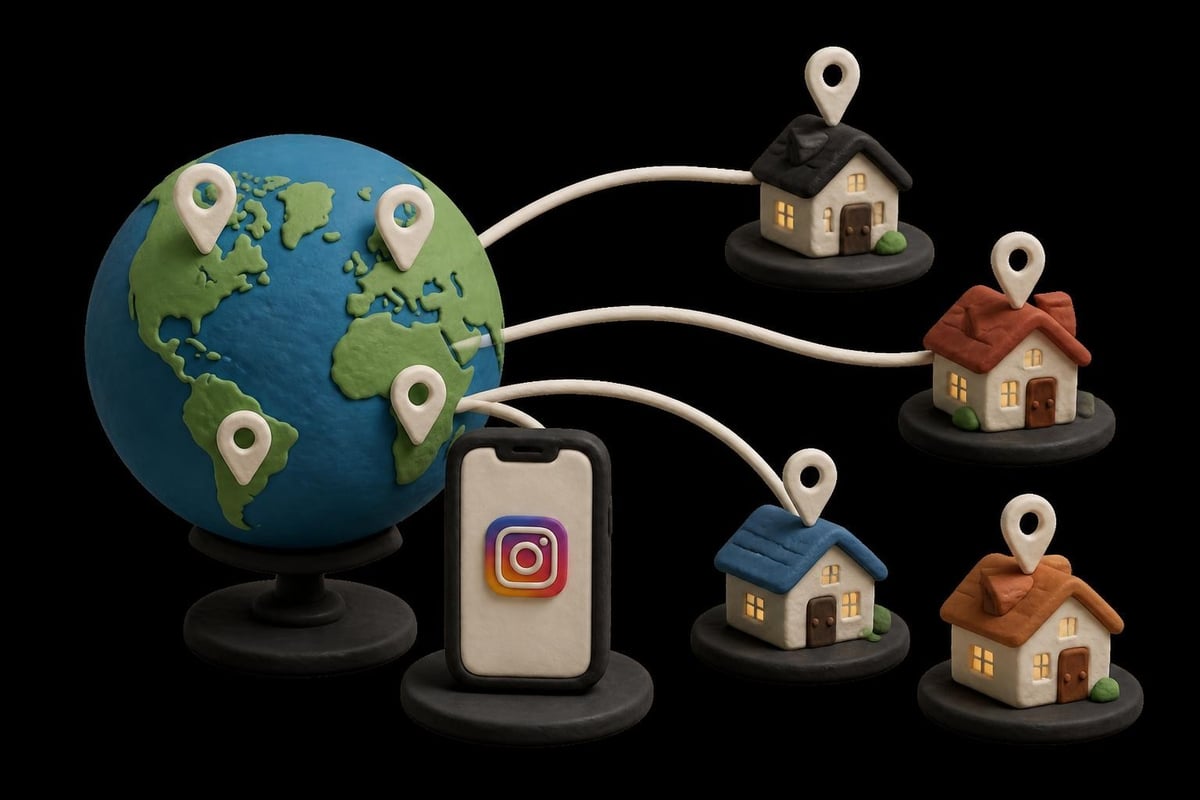
Geographic Targeting and IP Location
Instagram cross-references IP geolocation with account profile information. An account claiming to be in Miami but consistently accessing from London IPs raises red flags. Match your residential proxy location to:
- Account profile location (city/region level)
- Target audience geography for content relevance
- Posting time zones for authentic engagement patterns
- Local language and cultural context
Rate Limiting and Action Pacing
Even with perfect proxies, excessive actions trigger Instagram's rate limits. Platform algorithms analyze action velocity across multiple dimensions:
| Action Type | Conservative Limit | Aggressive Limit | Detection Signal |
|---|---|---|---|
| Follows/hour | 20-30 | 50-75 | Sudden spikes |
| Likes/hour | 50-100 | 150-200 | Pattern uniformity |
| Comments/hour | 10-20 | 30-50 | Generic messages |
| DMs/hour | 10-15 | 25-40 | Identical content |
| Stories viewed/hour | 100-200 | 300-500 | Sequential viewing |
Implement randomized delays between actions (15-45 seconds) and vary your activity patterns to simulate human behavior. Never maintain constant action intervals or predictable sequences.
Privacy, Security, and Compliance Considerations
The residential proxy industry has faced scrutiny over privacy concerns and potential misuse. Understanding the ethical and legal landscape is crucial for responsible use.
Legitimate vs. Problematic Proxy Sources
Not all residential proxy providers operate ethically. Some networks source IPs from compromised devices or use deceptive software installations. Security journalism from KrebsOnSecurity has extensively documented cases where residential proxy networks unknowingly enlisted home routers and IoT devices.
Ethical residential proxy providers ensure:
- Transparent user consent for IP sharing
- Fair compensation for bandwidth contributors
- Clear terms of service prohibiting illegal activity
- Compliance with data protection regulations
- Regular security audits and vulnerability assessments
Compliance with Instagram's Terms of Service
Instagram's Terms of Service explicitly prohibit certain automated activities. While using residential proxies for Instagram isn't inherently against the rules, the activities you perform through those proxies must comply with platform policies.
Permitted activities generally include:
- Managing multiple accounts you own or have authorization to access
- Scheduling posts through Instagram's official API
- Monitoring public metrics and engagement data
- Conducting market research on publicly available content
Prohibited activities include:
- Mass following/unfollowing to inflate metrics artificially
- Scraping private user data without consent
- Automated commenting or DMing for spam purposes
- Creating fake accounts or engagement
Recent investigations, including reporting on account compromise campaigns, demonstrate how residential proxies can be misused for malicious purposes, emphasizing the importance of legitimate use cases.
Advanced Fingerprinting and Detection Evasion
Modern bot detection extends far beyond IP analysis. Instagram and other platforms employ sophisticated fingerprinting techniques to identify automated tools regardless of proxy usage.
Browser Fingerprinting Components
Device fingerprinting combines dozens of data points to create unique browser signatures. Research on web fingerprinting risk assessment reveals the entropy available through JavaScript APIs, canvas rendering, and WebGL capabilities.
Key fingerprinting vectors include:
- Canvas and WebGL rendering signatures
- Audio context fingerprinting
- Screen resolution and color depth
- Installed fonts and system languages
- Timezone and geolocation API responses
- WebRTC local IP leaks
- Battery API and device sensors
- HTTP header order and TLS fingerprints
When using residential proxies for Instagram, pair them with proper fingerprint management. Tools should randomize or normalize these signals to prevent cross-session correlation.
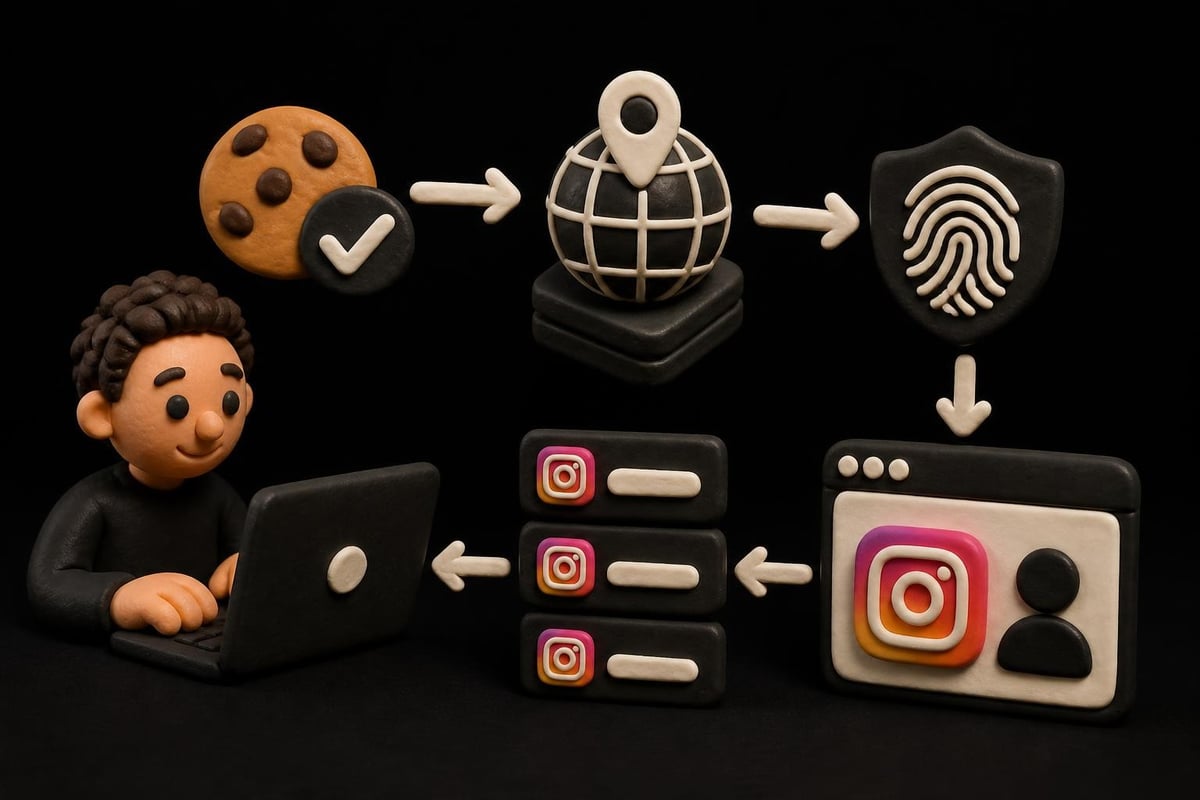
Session Management and Cookie Handling
Instagram tracks session integrity through cookies, local storage, and session tokens. Switching proxies mid-session while maintaining the same cookies creates inconsistencies that trigger security checks.
Proper session management requires:
- Isolated browser profiles per account with unique fingerprints
- Cookie persistence aligned with proxy assignments
- User-agent consistency throughout session lifecycle
- Gradual warmup periods for new accounts or IPs
- Session recreation protocols when changing proxies
Infrastructure Architecture for Instagram Automation
Building reliable Instagram automation infrastructure requires careful architectural planning. The goal is creating systems that scale while maintaining the appearance of organic, distributed activity.
Proxy Pool Design
Pool sizing depends on your operation scale. Calculate required residential IPs based on:
- Total Instagram accounts managed (1-3 accounts per IP recommended)
- Geographic distribution requirements across regions
- Backup IP availability for rotation scenarios
- Growth projections for the next 6-12 months
For example, managing 100 Instagram accounts across 10 geographic regions optimally requires 100-150 residential proxies with appropriate regional distribution.
Network Architecture Patterns
Effective automation systems typically implement one of these architectural patterns:
Distributed worker model: Multiple automation workers each with dedicated residential proxy assignments, coordinated through a central queue manager. This pattern provides fault isolation and scales horizontally.
Centralized gateway model: All Instagram traffic routes through a gateway layer that manages proxy assignment and rotation. Simpler to implement but creates a potential bottleneck.
Hybrid approach: Account clusters with regional gateways handling local proxy pools, coordinated by a global scheduler for cross-regional campaigns.
When implementing your architecture, consider integration with PinguProxy's API for programmatic proxy management and real-time pool monitoring.
Performance Optimization and Monitoring
Maintaining reliable residential proxies for Instagram requires continuous monitoring and optimization. Performance degrades over time as IPs accumulate usage history or get flagged by platform algorithms.
Key Performance Metrics
Track these metrics to identify issues before they impact operations:
- Success rate: Percentage of requests completing without blocks or captchas
- Response time: Latency from request to response completion
- Session survival: Average session duration before forced re-authentication
- Account health: Frequency of security challenges or action blocks
- IP reputation: Historical performance data per residential IP
| Metric | Excellent | Good | Poor | Action Required |
|---|---|---|---|---|
| Success Rate | >95% | 85-95% | <85% | Rotate problematic IPs |
| Avg. Response Time | <2s | 2-4s | >4s | Check proxy health |
| Daily Captcha Rate | <2% | 2-5% | >5% | Review fingerprints |
| Account Warnings | 0 | 1-2/month | >2/month | Reduce action velocity |
Troubleshooting Common Issues
Frequent captchas despite using residential proxies for Instagram often indicate fingerprinting mismatches rather than IP problems. Review browser fingerprint consistency and ensure user-agent alignment with the proxy's geographic region.
Session terminations may result from switching proxies mid-session or cookie/IP mismatches. Implement sticky sessions where the same account always uses the same IP for consistent login history.
Rate limit blocks suggest action velocity exceeding platform thresholds. Reduce automation speed, add randomized delays, and distribute actions across more time windows.
Proxy Protocol Selection and Configuration
Technical protocol choice impacts performance and compatibility with Instagram automation tools. Understanding protocol differences helps optimize your residential proxy implementation.
HTTP vs. SOCKS Proxies
HTTP proxies operate at the application layer, understanding HTTP-specific headers and methods. They provide easier debugging and can modify requests, but only work with HTTP/HTTPS traffic.
SOCKS proxies function at a lower network level, supporting any protocol including HTTP, HTTPS, FTP, and more. SOCKS host proxy configurations offer greater flexibility for complex automation scenarios.
For Instagram specifically:
- HTTP/HTTPS proxies work well for web-based automation
- SOCKS5 proxies provide better compatibility with mobile app emulation
- Both should support HTTPS CONNECT for secure Instagram API communication
IPv4 vs. IPv6 Considerations
While Instagram fully supports IPv6, residential proxy pools predominantly use IPv4 addresses due to greater availability. However, dual-stack support (both IPv4 and IPv6) provides advantages:
- Larger available IP pool for rotation
- Better geographic coverage in IPv6-enabled regions
- Future-proofing as IPv6 adoption increases
- Potential detection evasion through less-monitored IPv6 space
PinguProxy offers complete IPv4 and IPv6 protocol support, enabling flexible proxy selection based on specific requirements and target demographics.
Cost Analysis and ROI Calculation
Residential proxies for Instagram represent a significant operational expense. Understanding cost structures and calculating return on investment helps justify infrastructure spending.
Pricing Models Explained
Residential proxy providers typically offer these pricing structures:
- Pay-per-GB: Charge based on bandwidth consumption (common for scraping use cases)
- Pay-per-IP: Monthly fee per residential IP address (better for persistent accounts)
- Unlimited plans: Fixed monthly cost for unlimited bandwidth within IP pool
- Hybrid models: Base fee plus overage charges or tiered pricing
For Instagram account management, pay-per-IP or unlimited models generally provide better economics since bandwidth consumption remains relatively low compared to scraping applications.
Calculating Total Cost of Ownership
Beyond proxy subscription costs, factor in:
- Automation tool licenses and maintenance
- Development time for integration and monitoring
- Infrastructure costs (servers, databases, queue managers)
- Support and troubleshooting overhead
- Account replacement costs if proxies fail and accounts get banned
ROI calculation example: An agency managing 50 client Instagram accounts billing $500/month per client generates $25,000 monthly revenue. If residential proxy infrastructure costs $2,000/month and prevents account bans that would cost $10,000 in client churn, the ROI is clear: $8,000 net monthly benefit from proxy investment.
Future Trends and Platform Evolution
Instagram's detection capabilities continue evolving, requiring adaptation in residential proxy strategies. Understanding emerging trends helps future-proof your infrastructure.
Machine Learning Detection Advances
Platforms increasingly deploy machine learning models to classify residential proxy traffic, analyzing behavioral patterns that distinguish legitimate users from automated tools regardless of IP type. Future residential proxy usage will require:
- More sophisticated behavioral mimicry
- Longer warmup periods for new accounts
- Greater diversity in action patterns
- Integration with AI-driven automation tools
Platform API Evolution
Instagram may expand official API capabilities, potentially reducing the need for proxy-based workarounds for legitimate business use cases. Monitor Meta's developer documentation for new endpoints supporting multi-account management and analytics.
Regulatory Landscape Changes
Data protection regulations globally may impact residential proxy operations. The European Union's Digital Services Act and similar legislation could impose new requirements on proxy providers and users, particularly around transparency and consent.
Managing Instagram presence at scale in 2026 requires sophisticated infrastructure that balances automation efficiency with platform compliance and account security. Residential proxies provide the foundation for this balance, but success demands careful implementation, continuous monitoring, and ethical operation within Instagram's guidelines. PinguProxy delivers the high-speed residential proxy infrastructure you need with unlimited bandwidth, dual IPv4/IPv6 support, and 1ms rotation capabilities, backed by 24/7 support to keep your Instagram operations running smoothly. Whether managing client accounts, conducting market research, or scaling influencer campaigns, the right proxy partner makes the difference between sustainable growth and costly account restrictions.