
GeoSurf Proxies: Performance, Features & Alternatives
The proxy services market in 2026 continues to expand rapidly, driven by increasing demand for web scraping, ad verification, market research, and privacy-focused browsing. Among the established players, GeoSurf has positioned itself as a residential proxy provider emphasizing global coverage and location-based targeting. Understanding what geosurf proxies offer, how they perform, and where they fit in the competitive landscape helps businesses make informed decisions about their proxy infrastructure needs.
GeoSurf operates a residential proxy network built on partnerships with ISPs and device owners, providing access to genuine residential IP addresses across numerous countries and cities. This approach differs fundamentally from datacenter proxies, which originate from cloud hosting providers and are more easily identified and blocked by sophisticated anti-bot systems.
Understanding GeoSurf's Residential Network Architecture
GeoSurf proxies function as intermediaries that route your requests through residential IP addresses associated with real internet service providers. When you connect through a GeoSurf proxy, your traffic appears to originate from a home internet connection rather than a commercial datacenter. This residential origin provides several advantages for tasks requiring high trust scores and low detection rates.
The network topology relies on exit nodes distributed globally, with GeoSurf claiming coverage in over 130 countries and thousands of cities. Each request can be routed through a specific geographic location, allowing precise targeting for location-sensitive applications like ad verification, price comparison, and market research.
Geographic Targeting Capabilities
Location targeting represents one of the primary differentiators for geosurf proxies. The service allows filtering by:
- Country-level targeting: Access IPs from specific nations
- City-level precision: Target metropolitan areas for localized testing
- State/region selection: Narrow down to specific administrative regions
- ASN targeting: Route through particular internet service providers
However, research on IP geolocation accuracy reveals important limitations. According to IEEE studies on geolocation database accuracy, commercial geolocation services can exhibit significant error rates, particularly for residential IPs. These discrepancies mean that a proxy labeled as originating from a specific city might be geolocated differently by target websites, affecting use cases requiring precise location matching.

Performance Benchmarks and Speed Characteristics
Speed performance varies considerably across residential proxy providers, and geosurf proxies demonstrate both strengths and limitations compared to datacenter alternatives. Residential networks inherently face bandwidth constraints tied to home internet connections, which typically offer lower uplink speeds than commercial hosting infrastructure.
| Performance Metric | GeoSurf Residential | Typical Datacenter | Impact on Use Cases |
|---|---|---|---|
| Connection Speed | 5-50 Mbps | 100-1000 Mbps | Scraping speed, data collection |
| Latency | 100-500ms | 10-50ms | Real-time applications, API calls |
| Success Rate | 85-95% | 70-85% | Bot detection, complex sites |
| IP Pool Size | Millions | Thousands | Rotation, avoiding blocks |
The trade-off becomes clear: datacenter proxies from providers like PinguProxy deliver superior raw speed with 10Gbps bandwidth capabilities, while residential networks prioritize trust and authenticity over throughput. Your specific use case determines which characteristics matter most.
Connection Reliability and Uptime
Residential proxy stability differs from datacenter reliability. Since geosurf proxies route through devices connected to consumer ISPs, connection availability fluctuates based on:
- Device online/offline status
- Home network interruptions
- ISP maintenance windows
- Geographic demand vs. supply
This variability means connection retry logic becomes essential. Applications using residential proxies should implement robust error handling and automatic fallback mechanisms to maintain operational continuity when individual exit nodes become unavailable.
Pricing Structure and Cost Considerations
GeoSurf employs a bandwidth-based pricing model common among residential proxy providers. Unlike unlimited plans offered by some datacenter services, residential networks typically charge based on data transfer volume measured in gigabytes. As of 2026, GeoSurf's pricing tiers include:
- Starter plans: Beginning around $300-500 for 10GB monthly
- Professional tiers: Mid-range options at $1,000-2,000 for 50-100GB
- Enterprise packages: Custom pricing for high-volume users exceeding 500GB
These costs significantly exceed datacenter proxy pricing, where unlimited bandwidth plans often start under $100 monthly. The premium reflects the operational complexity of maintaining residential networks and compensating device owners or ISP partners.
Total Cost of Ownership Calculation
When evaluating geosurf proxies against alternatives, consider bandwidth efficiency:
- Web scraping: 1GB typically covers 10,000-50,000 page requests depending on page size
- Ad verification: Lighter bandwidth usage, potentially 50-100 checks per MB
- Streaming/media: Heavy consumption, potentially 1-5GB per hour of video content
Calculate your expected monthly data transfer to determine whether residential pricing justifies the benefits over cheaper datacenter alternatives. For many applications, a USA rotating proxy with datacenter infrastructure provides sufficient capability at a fraction of the cost.
Technical Integration and API Functionality
GeoSurf provides multiple authentication methods and proxy protocols to accommodate different technical environments. The service supports HTTP/HTTPS proxies with username/password authentication, allowing straightforward integration with most scraping frameworks and automation tools. Understanding HTTP proxy behavior at the protocol level helps developers optimize their implementation for reliability and performance.
Supported Protocols and Features
Authentication methods:
- Username/password per request
- Session persistence controls
- IP whitelist authorization options
Protocol support:
- HTTP/HTTPS proxies (primary)
- SOCKS5 available on certain plans
- IPv4 addressing (IPv6 support limited)
The lack of comprehensive IPv6 support represents a limitation as the internet continues transitioning toward IPv6 adoption. Services offering full IPv4 and IPv6 protocol support provide future-proof infrastructure for evolving network requirements.
Session Management and IP Rotation
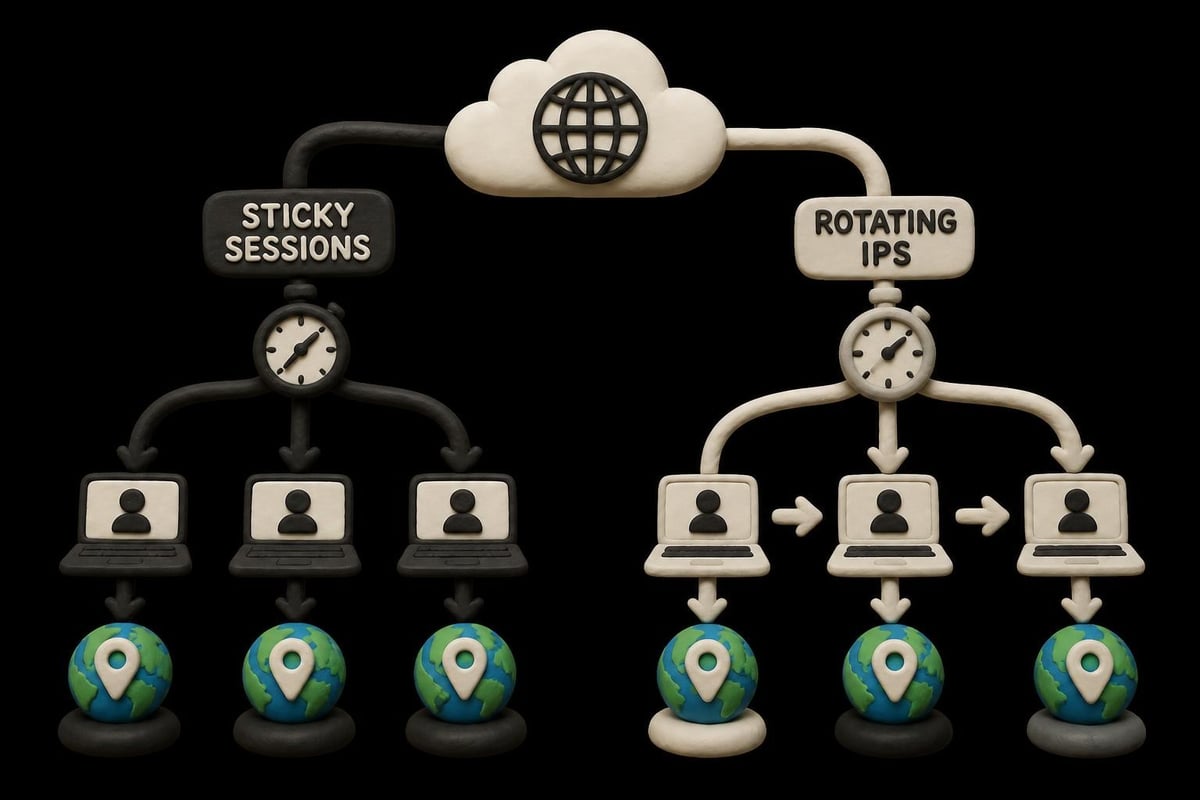
GeoSurf proxies offer two primary session modes that determine how IP addresses are assigned across requests:
Sticky sessions maintain the same exit IP for a defined duration (typically 1-30 minutes), enabling multi-step workflows like login sequences, shopping cart operations, or multi-page scraping tasks requiring consistent identity. Session persistence helps avoid triggering security measures that flag rapid IP changes as suspicious behavior.
Rotating sessions assign a new residential IP for each request or connection, maximizing anonymity and reducing the chance of rate limiting or IP-based blocking. This approach works well for large-scale data collection where each request stands independently.
The rotation speed of 1ms offered by some modern proxy services provides instantaneous IP changes, whereas GeoSurf's rotation occurs at the connection level with new IPs assigned when sessions expire or connections reset.
Privacy, Security, and Compliance Concerns
Using residential proxy networks raises important privacy and security considerations that businesses must address. Research examining residential proxy networks at scale reveals potential risks including data leakage, lack of transparency about IP sources, and ethical questions about how exit node devices are recruited and compensated.
Data Handling and Logging Policies
GeoSurf's terms indicate they collect connection metadata for billing, troubleshooting, and network optimization. Understanding what data gets logged matters for compliance with privacy regulations:
- Connection timestamps and durations
- Bandwidth consumption per session
- Target URLs (may be logged for troubleshooting)
- User account associations
For applications requiring strict zero-log policies, providers explicitly offering zero-log proxy services with documented data retention policies provide stronger privacy guarantees.
Legal and Ethical Considerations
The legality of web scraping through proxies depends on multiple factors analyzed in detail in legal scholarship on web scraping. Key considerations include:
- Compliance with website terms of service
- Respect for robots.txt directives
- Avoiding computer fraud and abuse violations
- Data protection and privacy law adherence
Organizations should implement compliance frameworks that govern proxy usage, regardless of provider, ensuring scraping activities remain within legal boundaries and respect website owner rights.
Fingerprinting Resistance and Detection Risks
Even when using geosurf proxies to mask IP addresses, sophisticated fingerprinting techniques can identify proxy usage through browser characteristics, WebRTC leaks, and behavioral patterns. Google Research on web fingerprinting risk assessment demonstrates how browser signals combine to create unique identities despite IP rotation.
Recent studies on fingerprinting from encrypted communications reveal that network-level metadata can expose proxy usage even when application data remains encrypted. This means that relying solely on IP rotation provides incomplete protection against advanced detection systems.

Mitigation Strategies
To minimize detection when using residential proxies:
- Rotate user agents in coordination with IP changes to avoid mismatched signals
- Implement realistic request pacing that mimics human browsing patterns
- Respect rate limits even when technically capable of faster scraping
- Use browser automation tools that manage fingerprint consistency
- Monitor for blocks and adjust targeting or behavior when detection occurs
Organizations concerned about proxy detection can reference SANS guidance on detecting anonymous proxy usage to understand what security teams look for, then architect their usage patterns to avoid triggering these indicators.
Comparing GeoSurf to Alternative Solutions
The proxy services market in 2026 offers numerous alternatives to geosurf proxies, each with distinct advantages for specific use cases. Decision factors include budget constraints, performance requirements, geographic coverage needs, and the sophistication of target anti-bot systems.
| Provider Type | Speed | Cost | Detection Resistance | Best For |
|---|---|---|---|---|
| GeoSurf | Medium | High | High | Ad verification, market research |
| Datacenter | Very High | Low | Medium | High-volume scraping, APIs |
| Mobile Proxies | Low-Medium | Very High | Very High | Social media, mobile apps |
| Free Proxies | Variable | Free | Very Low | Testing only (not production) |
While free web proxies exist, they present significant security and reliability risks unsuitable for business applications. Datacenter proxies from reputable providers deliver exceptional speed and stability when target sites don't employ aggressive residential IP verification.
Use Case Alignment
Choose residential proxies like GeoSurf when:
- Target sites block datacenter IP ranges aggressively
- Location authenticity verification is critical
- Success rate matters more than raw speed
- Budget accommodates premium pricing
Choose datacenter proxies when:
- Speed and bandwidth are primary requirements
- Target sites accept datacenter traffic
- Cost efficiency drives infrastructure decisions
- Scraping public data from cooperative sources
Enterprise Features and Support Infrastructure
GeoSurf positions itself as an enterprise solution, offering dedicated account management, custom integrations, and service level agreements for high-volume customers. These enterprise features include:
- Dedicated IP pools: Reserved IPs for exclusive client use
- Custom integrations: API development and technical consultation
- Priority support: Faster response times and dedicated channels
- Volume discounts: Reduced per-GB pricing at scale
The quality of technical support significantly impacts operational efficiency, particularly when troubleshooting connection issues or optimizing for specific use cases. Services offering 24/7 customer support ensure assistance availability across global time zones and during critical operational periods.
Network Security and Access Control
Modern network security frameworks increasingly scrutinize proxy traffic as a potential security risk. CISA guidance on network access security highlights concerns about unauthorized proxy usage and recommends detection mechanisms for enterprise environments.
Organizations using geosurf proxies for legitimate purposes should:
- Document proxy usage in security policies
- Implement access controls limiting who can configure proxy settings
- Monitor outbound proxy connections for anomalies
- Maintain audit trails of proxy-based activities
- Coordinate with security teams to whitelist necessary proxy infrastructure
IP Reputation Management
Residential proxy IP addresses carry varied reputation scores based on previous usage. Since these IPs are shared across multiple customers over time, one user's aggressive scraping or malicious activity can degrade the reputation of IPs later assigned to other customers. This shared reputation risk means:
- Some residential IPs arrive pre-blocked by security services
- Reputation varies widely across the pool
- Success rates fluctuate based on IP assignment
- Consistent monitoring helps identify problematic ranges
Selecting the right proxy infrastructure requires balancing performance, cost, detection resistance, and specific use case requirements against the capabilities different providers offer. Whether geosurf proxies align with your needs depends on your target websites, budget, and technical requirements. If you need high-speed infrastructure with IPv4 and IPv6 support, unlimited bandwidth, and robust privacy protections through zero-log policies and 1ms rotation, PinguProxy delivers enterprise-grade proxy services optimized for web scraping, gaming, and global content access with 24/7 support backing your operations.