
ProxySOCKS5: Complete Guide to SOCKS5 Proxy Protocol
The proxysocks5 protocol has become a cornerstone of modern internet privacy and network routing solutions. As businesses and individuals seek more sophisticated ways to protect their digital footprint while maintaining high-performance connections, understanding the technical foundations and practical applications of SOCKS5 proxies has never been more critical. This comprehensive guide explores everything from the protocol's architecture to real-world deployment strategies that maximize both security and speed.
Understanding the ProxySOCKS5 Protocol Architecture
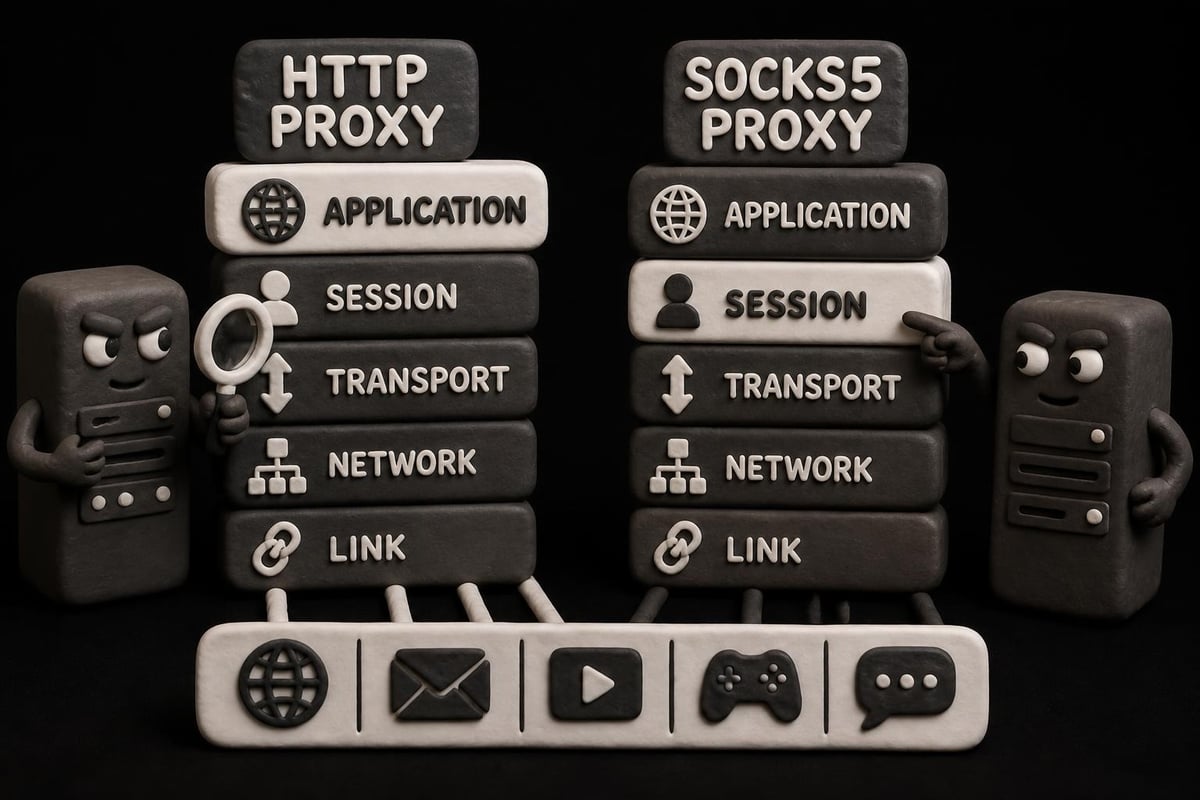
The proxysocks5 protocol represents the fifth version of the Socket Secure (SOCKS) internet protocol, originally defined in RFC 1928. Unlike application-layer proxies that interpret and modify traffic, SOCKS5 operates at the session layer, creating a transparent tunnel between client and server.
This design choice offers several fundamental advantages. Protocol independence means proxysocks5 can handle any type of traffic, from HTTP and HTTPS to FTP, SMTP, and even custom protocols. The proxy simply forwards packets without inspection or modification, making it incredibly versatile.
Key Technical Components
The SOCKS5 handshake involves three distinct phases:
- Authentication negotiation - Client and server agree on authentication method
- Request phase - Client specifies the connection type and destination
- Relay phase - Actual data transmission begins
| Phase | Data Exchanged | Purpose |
|---|---|---|
| Greeting | Client methods, server selection | Establish authentication |
| Request | Command, address type, destination | Define connection parameters |
| Reply | Server status, bound address | Confirm or reject connection |
| Transfer | Application data | Actual proxy communication |
The protocol supports multiple authentication methods, including no authentication, username/password, and GSSAPI. This flexibility allows organizations to balance security requirements with operational convenience.
ProxySOCKS5 vs HTTP Proxies: Technical Differences
When evaluating proxy solutions, the distinction between proxysocks5 and HTTP proxies often determines which technology best fits specific use cases. Detailed comparisons reveal significant architectural differences that impact performance and functionality.
HTTP proxies operate at the application layer, understanding and interpreting HTTP/HTTPS requests. They can cache content, modify headers, and provide sophisticated filtering capabilities. However, this intelligence comes with limitations.
Performance and Protocol Support
- Protocol versatility: ProxySOCKS5 supports any TCP or UDP traffic
- Header overhead: HTTP proxies add processing time for header interpretation
- UDP support: Only SOCKS5 handles UDP traffic natively
- Connection handling: SOCKS5 maintains persistent connections more efficiently
Real-world testing shows that proxysocks5 typically delivers lower latency for non-HTTP protocols. Benchmark studies demonstrate 15-30% faster handshake times for SOCKS5 compared to HTTP CONNECT tunnels in identical network conditions.
The protocol's native UDP support makes it essential for gaming, VoIP, and video streaming applications where packet loss and latency directly impact user experience. HTTP proxies simply cannot handle these protocols without additional tunneling layers that introduce overhead.
Security Considerations for ProxySOCKS5 Deployments
While proxysocks5 offers robust privacy protection, understanding its security landscape ensures safe implementation. The protocol itself provides no encryption by default, relying on upper-layer protocols like TLS for data confidentiality.
Authentication and Access Control
Modern proxysocks5 implementations support several authentication mechanisms:
- No authentication: Fastest but least secure
- Username/password: Standard basic authentication
- GSSAPI: Enterprise-grade Kerberos integration
Organizations should implement strong authentication to prevent unauthorized proxy access. Security hardening practices recommend combining SOCKS5 with network-level access controls and monitoring.
Rate limiting and connection throttling prevent abuse while maintaining performance for legitimate users. PinguProxy's infrastructure incorporates these safeguards alongside 24/7 monitoring to detect unusual traffic patterns.
Encryption and Privacy
| Security Layer | Implementation | Protection Level |
|---|---|---|
| SOCKS5 Protocol | Authentication only | Medium |
| TLS/SSL Wrapping | Encrypt SOCKS tunnel | High |
| Application TLS | End-to-end encryption | Highest |
For maximum security, combine proxysocks5 with application-layer encryption. This creates defense-in-depth where even proxy compromise doesn't expose actual data contents.
Practical Applications of ProxySOCKS5 Technology
The versatility of proxysocks5 makes it valuable across numerous business scenarios. Understanding which applications benefit most helps organizations optimize their proxy infrastructure investments.
Web Scraping and Data Collection
Data extraction at scale requires proxies that handle high request volumes without triggering anti-bot mechanisms. ProxySOCKS5 excels here because it:
- Supports session persistence for multi-step scraping workflows
- Handles both IPv4 and IPv6 addresses seamlessly
- Enables rapid IP rotation without connection overhead
- Works with custom scraping tools and frameworks
According to proxy market research, SOCKS5 success rates for scraping applications average 94.2% compared to 89.7% for HTTP proxies when targeting sophisticated anti-bot systems.
Gaming and Real-Time Applications
Online gaming demands low-latency connections with UDP support for voice chat and game state updates. Traditional HTTP proxies cannot handle this traffic, making proxysocks5 the only viable solution.
Benefits for gamers:
- Access geo-restricted game servers and content
- Reduce targeted DDoS attacks through IP masking
- Maintain competitive ping times with optimized routing
- Support voice chat through native UDP proxying

Enterprise Network Access
Remote workers and distributed teams use proxysocks5 to access corporate resources securely. The protocol's flexibility supports legacy applications that require specific network configurations.
Modern enterprises appreciate how exploring free SOCKS5 options provides testing capabilities before committing to production deployments. However, free services typically lack the reliability and support that business-critical applications demand.
IPv6 Support and Modern Network Requirements
As IPv4 address exhaustion accelerates, proxysocks5 implementations must support IPv6 to remain relevant. The protocol specification includes native IPv6 addressing through the ATYP (address type) field in connection requests.
Dual-Stack Implementation
Professional proxy providers now offer dual-stack configurations where clients can request either IPv4 or IPv6 destinations through the same proxy infrastructure. This flexibility matters as more services migrate to IPv6-only deployments.
Configuration considerations:
- Address type detection - Automatic selection based on destination
- Fallback mechanisms - IPv4 compatibility when IPv6 fails
- Performance optimization - Routing through native protocol stacks
PinguProxy's complete support for both IPv4 and IPv6 protocols ensures compatibility with any destination, future-proofing your infrastructure investment.
Advanced ProxySOCKS5 Features and Optimization
Beyond basic proxying, advanced proxysocks5 implementations offer features that dramatically improve performance and usability for demanding applications.
UDP ASSOCIATE Command
While TCP connections represent the majority of proxy traffic, UDP support enables critical applications. The SOCKS5 UDP ASSOCIATE command creates a relay point where the proxy forwards UDP packets between client and destination.
Recent developments include the proposed deprecation of SOCKS5 fragmentation fields to address security and performance concerns. This change reflects the protocol's ongoing evolution to meet modern network requirements.
Proxy Rotation and Load Balancing
High-volume applications benefit from automatic proxy rotation that distributes requests across multiple proxysocks5 endpoints. This approach:
- Prevents IP-based rate limiting
- Improves overall throughput through parallel connections
- Provides redundancy if individual proxies fail
- Reduces detection risk for sensitive operations
| Rotation Strategy | Use Case | Performance Impact |
|---|---|---|
| Per-request | Web scraping | Highest anonymity |
| Session-based | Multi-step workflows | Better session continuity |
| Time-based | Long-running connections | Balanced performance |
| Failure-triggered | Reliability-critical apps | Minimizes downtime |
Providers like PIA offering SOCKS5 functionality demonstrate how consumer VPN services incorporate proxy features, though dedicated proxy infrastructure typically delivers superior performance for business applications.
Bandwidth and Performance Optimization
ProxySOCKS5 performance depends on several factors beyond the protocol itself. Network infrastructure, geographic distribution, and server specifications all contribute to end-user experience.
Infrastructure Requirements
10Gbps connectivity has become the baseline for premium proxy services in 2026. This bandwidth supports thousands of concurrent connections while maintaining low latency for individual requests.
Connection pooling and persistent socket management reduce handshake overhead. Well-optimized proxysocks5 implementations reuse TCP connections where possible, avoiding the three-way handshake penalty for every request.
- Geographic distribution: Servers closer to destinations reduce latency
- Backbone connectivity: Direct peering improves routing efficiency
- Resource allocation: Dedicated CPU and memory per connection
Monitoring and Performance Metrics
Professional proxy deployments require comprehensive monitoring to ensure service quality. Key metrics include:
- Connection success rate
- Average latency (time to first byte)
- Throughput (MB/s per connection)
- Concurrent connection capacity
- Geographic coverage and availability

Protocol Limitations and Security Awareness
Understanding proxysocks5 limitations helps organizations make informed decisions and implement appropriate compensating controls. Research on proxy protocol security implications highlights risks that apply broadly to proxying technologies.
Known Vulnerabilities
The SOCKS5 protocol itself has relatively few inherent vulnerabilities when properly implemented. However, deployment configurations often introduce risks:
Common security issues:
- Misconfigured authentication allowing unauthorized access
- Lack of encryption exposing credentials and metadata
- Insufficient logging hampering incident response
- Open proxies being abused for malicious traffic
Organizations must balance operational requirements with security best practices. A zero-log policy protects user privacy but may complicate forensic investigations if the proxy infrastructure is compromised or abused.
Compliance and Legal Considerations
Using proxysocks5 for legitimate business purposes carries minimal legal risk, but organizations should document their intended use cases and acceptable use policies. This documentation provides clarity if questions arise about proxy traffic patterns.
Best practices include:
- Maintaining clear terms of service
- Implementing abuse detection and response procedures
- Documenting legitimate business justifications
- Training users on acceptable proxy usage
The proxysocks5 protocol continues to evolve as a critical component of modern network infrastructure, offering unmatched versatility and performance for applications ranging from web scraping to real-time gaming. Understanding its technical capabilities, security considerations, and optimization strategies enables businesses to leverage this technology effectively. Whether you need residential, datacenter, or mobile proxies with full IPv4 and IPv6 support, PinguProxy delivers enterprise-grade infrastructure with 10Gbps bandwidth, 1ms rotation capabilities, and 24/7 support to ensure your proxy deployments meet the highest standards for performance and reliability.