
Residential IP Address: Complete Guide for 2026
A residential IP address represents the digital identity assigned by internet service providers to home users and residential locations. Unlike datacenter IPs that originate from cloud servers and hosting facilities, these addresses come from real consumer internet connections, making them appear indistinguishable from typical household traffic. Understanding the technical infrastructure and practical applications of residential IP addresses has become essential for businesses conducting web scraping, market research, and global content access in 2026.
What Makes a Residential IP Address Unique
A residential IP address is assigned by an ISP to a physical home location, creating a direct relationship between the internet connection and a verifiable street address. This geographic authenticity makes these addresses fundamentally different from their datacenter counterparts.
The allocation process follows strict guidelines established by regional internet registries. ARIN's Number Resource Policy Manual governs how address space is distributed to ISPs, who then reassign blocks to end users. This chain of custody creates a traceable lineage that websites use to verify traffic legitimacy.
Technical Assignment Methods
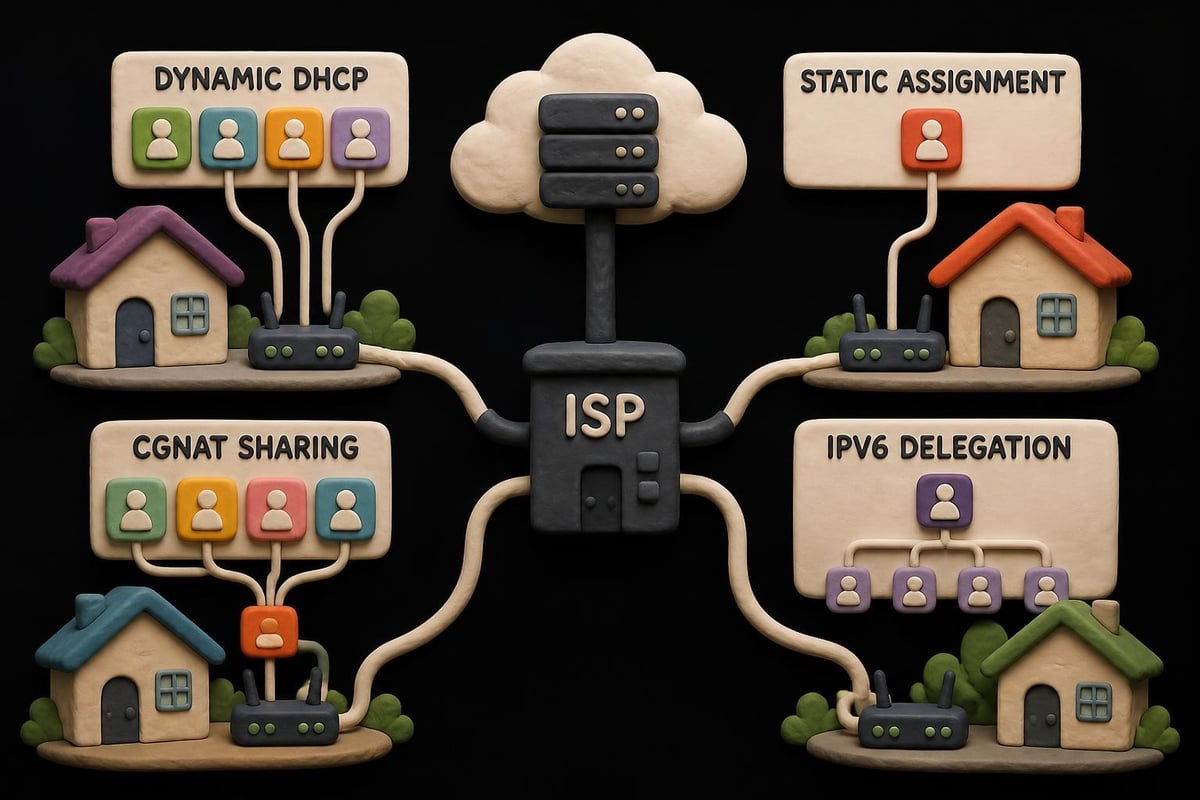
ISPs employ several mechanisms to distribute addresses to residential customers:
- Dynamic assignment through DHCP, rotating addresses periodically
- Static allocation for customers requiring consistent IPs
- Carrier-Grade NAT (CGNAT) sharing addresses among multiple households
- IPv6 delegation providing entire address blocks to single homes
The Shared Address Space defined in RFC 6598 allows ISPs to use CGNAT when IPv4 addresses become scarce. This technique means multiple households can share a single public-facing residential IP address, complicating attribution and reputation tracking.
Residential vs. Datacenter IP Infrastructure
The infrastructure supporting residential IP addresses differs substantially from datacenter environments in ways that affect performance, detection, and use cases.
| Feature | Residential IP | Datacenter IP |
|---|---|---|
| Origin | Home ISP connection | Cloud/hosting provider |
| Speed | Varies by consumer plan | Consistently high (10Gbps+) |
| Geographic accuracy | Precise street-level | City or region level |
| Rotation frequency | ISP-controlled | User-controlled (1ms capable) |
| Cost per IP | Higher | Lower |
| Detection rate | Very low | Moderate to high |
Residential addresses carry inherent trust because they represent actual consumer behavior. Websites struggle to distinguish legitimate proxy traffic from genuine home users when the IP originates from a residential ISP block.
Detection Challenges and Solutions
Modern anti-bot systems employ sophisticated methods to identify proxy traffic. Cloudflare's machine learning approach to residential proxy detection analyzes behavioral patterns rather than relying solely on IP reputation. Their research shows that even residential IP addresses can be flagged when traffic patterns deviate from typical consumer behavior.
Services like PinguProxy address these challenges by maintaining diverse residential pools and implementing smart rotation strategies that mimic natural user behavior. The 1ms proxy rotation capability allows businesses to distribute requests across thousands of addresses, avoiding the concentrated traffic patterns that trigger detection systems.
IPv4 and IPv6 in Residential Networks
The transition from IPv4 to IPv6 fundamentally changes how residential IP addresses function and what security implications they carry for home networks.
IPv4 scarcity forces most residential users behind NAT, sharing public addresses with neighbors through CGNAT implementations. This sharing creates challenges for services requiring unique address identification. Cloudflare's research on detecting CGNAT demonstrates how shared addresses affect reputation systems and why innocent users sometimes face blocks due to neighbor activity.
IPv6 Adoption Impact
IPv6 provides abundant address space, allowing ISPs to assign entire /56 or /64 blocks to individual households. The RFC 9526 experimental standard on residential network naming explores how home networks can publish DNS names for their IPv6 addresses, creating new possibilities for device identification.
Recent security research on residential IPv6 transitions reveals privacy concerns:
- Reduced NAT protection exposes internal devices
- Persistent IPv6 addresses enable long-term tracking
- Misconfigured firewalls allow unwanted inbound connections
- IPv6 fragmentation bypasses some security controls
Both protocols matter for comprehensive proxy coverage. Businesses requiring global reach need access to mixed IPv4 and IPv6 residential pools, since different regions and services support different protocols. PinguProxy's complete support for both IPv4 and IPv6 ensures compatibility across all target platforms.
Legitimate Use Cases for Residential Proxies
Organizations leverage residential IP addresses for numerous legitimate business purposes that require authentic geographic presence and reduced detection rates.
Web Scraping and Data Collection
Market intelligence relies on accurate, unblocked data extraction. E-commerce businesses monitor competitor pricing, airlines track fare changes, and SEO professionals analyze search rankings across locations. Residential addresses bypass the aggressive rate limiting that datacenter IPs encounter.
For social media monitoring, residential proxies for Instagram enable brands to gather engagement metrics, track influencer content, and analyze campaign performance without triggering account restrictions or IP bans.
Ad Verification and Brand Protection
Advertising networks use residential IP addresses to verify ad placement, detect click fraud, and ensure campaigns display correctly across regions. Geographic authenticity proves essential because ad networks specifically filter datacenter traffic to prevent manipulation.
Brand protection teams monitor unauthorized resellers, trademark violations, and counterfeit products on marketplaces worldwide. Residential addresses allow continuous monitoring without alerting bad actors to enforcement activity.
Content Access and Localization Testing
Companies test how their services appear to users in different markets. Streaming platforms verify content availability, e-commerce sites check regional pricing, and software developers test geo-restricted features. Residential IP addresses provide the most accurate representation of actual user experience.

The Residential Proxy Ecosystem
The market for residential proxy services has evolved into a complex ecosystem with varying acquisition methods, ethical considerations, and quality tiers.
How Residential Pools Are Built
Proxy providers assemble residential IP pools through several channels:
- Peer-to-peer networks where users share bandwidth
- ISP partnerships for direct residential access
- SDK integration in mobile applications
- Browser extensions that route traffic through users
Research measuring user-installed residential proxy applications from a network operator's perspective reveals the traffic characteristics and scale of these networks. The study shows how applications installed on consumer devices create massive proxy pools without users fully understanding the implications.
Transparency varies dramatically across providers. Some services clearly disclose their collection methods and compensate users fairly, while others embed proxy functionality in unrelated applications. The hCaptcha report analyzing residential proxy networks examines the spectrum from legitimate services to those enabling fraud.
Security and Abuse Concerns
The same characteristics that make residential IP addresses valuable for legitimate purposes also attract malicious actors. HUMAN Security's threat research on PROXYLIB details how mobile devices are transformed into proxy nodes without user knowledge, creating networks used for credential stuffing, web scraping, and ad fraud.
| Risk Category | Description | Mitigation |
|---|---|---|
| Credential stuffing | Testing stolen passwords | Rate limiting, behavioral analysis |
| Click fraud | Simulating ad clicks | Traffic pattern detection |
| Account creation abuse | Mass fake registrations | Device fingerprinting |
| Scraper bots | Unauthorized data extraction | Challenge systems, CAPTCHAs |
Reputable providers implement strict acceptable use policies and monitoring systems to prevent abuse. PinguProxy's zero-log policy protects user privacy while maintaining abuse prevention through real-time traffic analysis that identifies suspicious patterns.
Technical Implementation Considerations
Successfully integrating residential IP addresses into business workflows requires understanding protocol options, rotation strategies, and performance optimization.
Protocol Selection
The SOCKS protocol offers advantages for residential proxy connections, supporting both TCP and UDP traffic with full authentication capabilities. SOCKS5 specifically provides:
- Enhanced security through username/password authentication
- Protocol flexibility supporting HTTP, HTTPS, FTP, and custom applications
- UDP support essential for certain scraping and gaming scenarios
- IPv6 compatibility for modern addressing requirements
HTTP/HTTPS proxies remain popular for web-focused applications due to easier configuration and built-in header manipulation, though they offer less protocol versatility than SOCKS implementations.
Rotation and Session Management
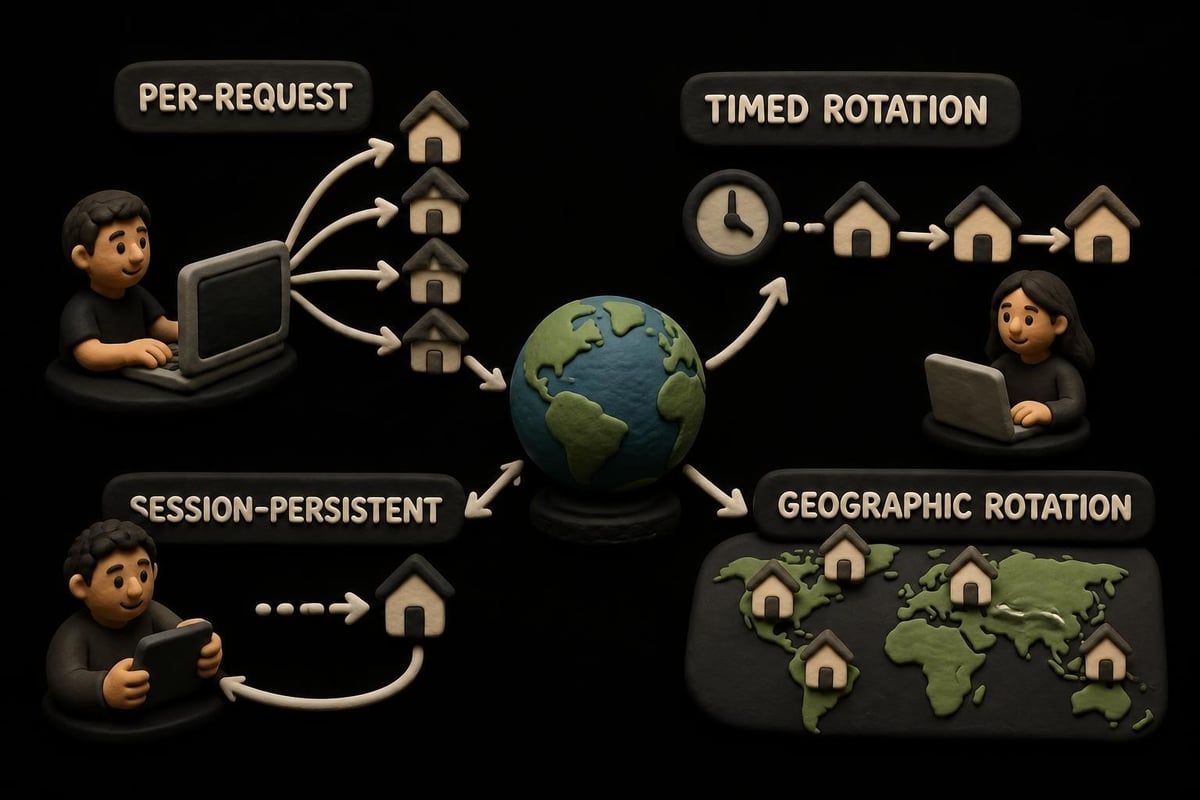
Strategic rotation prevents detection while maintaining session consistency when needed. Different use cases require different approaches:
- Per-request rotation: New IP for every connection (web scraping)
- Timed rotation: Change IP every N minutes (monitoring)
- Session persistence: Maintain same IP during user session (account management)
- Geographic rotation: Cycle through specific locations (localization testing)
High-frequency rotation capabilities, like PinguProxy's 1ms rotation, allow businesses to distribute requests across thousands of addresses instantly. The API reference for listing available proxies shows how programmatic access enables sophisticated rotation logic tailored to specific requirements.
Performance and Reliability Factors
Not all residential IP addresses deliver equivalent performance. Understanding the factors affecting speed, availability, and reliability helps businesses select appropriate proxy solutions.
Bandwidth and Speed Variables
Residential connections vary from basic DSL to gigabit fiber, creating inconsistent performance across different addresses in a pool. Average speeds depend on the provider's infrastructure quality and the underlying residential connections they access.
Key performance metrics to evaluate:
- Response time: Latency from proxy server to target
- Bandwidth capacity: Maximum throughput per connection
- Concurrent connections: Simultaneous requests supported
- Uptime percentage: Availability over time periods
Premium providers maintain dedicated infrastructure that aggregates residential connections while adding high-capacity backbone links. PinguProxy's 10Gbps bandwidth ensures that even residential traffic routes through high-speed infrastructure, minimizing the performance gap between residential and datacenter options.
Geographic Coverage and Targeting
Precise location targeting requires extensive residential presence. Businesses need city-level or even ISP-level precision for certain applications like local search monitoring or regional content verification.
A comprehensive residential network should provide:
- Broad country coverage (100+ countries)
- City-level targeting in major markets
- ISP-specific options for carrier testing
- State/province granularity for regional campaigns
The installation documentation demonstrates how to configure location targeting through API parameters, enabling businesses to route traffic through specific geographic regions as needed.
Compliance and Ethical Considerations
Using residential IP addresses responsibly requires attention to legal frameworks, privacy regulations, and ethical sourcing practices.
Legal Framework and Terms of Service
Websites' terms of service often explicitly prohibit automated access, regardless of IP type used. Businesses must evaluate whether their use cases comply with target site policies and applicable laws like the Computer Fraud and Abuse Act (CFAA) in the United States.
Responsible practices include:
- Respecting robots.txt directives
- Implementing reasonable rate limiting
- Avoiding authentication bypass attempts
- Honoring opt-out requests
ISP reassignment documentation shows how address blocks are tracked and assigned, creating audit trails that can identify proxy traffic origins during investigations. This transparency underscores the importance of legitimate use cases and proper authorization.
Privacy and Consent Issues
The ethical acquisition of residential IP addresses depends on informed consent from the actual users sharing their connections. Users should clearly understand that their internet connection routes third-party traffic and receives fair compensation for bandwidth sharing.
Red flags indicating potentially unethical providers:
- Vague explanations of how IPs are obtained
- Extremely low pricing suggesting compromised sources
- Inability to specify geographic sourcing methods
- Absence of user compensation models
Transparent providers disclose their peer-to-peer networks, application partnerships, or ISP relationships openly, allowing customers to make informed decisions about the services they purchase.
Selecting a Residential Proxy Provider
The residential proxy market includes dozens of providers with varying quality levels, pricing structures, and capabilities. Evaluating options requires examining technical specifications, support quality, and business alignment.
Critical Evaluation Criteria
| Criteria | Why It Matters | What to Look For |
|---|---|---|
| Pool size | Diversity and availability | Millions of IPs, regular rotation |
| Geographic coverage | Target market access | Specific countries/cities needed |
| Protocol support | Technical compatibility | HTTP, SOCKS5, IPv4/IPv6 |
| Rotation capabilities | Detection avoidance | Sub-second rotation options |
| Support quality | Problem resolution | 24/7 availability, technical expertise |
| Pricing model | Budget predictability | Per GB, unlimited, or hybrid |
Documentation quality indicates provider maturity. Comprehensive API references, integration guides, and troubleshooting resources suggest an established service with technical depth. The PinguProxy plans documentation exemplifies clear pricing and feature breakdowns that help businesses estimate costs accurately.
Provider Comparison Approach
When evaluating competitors, businesses should test actual performance rather than relying solely on marketing claims. Request trial access to verify:
- Success rates against target websites
- Actual speeds under production load
- IP rotation effectiveness and patterns
- Support responsiveness to technical questions
- Geographic targeting accuracy
Comparing established providers requires examining their track records and user feedback. Reviews of services like iProyal proxies and SOAX proxies provide insights into how different platforms handle common use cases and what tradeoffs exist between features and pricing.
Future Trends in Residential Addressing
The landscape of residential IP addresses continues evolving as technology advances, regulations tighten, and detection methods improve throughout 2026 and beyond.
IPv6 Acceleration
Universal IPv6 adoption will fundamentally change residential networking. As NAT becomes unnecessary, every device receives a globally routable address, complicating privacy and enabling more granular tracking. This transition creates opportunities for enhanced targeting but also raises new challenges for maintaining anonymity.
ISPs increasingly deploy IPv6-only networks with IPv4 as a service (IPv4aaS), where legacy protocol support runs through translation mechanisms. Proxy providers must adapt infrastructure to handle this hybrid environment while maintaining compatibility across both addressing schemes.
Enhanced Detection Technologies
Anti-bot systems grow more sophisticated annually. Machine learning models now analyze hundreds of behavioral signals beyond simple IP reputation, including:
- Mouse movement patterns and timing
- Browser fingerprinting across multiple dimensions
- TLS/SSL handshake characteristics
- HTTP header ordering and values
The arms race between detection and evasion continues. Successful proxy services must continuously update their infrastructure to match evolving user behavior patterns and emerging browser technologies.
Regulatory Developments
Privacy regulations like GDPR and CCPA affect how residential IP addresses can be collected, used, and shared. Future legislation may impose stricter requirements on consent, transparency, and data handling for services that route traffic through consumer connections.
Industry self-regulation efforts seek to establish standards distinguishing legitimate proxy services from malicious networks. These frameworks may eventually influence purchasing decisions as businesses prioritize compliant providers to minimize legal risk.
Understanding residential IP addresses and their applications enables businesses to make informed decisions about proxy infrastructure for web scraping, market research, and global content access. Whether you need precise geographic targeting, maximum anonymity, or high-speed data collection, choosing the right residential proxy solution directly impacts your success. PinguProxy delivers enterprise-grade residential and mobile proxies with complete IPv4/IPv6 support, unlimited bandwidth, and 24/7 technical assistance to help you achieve your business objectives while maintaining the highest standards of security and performance.