
Rotating ISP Proxies: Speed, Trust & Anonymity in 2026
The proxy landscape has evolved dramatically over the past few years, with businesses demanding solutions that balance speed, legitimacy, and anonymity. Rotating ISP proxies have emerged as a premium middle ground between traditional datacenter proxies and residential networks, offering the reliability of static ISP connections with the dynamic rotation capabilities that modern web scraping and automation require. These proxies leverage real internet service provider infrastructure while automatically switching between thousands of IP addresses, making them ideal for businesses that need to operate at scale without triggering anti-bot systems or rate limits.
What Makes Rotating ISP Proxies Different
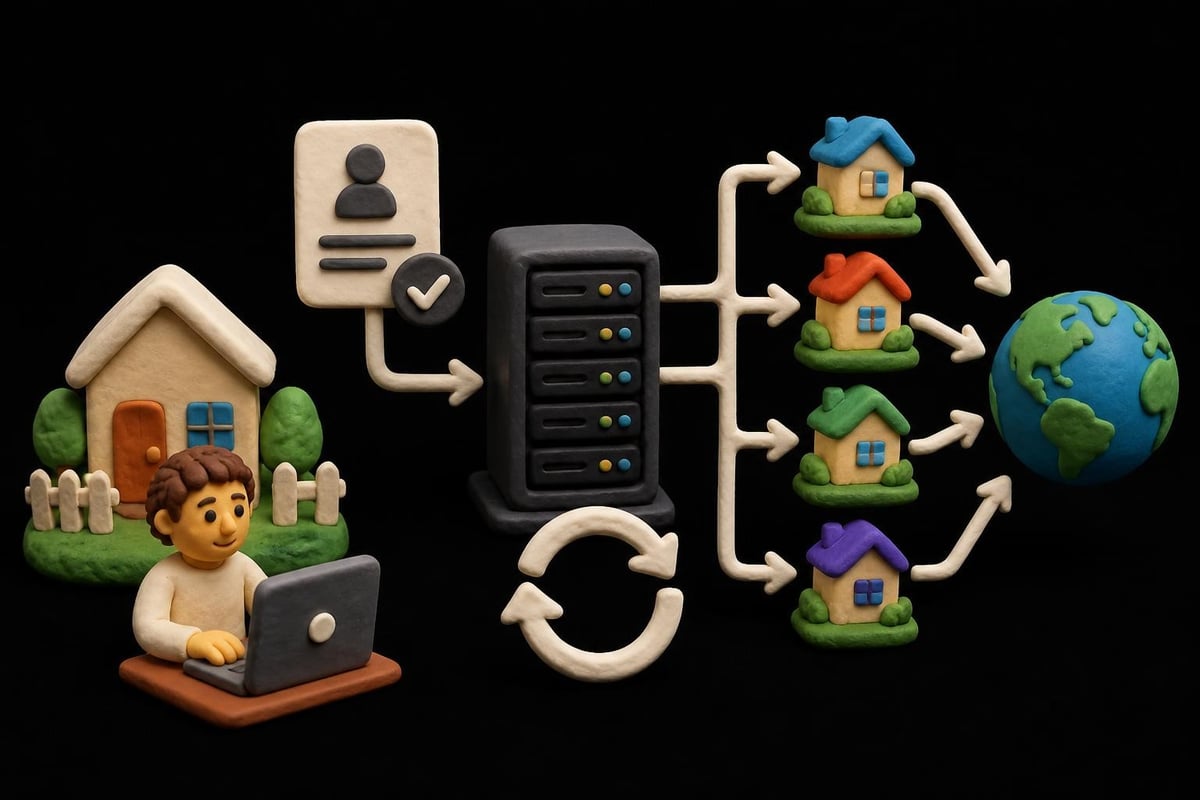
Rotating ISP proxies occupy a unique position in the proxy ecosystem. Unlike datacenter proxies that originate from hosting providers like AWS or DigitalOcean, ISP proxies come from legitimate internet service providers but are hosted in data centers for superior speed and uptime.
The key differentiator lies in their registration. ISP proxies are registered under actual internet service providers, meaning they appear as genuine residential connections to target websites. However, unlike traditional residential proxies that route through home users' devices, ISP proxies run on dedicated infrastructure with enterprise-grade bandwidth.
Speed vs. Trust Comparison
| Proxy Type | Speed | Trust Score | Stability | Cost |
|---|---|---|---|---|
| Datacenter | 10Gbps+ | Low | Excellent | $ |
| Residential | 1-50Mbps | Highest | Variable | $$$ |
| ISP Rotating | 1-10Gbps | High | Excellent | $$ |
| Mobile | 5-100Mbps | Highest | Good | $$$$ |
When these proxies rotate automatically, they combine consistent performance with the anonymity benefits of changing IP addresses. Each rotation presents a fresh identity to target servers, reducing the risk of blocks while maintaining the throughput needed for large-scale operations.
Core Use Cases for Businesses
Rotating ISP proxies excel in scenarios where both speed and legitimacy matter. Web scraping operations benefit enormously, as automated data collection faces increasing detection by sophisticated anti-bot systems.
E-commerce price monitoring represents one of the most common applications. Retailers need to track competitor pricing across hundreds or thousands of products daily. Static IP addresses get flagged quickly, while residential proxies often lack the bandwidth for efficient operation.
For ad verification campaigns, marketers must validate that their advertisements display correctly across different geographic regions and ISP networks. Rotating through authentic ISP addresses ensures accurate representation of how real users experience campaigns.
Additional Business Applications
- Market research and competitive intelligence
- Social media management across multiple accounts
- SEO rank tracking and SERP analysis
- Travel fare aggregation and monitoring
- Sneaker and limited-release product purchasing
Brand protection teams use rotating ISP proxies to identify counterfeit listings and unauthorized resellers. The rotation prevents marketplaces from associating monitoring activity with a single entity, while the ISP source ensures access isn't blocked as datacenter traffic often is.
How Rotation Mechanisms Work
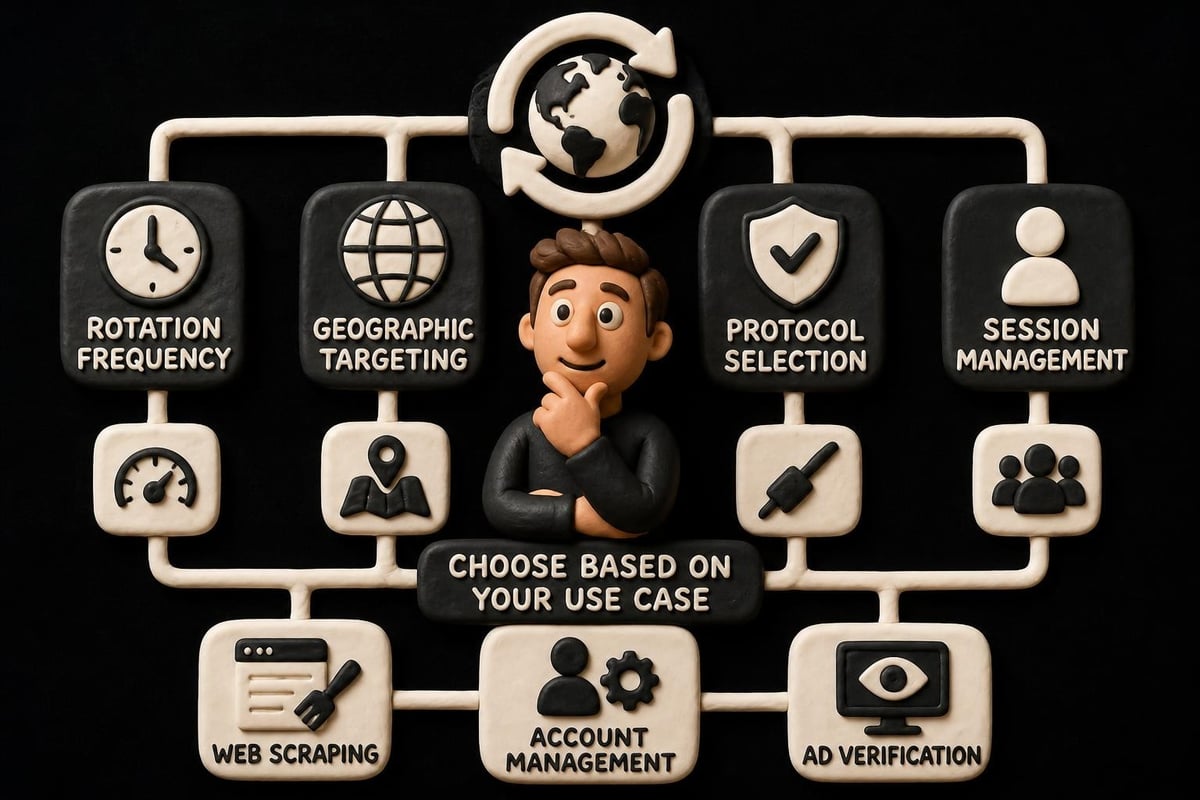
The rotation strategy you choose fundamentally impacts both performance and detection avoidance. Most providers offer several rotation approaches, each suited to different use cases.
Time-based rotation switches IP addresses at predetermined intervals. Every request, every minute, or every 10 minutes represents common settings. This predictability makes it easy to plan scraping sessions but can create patterns that sophisticated detection systems identify.
Request-based rotation assigns a new IP address for each HTTP request. This approach maximizes anonymity but can complicate session management for websites that require authentication or shopping cart functionality.
Session-Based Rotation Strategy
Session-based rotation maintains the same IP address for a specified duration or until you explicitly request a change. This proves essential when:
- Logging into accounts where IP changes trigger security alerts
- Completing multi-step forms that validate session consistency
- Maintaining shopping carts across multiple page views
- Preserving authentication tokens tied to source IP addresses
According to IETF standards on HTTP proxying, intermediaries must carefully handle connection semantics to maintain proper protocol behavior.
The technical implementation often involves sticky sessions tied to a session ID or authentication token. Your scraping script passes this identifier with each request, and the proxy infrastructure maintains IP consistency for that session lifetime.
Geographic Distribution and Targeting
One of rotating ISP proxies' most valuable features is precise geographic targeting combined with automatic rotation within that region. Businesses can specify city-level or even ASN-level targeting while still benefiting from IP diversity.
Country-level targeting suffices for most general web scraping. You might need US-based IPs for accessing American e-commerce sites or UK addresses for British media outlets.
| Region | Typical Pool Size | Rotation Speed | Best For |
|---|---|---|---|
| North America | 50,000+ IPs | 1-10ms | E-commerce, Finance |
| Europe | 30,000+ IPs | 1-10ms | Travel, Media |
| Asia-Pacific | 20,000+ IPs | 5-15ms | Gaming, Social |
| Latin America | 10,000+ IPs | 10-20ms | Market Research |
City-level targeting becomes critical for local SEO monitoring and geo-specific content verification. A restaurant chain might need to verify how their locations appear in search results across dozens of cities simultaneously.
ASN (Autonomous System Number) targeting allows even finer control, letting you rotate through IPs from specific internet service providers. This matters when testing how content delivery networks or applications behave across different ISP networks.

Integration and Technical Considerations
Implementing rotating ISP proxies requires understanding both the authentication mechanisms and the optimal configuration for your use case. Most providers support both username-password authentication and IP whitelisting.
HTTP/HTTPS proxy protocol remains the most common integration method. Your application or scraping framework sends requests through the proxy endpoint, which handles rotation transparently:
http://username:password@proxy.provider.com:8080
For applications requiring SOCKS5 protocol, the proxy handles UDP and TCP traffic, enabling use cases beyond web scraping like gaming or P2P applications.
Configuration Best Practices
When configuring rotating ISP proxies, consider these technical requirements:
- Connection pooling: Reuse connections when using session-based rotation to reduce overhead
- Retry logic: Implement exponential backoff for failed requests due to rotation timing
- Header management: Rotate User-Agent strings alongside IP addresses to avoid fingerprinting
- Cookie handling: Clear cookies between rotations unless maintaining sessions
- DNS resolution: Use proxy-side DNS to prevent leaking your actual location
The W3C's fingerprinting guidance emphasizes that IP rotation alone doesn't guarantee anonymity. Browser fingerprinting techniques can identify users through canvas rendering, WebGL capabilities, and installed fonts.
Research from Google on web fingerprinting risk assessment demonstrates that combining IP rotation with browser-level anti-fingerprinting measures significantly improves anonymity.
Avoiding Detection and Rate Limits
Even with rotating ISP proxies, detection remains a concern if you don't follow best practices. Modern anti-bot systems employ sophisticated techniques that look beyond simple IP reputation.
Behavior patterns matter as much as IP address diversity. Scraping 1000 pages per minute from rotating IPs still creates an anomalous traffic pattern. Human-like delays and randomization prove essential.
The OWASP Web Security Testing Guide outlines tests that developers implement to detect automated clients, providing valuable insight into what triggers blocks.
Rate Limiting Strategies
| Strategy | Detection Risk | Efficiency | Complexity |
|---|---|---|---|
| Fixed delays | Medium | Low | Low |
| Random intervals | Low | Medium | Low |
| Adaptive throttling | Very Low | High | High |
| Concurrent requests | Medium | Very High | Medium |
Concurrent requests across multiple rotating IPs can dramatically increase throughput while reducing per-IP request rates. Instead of sending 100 requests sequentially through rotating proxies, send 10 concurrent requests across 10 different IPs.
Understanding how platforms like Cloudflare's proxy infrastructure operates helps anticipate detection mechanisms. Large CDNs analyze patterns across their entire network, identifying coordinated activity even across different IP addresses.
Protocol Support and IPv6 Considerations
The proxy landscape in 2026 increasingly requires dual-stack support. While IPv4 remains dominant, IPv6 adoption has accelerated, with many networks now preferring IPv6 routing.
Rotating ISP proxies that support both IPv4 and IPv6 offer significant advantages. IPv6's massive address space (340 undecillion addresses) enables virtually unlimited rotation possibilities within a single ISP allocation.
Many websites and applications now serve different content or apply different rate limits based on protocol version. Testing across both protocols ensures comprehensive coverage.
Protocol Comparison
- IPv4: Universal compatibility, smaller address pools, higher cost per IP
- IPv6: Massive address space, growing support, potential compatibility gaps
- Dual-stack: Maximum flexibility, complete coverage, optimal for future-proofing
Recent academic research on browser fingerprinting indicates that protocol choice can contribute to fingerprinting vectors, making dual-stack rotation valuable for comprehensive anonymity.
Performance Optimization Techniques
Maximizing the value of rotating ISP proxies requires optimization at multiple levels. Network performance, rotation timing, and application-level efficiency all contribute to overall success.
Connection reuse significantly reduces overhead when using session-based rotation. Establishing a new TCP connection for each request adds latency and increases the attack surface for detection.
Bandwidth management becomes critical at scale. A 10Gbps proxy connection supports massive throughput, but inefficient scraping code might only utilize a fraction of available capacity.
Optimization Checklist
- Enable HTTP/2 or HTTP/3 where supported for multiplexing benefits
- Compress requests and responses to reduce bandwidth consumption
- Implement connection pooling with appropriate timeout settings
- Cache DNS lookups to avoid repetitive resolution delays
- Use async/concurrent requests to maximize throughput
- Monitor proxy health and automatically failover to backup pools
Error handling deserves special attention. Not every rotation succeeds immediately, and your application must gracefully handle scenarios where an IP is temporarily blocked or the rotation service experiences latency.
Cost Efficiency and Provider Selection
Pricing models for rotating ISP proxies vary significantly across providers. Understanding the cost structure helps optimize your spend while maintaining performance.
Bandwidth-based pricing charges per gigabyte transferred, making it ideal for high-volume scraping with efficient code. Bloated requests or downloading unnecessary resources directly impacts costs.
Request-based pricing bills per API call or HTTP request, favoring operations that transfer large amounts of data per request. Downloading full page content becomes more economical than making many small API calls.
Subscription models offer unlimited bandwidth or requests within a time period, providing predictability for budgeting but potentially leaving value on the table if you don't fully utilize capacity.
Cost Comparison Factors
| Factor | Impact on Cost | Optimization Strategy |
|---|---|---|
| Bandwidth usage | High | Compress data, request only needed fields |
| Request volume | Medium | Batch operations, reduce redundant requests |
| Geographic diversity | Medium | Focus on required regions only |
| Concurrent connections | Low | Scale to match actual parallelism needs |
Provider reputation and support quality matter as much as pricing. Technical issues with proxy rotation can halt business-critical operations, making responsive support essential.
Security and Privacy Standards
When using rotating ISP proxies, understanding the security and privacy implications protects both your business and any data you collect. Zero-log policies ensure that proxy providers don't retain records of your browsing activity or data transfers.
Encryption becomes non-negotiable for sensitive operations. While the proxy connection itself should use HTTPS, the end-to-end encryption of your data transmission to target websites requires additional consideration.
Man-in-the-middle risks exist when routing traffic through any intermediary. Reputable providers implement certificate pinning and transparent proxy modes that prevent interception, but verification remains your responsibility.
Privacy Best Practices
- Verify the provider's logging and data retention policies
- Use HTTPS for all connections to target websites
- Implement application-level encryption for sensitive data
- Regularly audit proxy traffic for unexpected behavior
- Maintain separate proxy pools for different security levels
Your use of rotating ISP proxies must comply with both the target website's terms of service and applicable data protection regulations. While proxies provide anonymity, they don't provide legal protection for prohibited activities.
Scaling Operations with Proxy Rotation
As your business grows, scaling proxy operations requires strategic planning. Starting with 10 concurrent connections differs vastly from managing 1,000 simultaneous scraping sessions.
Pool size directly impacts rotation effectiveness. A pool of 100 IPs rotating every 10 seconds provides less diversity than 10,000 IPs rotating every minute. Larger pools reduce the chance of presenting the same IP to a target within a detection window.
Infrastructure considerations multiply at scale. Connection management, error handling, and monitoring become critical when operating dozens of scraping clusters across multiple regions.
Automated failover mechanisms detect when specific IP addresses or entire ISP ranges face blocks, automatically shifting traffic to healthy pools. This requires real-time monitoring and intelligent routing logic.
Real-World Performance Metrics
Understanding what performance to expect from rotating ISP proxies helps set realistic goals and identify optimization opportunities. Industry benchmarks provide useful reference points.
Success rate measures the percentage of requests that complete successfully without blocks or errors. Well-configured rotating ISP proxies typically achieve 95-99% success rates for general web scraping.
Average response time varies by target website and geographic distance but generally ranges from 200ms to 2 seconds for ISP proxies. This represents the time from request initiation to full response receipt.
Key Performance Indicators
| Metric | Good | Excellent | Action if Below |
|---|---|---|---|
| Success rate | 95%+ | 99%+ | Review rotation settings, targeting |
| Avg response time | <2s | <1s | Check geographic proximity, bandwidth |
| Rotation speed | <100ms | <10ms | Verify provider infrastructure |
| Uptime | 99%+ | 99.9%+ | Consider backup provider |
Cost per successful request combines pricing with success rate to reveal true efficiency. A cheaper provider with 80% success rate may cost more per completed operation than a premium provider with 98% success.
Rotating ISP proxies represent a sophisticated solution that balances the speed of datacenter infrastructure with the trust signals of legitimate internet service provider connections. By implementing proper rotation strategies, geographic targeting, and anti-detection measures, businesses can operate at scale while maintaining the anonymity and access required for competitive advantage. Whether you're conducting market research, monitoring brand presence, or gathering competitive intelligence, PinguProxy delivers the high-speed infrastructure, comprehensive protocol support, and instant rotation capabilities you need to succeed in 2026's increasingly challenging web landscape.