
SOCKS5 Proxy Buy: Complete 2026 Guide for Businesses
When you decide to socks5 proxy buy, you're investing in one of the most versatile and powerful proxy protocols available today. SOCKS5 proxies have become essential tools for businesses and individuals who need reliable, high-performance connections for web scraping, accessing geo-restricted content, maintaining privacy, and bypassing network restrictions. Unlike traditional HTTP proxies that only handle web traffic, SOCKS5 proxies operate at a lower level, making them suitable for any type of internet traffic including gaming, torrenting, and streaming applications.
Understanding SOCKS5 Proxies Before Your Purchase
Before you socks5 proxy buy, understanding the technical foundation helps you make informed decisions. SOCKS5 represents the fifth version of the Socket Secure protocol, designed to route network packets between client and server through a proxy server.
Key Technical Advantages
The protocol offers several distinct benefits that separate it from alternatives:
- Protocol agnostic: Works with HTTP, HTTPS, FTP, SMTP, and virtually any internet protocol
- UDP support: Handles both TCP and UDP connections for gaming and streaming
- Authentication: Supports username/password authentication for secure access
- No data modification: Passes traffic without interpretation or alteration
- Lower overhead: Minimal processing requirements result in faster speeds
These technical characteristics make SOCKS5 proxies particularly valuable for applications requiring speed and flexibility. When businesses evaluate their proxy needs, the versatility of SOCKS5 protocol becomes a decisive factor.
Common Use Cases Driving Purchase Decisions
Organizations socks5 proxy buy for diverse operational requirements:
- Web scraping and data collection: Rotating IPs prevent detection and blocking
- Market research: Access competitor websites from different geographic locations
- Ad verification: Check how advertisements display across regions
- Social media management: Manage multiple accounts without triggering security alerts
- Gaming: Reduce latency and access region-locked servers
- Content streaming: Access geo-restricted media libraries

Evaluating Providers When You SOCKS5 Proxy Buy
The proxy market offers numerous providers, but quality varies dramatically. Your purchasing decision should rest on concrete evaluation criteria rather than marketing promises.
Essential Provider Features
| Feature | Why It Matters | What to Look For |
|---|---|---|
| IP Pool Size | Larger pools reduce detection risk | Minimum 10,000+ unique IPs |
| Geographic Coverage | Access target locations | Servers in required countries/cities |
| Bandwidth | Determines data throughput | Unlimited or generous limits (10Gbps+) |
| Uptime Guarantee | Ensures reliability | 99.9% minimum SLA |
| Authentication | Security and access control | Username/password and IP whitelisting |
| Rotation Speed | Prevents pattern detection | Sub-second rotation capability |
When you socks5 proxy buy from reputable providers, these features should be standard offerings. Premium services distinguish themselves through infrastructure quality rather than feature lists alone.
Speed and Performance Metrics
Performance directly impacts productivity and success rates for business applications. Testing methodologies should include:
Connection establishment time: How quickly the proxy connects to target servers affects overall operation speed. Enterprise-grade providers maintain connection times under 100ms.
Data transfer rates: Measured in Mbps or Gbps, this determines how fast you can scrape websites or download content. Look for providers offering 10Gbps bandwidth infrastructure.
Latency measurements: Critical for gaming and real-time applications. Quality SOCKS5 proxy services maintain latency under 50ms for nearby servers.
Success rates: The percentage of successful requests versus failures indicates proxy quality. Premium providers achieve 99%+ success rates.
Security Considerations for SOCKS5 Proxy Purchases
Security represents a critical dimension often overlooked during the purchase process. While SOCKS5 proxies provide anonymity through IP masking, the protocol itself doesn't include encryption, requiring additional security measures.
Authentication and Access Control
Robust authentication prevents unauthorized proxy usage and protects your investment:
- Username/password combinations: Change credentials regularly to prevent compromise
- IP whitelisting: Restrict proxy access to specific IP addresses
- Session management: Monitor active connections and terminate suspicious sessions
- Multi-factor authentication: Advanced providers offer 2FA for dashboard access
Privacy and Logging Policies
When you socks5 proxy buy, scrutinize the provider's logging policies carefully. Zero-log policies mean the provider doesn't record:
- Connection timestamps
- Bandwidth usage details
- Websites or services accessed
- Original IP addresses
- DNS queries made through proxies
Data retention practices vary significantly between providers. Some maintain logs for troubleshooting purposes, while privacy-focused services implement strict no-log policies with regular third-party audits.

Avoiding Free Proxy Security Risks
Free SOCKS5 proxies pose substantial security threats that far outweigh any cost savings. Research on free proxy services reveals alarming patterns:
- Data interception: Operators may capture and sell user traffic data
- Malware distribution: Injected scripts can compromise user systems
- Credential theft: Login information passes unencrypted through malicious servers
- Network attacks: Free proxies often serve as honeypots for hackers
- Unreliable service: Frequent downtime disrupts business operations
Professional environments should exclusively utilize paid, reputable services when they socks5 proxy buy.
Pricing Models and Cost Optimization
Understanding proxy pricing structures helps maximize value while controlling expenses. Providers structure pricing around several models, each suited to different usage patterns.
Common Pricing Structures
Per-proxy pricing: You pay for each individual proxy connection, typically ranging from $1-$5 per proxy monthly. This model suits users needing small quantities with consistent usage.
Bandwidth-based pricing: Charges apply based on data transferred through proxies. Rates typically range from $3-$15 per gigabyte. This benefits users with high proxy counts but modest data requirements.
Subscription tiers: Fixed monthly fees provide access to proxy pools with varying features. Entry tiers start around $50/month, while enterprise plans exceed $500/month.
Pay-as-you-go: Flexible pricing where you purchase credits and consume them as needed. Ideal for seasonal or irregular proxy requirements.
| Pricing Model | Best For | Average Cost Range | Typical Minimum |
|---|---|---|---|
| Per-Proxy | Small-scale operations | $1-5/proxy/month | 5-10 proxies |
| Bandwidth-Based | High proxy count, low data | $3-15/GB | 1GB minimum |
| Subscription | Regular, predictable usage | $50-500/month | Starter tier |
| Pay-as-you-go | Irregular or seasonal needs | Varies widely | $25-50 credit |
Calculating Total Cost of Ownership
When you socks5 proxy buy, consider factors beyond headline pricing:
Setup and integration costs: Developer time to configure proxy rotation, error handling, and monitoring systems can add substantial hidden costs.
Support expenses: Premium support tiers may cost extra but save hours of troubleshooting time. Calculate support costs against potential downtime losses.
Scaling considerations: How does pricing change as your needs grow? Volume discounts become critical for expanding operations.
Contract commitments: Annual contracts typically offer 15-30% discounts versus month-to-month pricing, but reduce flexibility.
Technical Setup and Configuration Best Practices
After you socks5 proxy buy, proper configuration ensures optimal performance and security. Setup complexity varies based on your technical infrastructure and specific requirements.
Initial Configuration Steps
- Obtain credentials: Collect proxy IP addresses, ports, usernames, and passwords from your provider
- Test connectivity: Verify each proxy responds correctly using curl or dedicated testing tools
- Configure authentication: Set up username/password or IP whitelist authentication
- Implement rotation: Configure automatic IP rotation based on time or request count
- Set up monitoring: Deploy uptime monitoring and alert systems for proxy failures
Application-Specific Configuration
Different applications require tailored setup approaches. Understanding SOCKS5 implementation details helps optimize each use case:
Web browsers: Configure browser proxy settings or use extensions for easy switching between proxies. Chrome, Firefox, and Edge all support SOCKS5 natively.
Programming languages: Python, Node.js, Java, and other languages offer SOCKS5 libraries. Implement connection pooling and retry logic for robustness.
Specialized software: Scrapers, automation tools, and gaming clients may require specific configuration formats or protocols.
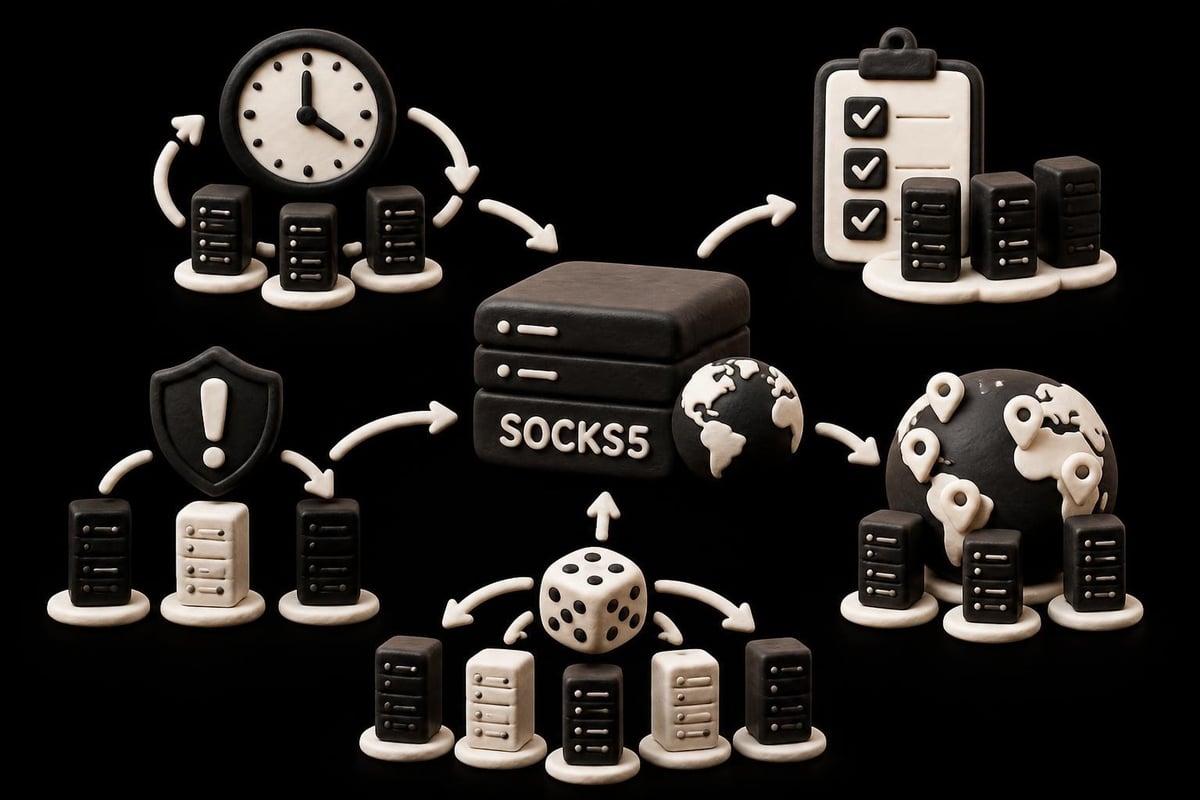
Rotation Strategies for Maximum Effectiveness
When you socks5 proxy buy with rotation capabilities, strategic implementation prevents detection:
- Time-based rotation: Switch IPs every 1-10 minutes regardless of request count
- Request-based rotation: Change proxies after specific numbers of requests (10-100 typical)
- Failure-triggered rotation: Automatically switch when encountering blocks or errors
- Geographic rotation: Cycle through different locations for distributed access patterns
- Random selection: Choose proxies unpredictably from available pools
Residential vs Datacenter SOCKS5 Proxies
One critical decision when you socks5 proxy buy involves choosing between residential and datacenter proxies. Each type serves distinct purposes with different cost-performance profiles.
Datacenter Proxy Characteristics
Advantages:
- Significantly faster speeds (10Gbps+ infrastructure)
- Lower costs ($1-3 per proxy monthly)
- Highly reliable uptime (99.9%+)
- Simple configuration and setup
- Excellent for high-volume operations
Limitations:
- Easier for websites to detect and block
- Shared IP ranges flagged by security systems
- Less effective for platforms with strict anti-bot measures
- Not ideal for social media or sneaker purchases
Residential Proxy Benefits
Advantages:
- Real IP addresses from ISPs appear legitimate
- Extremely difficult to detect or block
- Access platforms with strict security measures
- Geographic precision down to city level
- Higher success rates on restricted sites
Limitations:
- Substantially higher costs ($5-15 per GB)
- Slower speeds due to real device routing
- Variable reliability based on peer device uptime
- More complex setup and management
Making the Right Choice
Your decision depends on specific use case requirements. Consider comparing HTTP and SOCKS proxy types alongside residential versus datacenter options:
Choose datacenter when: Speed matters most, cost efficiency is critical, target sites don't aggressively block proxies, performing technical testing or development work.
Choose residential when: Accessing social media platforms, purchasing limited-release products, scraping sites with strong anti-bot protection, requiring high success rates over speed.
Hybrid approach: Many businesses maintain both proxy types, deploying each for appropriate tasks. This maximizes efficiency while controlling costs.
IPv4 vs IPv6 SOCKS5 Proxy Considerations
Modern proxy infrastructure increasingly supports both IPv4 and IPv6 protocols. When you socks5 proxy buy in 2026, IPv6 compatibility provides future-proofing and expanded capabilities.
IPv6 Advantages
The newer protocol offers several operational benefits:
Massive address space: IPv6's 128-bit addressing provides virtually unlimited IP addresses, enabling larger proxy pools without address recycling.
Native encryption: Built-in IPsec support enhances security compared to IPv4's optional encryption.
Reduced costs: Less competition for IPv6 addresses typically results in lower proxy pricing.
Future compatibility: Growing IPv6 adoption means better long-term infrastructure support.
Dual-Stack Implementation
Premium providers offer dual-stack support, enabling seamless IPv4 and IPv6 operation. This flexibility ensures compatibility with all internet resources regardless of protocol support.
Provider Support and Service Level Agreements
Technical support quality significantly impacts your proxy experience after you socks5 proxy buy. Evaluate support offerings carefully during provider selection.
Support Channel Availability
- 24/7 live chat: Immediate assistance for critical issues
- Email ticketing: Detailed technical inquiries with documentation
- Phone support: Enterprise-tier direct communication
- Knowledge base: Self-service resources for common questions
- API documentation: Comprehensive integration guides
Service Level Agreements Matter
SLAs define provider commitments and your recourse for service failures:
Uptime guarantees: Minimum 99.9% availability with credit compensation for outages
Response times: Maximum wait times for support inquiries by severity level
Refund policies: Conditions under which you receive partial or full refunds
Bandwidth commitments: Guaranteed minimum speeds and data transfer rates
Compliance and Legal Considerations
When businesses socks5 proxy buy, they must consider legal and regulatory implications. Proxy usage legality varies by jurisdiction and application.
Legitimate Use Cases
Proxies serve entirely legal purposes when used for:
- Market research and competitive intelligence
- Brand protection and ad verification
- Web scraping public data with proper rate limiting
- Accessing geo-restricted content you're authorized to view
- Testing websites and applications from different locations
- Privacy protection for legitimate browsing activities
Prohibited Activities
Responsible providers prohibit and monitor for:
- Accessing systems without authorization
- Bypassing payment systems or DRM protection
- Distributing malware or conducting attacks
- Harassment, fraud, or identity theft
- Violating intellectual property rights
Review provider terms of service carefully to understand prohibited activities and potential account termination conditions.
Testing and Validation After Purchase
Once you socks5 proxy buy and receive credentials, thorough testing ensures proper functionality before production deployment.
Essential Test Procedures
Connectivity verification: Confirm each proxy accepts connections and routes traffic correctly using command-line tools or dedicated proxy testers.
Speed benchmarking: Measure download and upload speeds to validate performance claims. Run tests at different times to assess consistency.
Geographic accuracy: Verify proxies appear in claimed locations using geolocation lookup services.
Anonymity testing: Confirm your original IP address remains hidden using proxy detection websites.
Failure rate assessment: Send hundreds of requests to measure success rates and identify problematic proxies.
Ongoing Monitoring
Continuous monitoring maintains proxy health after initial deployment:
- Track uptime percentages for each proxy or pool
- Monitor response times and speed degradation
- Log block rates from target websites
- Measure bandwidth consumption against limits
- Alert on proxy failures or performance issues
Choosing the right SOCKS5 proxies requires careful evaluation of technical capabilities, security features, pricing models, and provider reliability. Whether you need datacenter speed for high-volume web scraping or residential authenticity for accessing restricted platforms, matching proxy types to specific use cases maximizes your investment value. PinguProxy delivers enterprise-grade SOCKS5 proxies with complete IPv4 and IPv6 support, 10Gbps bandwidth, and 1ms rotation capabilities backed by 24/7 expert support, making it easy to find the perfect proxy solution for your business needs.