
Free SOCKS5 Proxies: Hidden Risks & Better Solutions
The allure of free SOCKS5 proxies continues to attract users looking to bypass geographic restrictions, enhance privacy, or conduct web scraping without upfront costs. While the promise of zero-cost access to proxy infrastructure sounds appealing, the reality is far more complex and potentially dangerous. Understanding what free socks5 proxies actually offer versus what they cost you in security, reliability, and privacy is essential before making a decision that could compromise your data or business operations.
Understanding SOCKS5 Protocol and Free Services
SOCKS5 represents the fifth version of the Socket Secure protocol, designed to route internet traffic through an intermediary server while supporting various authentication methods and protocols. Unlike HTTP proxies that only handle web traffic, SOCKS5 works at a lower level, managing any type of traffic including email, file transfers, and peer-to-peer connections.
The core features that make SOCKS5 attractive include:
- Support for TCP and UDP protocols
- Authentication mechanisms for added security
- No modification of packet headers, reducing error rates
- Compatibility with virtually all applications and services
Free socks5 providers advertise these same capabilities, positioning themselves as cost-effective alternatives to paid services. However, the operational model raises critical questions: How do these services sustain themselves financially? What happens to your data as it passes through their servers?
The Economics Behind Free Proxy Services
Research into the free proxy ecosystem reveals troubling patterns. A comprehensive study analyzing free web proxies discovered that less than 2% of advertised free proxies function properly, with a significant portion exhibiting malicious behaviors ranging from data interception to active traffic manipulation.
The business model of free socks5 providers typically relies on one or more revenue streams that directly conflict with user interests. Some inject advertisements into browsing sessions, while others harvest and sell user data to third parties. The most concerning operators use free proxies as honeypots, capturing credentials, payment information, and sensitive communications.

Security Vulnerabilities in Free SOCKS5 Networks
The security implications of using free socks5 services extend far beyond simple privacy concerns. These vulnerabilities can expose users to identity theft, financial fraud, and corporate espionage.
Data Interception and Man-in-the-Middle Attacks
When your traffic passes through a free proxy server, the operator has complete visibility into unencrypted data. This creates opportunities for man-in-the-middle attacks where operators can:
- Capture login credentials for websites and applications
- Monitor financial transactions and payment information
- Intercept API keys and authentication tokens
- Read private communications and business data
Many free socks5 operators actively downgrade HTTPS connections to HTTP, stripping away encryption protections that users assume are protecting their data. This technique, known as SSL stripping, occurs transparently without user notification.
Malware Distribution Networks
A longitudinal study tracking free proxy stability and security over 30 months revealed that many free proxy servers actively inject malicious code into user traffic. This malware ranges from cryptocurrency miners that hijack processing power to sophisticated trojans that establish persistent backdoors.
| Security Risk | Prevalence | Impact Level |
|---|---|---|
| Data harvesting | 78% | High |
| SSL stripping | 62% | Critical |
| Malware injection | 38% | Critical |
| Credential theft | 54% | High |
| Traffic analysis | 89% | Medium |
The table above summarizes findings from multiple security audits of free proxy services. The numbers demonstrate that security compromises are the norm rather than the exception in the free socks5 ecosystem.
Performance and Reliability Challenges
Beyond security concerns, free socks5 proxies suffer from fundamental performance limitations that make them unsuitable for most legitimate use cases.
Speed represents the most immediate concern. Free proxies typically operate on minimal infrastructure, sharing limited bandwidth across thousands of simultaneous users. Connection speeds often drop below 1 Mbps, making even basic web browsing frustratingly slow. For applications like web scraping or streaming that require consistent throughput, free proxies simply cannot deliver.
Common performance issues include:
- Frequent disconnections requiring constant reconnection
- High latency exceeding 500ms on average
- Bandwidth throttling during peak usage hours
- IP address blacklisting by major platforms
- Geographic location mismatches with advertised locations
Uptime and Availability Problems
Free socks5 services rarely maintain consistent uptime. Servers appear and disappear without warning, disrupting workflows and requiring constant monitoring for functional alternatives. This instability stems from the temporary nature of many free proxy operations, which may run on compromised servers or home connections rather than dedicated infrastructure.
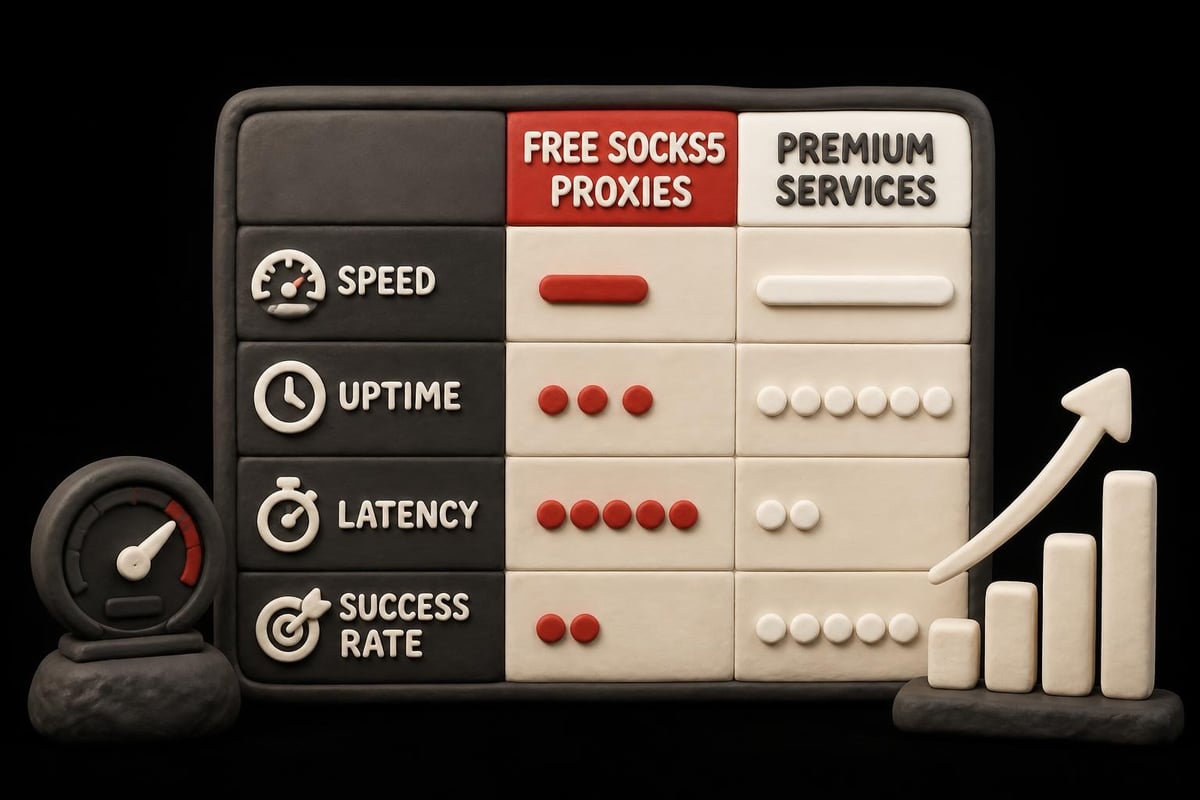
According to independent testing of free proxy services, average uptime hovers around 60% for free options compared to 99.9% for enterprise-grade paid services. This unreliability makes free proxies impractical for business operations or time-sensitive tasks.
Legal and Compliance Risks
Using free socks5 proxies introduces legal complications that many users fail to consider until facing consequences. The distributed nature of free proxy networks means traffic often routes through jurisdictions with varying laws regarding data privacy, computer fraud, and intellectual property.
Terms of Service Violations
Major platforms including social media networks, e-commerce sites, and streaming services explicitly prohibit access through free proxy services in their terms of service. Automated detection systems identify proxy traffic patterns, resulting in account suspensions or permanent bans. Business accounts face particularly severe consequences, potentially losing access to advertising accounts, seller privileges, or verified status.
Free proxies frequently appear on shared blacklists maintained by security companies and web services. When thousands of users share the same IP address for various purposes including spam, fraud, and policy violations, the address becomes permanently flagged. Legitimate users then face CAPTCHAs, blocked access, or immediate bans simply by association.
Data Sovereignty and Privacy Laws
GDPR, CCPA, and similar privacy regulations impose strict requirements on how personal data is processed and transmitted. When using free socks5 proxies, you lose control over where data travels and who has access. A detailed comparison of proxy providers highlights how professional services maintain compliance through transparent data handling policies, while free services offer no such guarantees.
Safer Alternatives to Free SOCKS5 Proxies
The risks associated with free socks5 services necessitate exploring alternatives that balance cost considerations with security, performance, and reliability requirements.
Self-Hosted Proxy Solutions
For technical users, deploying your own SOCKS5 server provides complete control without the vulnerabilities of free public proxies. Cloud providers offer affordable virtual private servers starting around $5 monthly, which you can configure with SSH SOCKS5 proxy functionality for secure, personal use.
Benefits of self-hosted proxies include:
- Full control over server configuration and security
- Dedicated bandwidth without sharing with unknown users
- Ability to choose server locations strategically
- No third-party access to your traffic data
- Customizable authentication and access controls
However, self-hosting requires technical expertise for setup, maintenance, and security hardening. You're also responsible for monitoring server health and addressing any abuse complaints from the hosting provider.
Professional SOCKS5 Proxy Services
Premium SOCKS5 proxy services eliminate security concerns while delivering the performance necessary for demanding applications. Unlike free alternatives, paid providers operate on sustainable business models that align with user interests rather than conflicting with them.
When evaluating professional services, consider these critical factors:
| Feature | Why It Matters | What to Look For |
|---|---|---|
| Zero-log policy | Ensures no activity records | Third-party audited policies |
| IP rotation | Prevents tracking and bans | Sub-second rotation capability |
| Bandwidth | Determines speed and throughput | 10Gbps or higher |
| Geographic coverage | Access to needed regions | Global server presence |
| Protocol support | IPv4/IPv6 compatibility | Dual-stack infrastructure |
Professional providers typically offer tiered pricing that scales with usage, making them accessible for individual users and large enterprises alike. The cost comparison for proxy servers shows that entry-level plans start around $10-20 monthly, representing minimal investment for significant security and performance improvements.
Use Case Analysis: When Free SOCKS5 Fails
Real-world applications expose the limitations of free socks5 proxies across different scenarios, demonstrating why professionals avoid these services.
Web Scraping and Data Collection
Web scraping requires reliable proxies that avoid detection while maintaining consistent connections. Free proxies fail on multiple fronts: shared IPs trigger anti-bot measures immediately, slow speeds limit scraping velocity, and frequent disconnections corrupt data collection processes. A practical guide to understanding SOCKS proxies explains how proper proxy infrastructure enables efficient data gathering without triggering blocks.
E-commerce price monitoring, market research, and competitive analysis all demand stable proxy infrastructure that free services cannot provide. When scrapers encounter rate limits or IP bans, rotating to fresh residential or datacenter IPs becomes essential, something free proxies cannot offer systematically.

Account Management and Social Media
Managing multiple social media accounts for clients or brands requires distinct IP addresses to prevent platform linking and account association. Free socks5 proxies not only get flagged immediately by social platforms but also put accounts at risk of permanent suspension. Professional mobile proxies for Instagram and similar platforms use residential IPs that appear as legitimate users rather than obvious proxies.
The consequences of account bans extend beyond inconvenience, potentially destroying business assets worth thousands of dollars in followers, content, and engagement history. This risk makes free proxies unsuitable for any professional social media management.
Gaming and Streaming Applications
Low-latency connections are critical for gaming, where delays of even 50-100ms create noticeable lag affecting competitive performance. Free socks5 proxies typically add 300-1000ms latency, making real-time gaming virtually impossible. Bandwidth limitations further degrade the experience, causing disconnections during crucial moments.
Streaming services employ sophisticated proxy detection that identifies and blocks free proxy traffic almost instantly. Users attempting to access geo-restricted content through free proxies encounter errors, degraded quality, or immediate service termination. Quality datacenter proxy providers maintain clean IPs that streaming platforms don't flag, ensuring uninterrupted access.
Technical Limitations of Free Proxy Infrastructure
Beyond obvious security and performance issues, free socks5 proxies suffer from technical constraints that limit functionality for advanced use cases.
Authentication and Access Control
Most free proxies offer no authentication whatsoever, creating open relays that anyone can exploit. This openness attracts abusers who use free proxies for spam, attacks, and illegal activities. When platforms detect abuse from a proxy IP, they blacklist it, affecting all users sharing that address.
Free services that do implement authentication typically use weak credentials or share login information publicly, offering no real access control. Understanding SOCKS5 configuration reveals how proper authentication protects proxy infrastructure and maintains IP reputation.
Protocol and Feature Support
Many free socks5 implementations are incomplete or buggy, lacking support for critical features like UDP protocols necessary for certain applications. DNS leaks are common when free proxies fail to properly handle DNS requests, exposing your real location despite using a proxy.
Technical shortcomings frequently encountered:
- Missing UDP support breaks VoIP and gaming applications
- DNS leak vulnerabilities expose real IP addresses
- IPv6 traffic bypasses proxy entirely (no IPv6 support)
- No support for authentication methods beyond basic username/password
- Proxy chaining limitations prevent multi-hop anonymity
Making the Right Choice for Your Needs
Choosing between free socks5 proxies and professional alternatives requires honest assessment of your priorities, risk tolerance, and actual requirements. While free options might seem viable for casual, low-stakes browsing, they fundamentally fail for any scenario involving sensitive data, consistent performance needs, or business applications.
The security research clearly demonstrates that risks associated with free SOCKS5 proxies far outweigh any cost savings. When factoring in the potential consequences of data breaches, account losses, or legal complications, the true cost of "free" services often exceeds premium alternatives significantly.
For users who absolutely must minimize costs, self-hosting represents a middle ground that maintains security while reducing expenses. Combined with proper configuration and security practices, a personal SOCKS5 server eliminates third-party data access while providing dedicated performance.
However, most users and businesses benefit from partnering with established proxy providers who specialize in secure, high-performance infrastructure. The operational expertise, global coverage, and technical support justify the subscription cost through reliability and risk mitigation alone.
Questions to Ask Before Choosing
- What happens if my accounts get banned or data gets compromised?
- Can I afford downtime or slow speeds in my workflow?
- Do I have technical expertise to secure self-hosted infrastructure?
- What privacy regulations apply to my use case?
- How much is my time worth when dealing with proxy failures?
Honest answers to these questions typically point away from free socks5 services toward solutions that align security, performance, and reliability with your actual needs. The proxy landscape offers options at every price point, making it unnecessary to accept the compromises that free services demand.
While free SOCKS5 proxies might seem tempting for budget-conscious users, the security vulnerabilities, performance limitations, and reliability issues make them unsuitable for serious applications. Whether you're scraping data, managing accounts, or accessing restricted content, your proxy infrastructure directly impacts success and security. PinguProxy delivers enterprise-grade datacenter, residential, and mobile proxies with complete IPv4/IPv6 support, zero-log privacy, 1ms rotation, and 24/7 support, providing the professional-grade infrastructure your projects deserve without the risks of free alternatives.