
SOCKS4 Proxy: Understanding the Classic Protocol
The SOCKS4 proxy protocol has served as a foundational technology in internet privacy and routing for over three decades. Despite newer versions and alternatives emerging, understanding SOCKS4 remains essential for anyone working with proxy services, network security, or web scraping operations. This protocol offers a straightforward, lightweight approach to routing network traffic through intermediary servers, making it relevant even in 2026 for specific use cases where simplicity and speed outweigh advanced features.
What Is a SOCKS4 Proxy
A socks4 proxy operates at the session layer of the OSI model, providing a method to route TCP connections through an intermediary server. Unlike application-layer proxies that understand specific protocols like HTTP, SOCKS4 works transparently with any TCP-based traffic.
The protocol's primary function is simple: it receives connection requests from clients, establishes connections to destination servers on behalf of those clients, and forwards data between them. This fundamental approach makes SOCKS4 remarkably efficient for basic proxy operations.
Technical Foundation
SOCKS4 was developed in the early 1990s and maintains a minimalist design philosophy. The protocol operates exclusively over TCP, handling connection requests through a basic handshake mechanism that specifies the destination IP address and port number.
Key technical characteristics include:
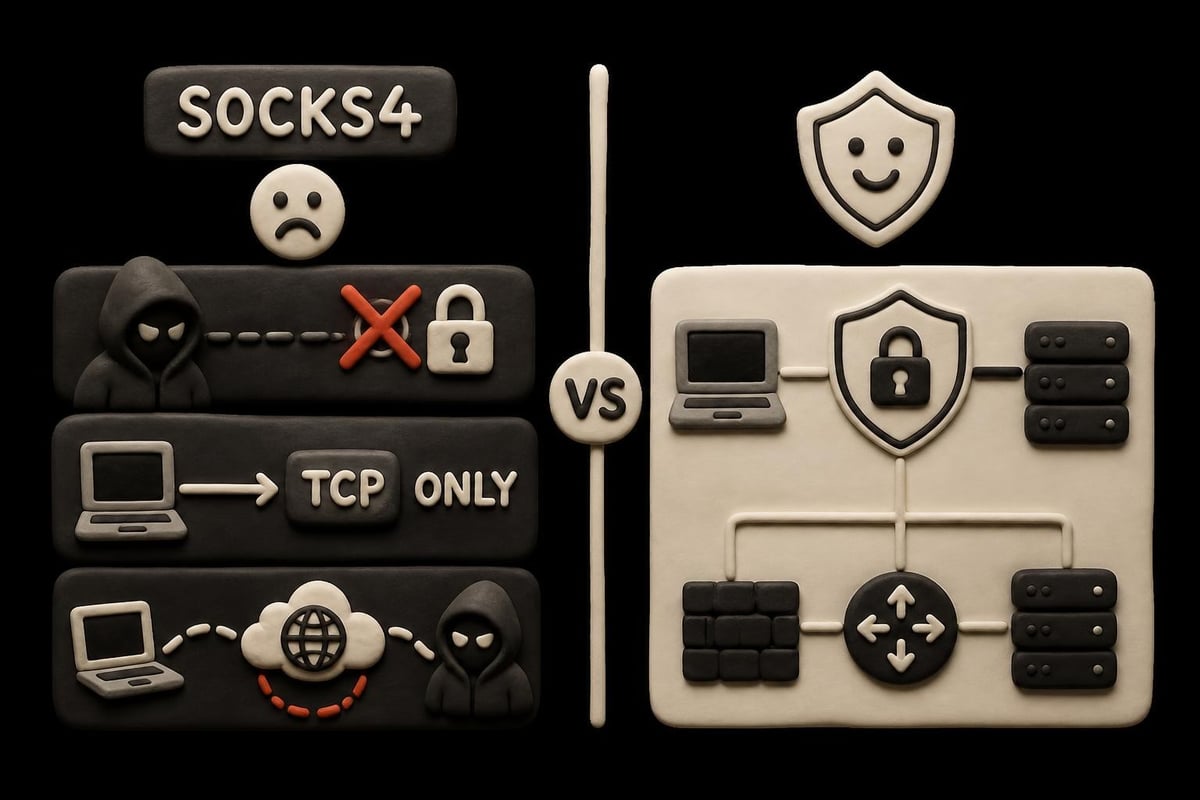
- TCP-only support (no UDP capability)
- IPv4 address space exclusively
- No built-in authentication mechanisms
- Simple binary protocol with minimal overhead
- Direct IP address specification required
The SOCKS Protocol Version 5 standard later addressed many of SOCKS4's limitations, but the original protocol's simplicity remains advantageous in certain scenarios where overhead must be minimized.

SOCKS4 vs SOCKS4A: An Important Distinction
The SOCKS4A extension emerged to address one of the original protocol's most significant limitations: the inability to resolve domain names. Standard SOCKS4 requires clients to resolve hostnames to IP addresses before making proxy requests.
SOCKS4A introduced a clever workaround. When the client sends an IP address in the format 0.0.0.x (where x is non-zero), the proxy interprets this as a signal to perform DNS resolution itself. The actual hostname follows the standard SOCKS4 request structure as a null-terminated string.
| Feature | SOCKS4 | SOCKS4A |
|---|---|---|
| DNS Resolution | Client-side only | Client or proxy-side |
| Domain Name Support | No | Yes |
| IP Format | Standard IPv4 | IPv4 + special signaling |
| Protocol Overhead | Minimal | Slightly higher |
The SOCKS4A specification shows how this extension maintains backward compatibility while enabling remote DNS resolution, which proves crucial for privacy-conscious applications.
This distinction matters significantly for security. Client-side DNS resolution can leak information about your browsing intentions before the proxy connection even establishes. SOCKS4A mitigates this risk by allowing the proxy server to handle DNS queries.
Comparing SOCKS4 to Modern Alternatives
Understanding where SOCKS4 fits in the broader proxy ecosystem requires examining its limitations and advantages compared to newer protocols.
SOCKS4 vs SOCKS5
SOCKS5 represents a comprehensive upgrade designed in the mid-1990s. The differences are substantial enough that many modern applications default to SOCKS5 when available.
SOCKS5 advantages over SOCKS4:
- Authentication support - Username/password and other authentication methods
- UDP protocol support - Essential for DNS, gaming, and VoIP applications
- IPv6 compatibility - Future-proofing for modern networks
- Domain name resolution - Built into the core protocol
- Enhanced security - Multiple authentication schemes available
The comparison between SOCKS4 and SOCKS5 protocols demonstrates that SOCKS5's additional features come with increased complexity. For applications requiring only basic TCP proxying, SOCKS4 maintains a performance edge through reduced overhead.
Modern configuration frameworks even recognize this distinction. The RFC 9643 standard defines YANG groupings that explicitly include "socks4-supported" and "socks4a-supported" flags alongside SOCKS5, acknowledging that legacy protocol support remains necessary.
SOCKS4 vs HTTP Proxies
The distinction between SOCKS and HTTP proxies fundamentally comes down to the OSI layer at which they operate. While HTTP proxies understand and can modify HTTP traffic specifically, a socks4 proxy remains protocol-agnostic at the application layer.
This difference creates specific advantages:
- Protocol flexibility - SOCKS4 handles any TCP traffic, not just HTTP/HTTPS
- Transparency - The proxy doesn't inspect or modify application data
- Lower overhead - No HTTP header parsing or manipulation
- Broader compatibility - Works with email, FTP, SSH, and custom protocols
The differences between HTTP and SOCKS proxies illustrate why certain applications specifically require SOCKS-type proxies rather than HTTP alternatives.

Practical Applications for SOCKS4 Proxies
Despite being an older protocol, SOCKS4 maintains relevance in 2026 for specific use cases where its characteristics align perfectly with requirements.
Web Scraping Operations
Web scraping represents one of the most common modern applications for SOCKS4 proxies. When scraping operations focus exclusively on HTTP/HTTPS content and don't require UDP or advanced authentication, SOCKS4 provides efficient routing with minimal latency.
Benefits for scraping:
- Fast connection establishment due to simple handshake
- Lower CPU overhead on both client and proxy server
- Compatibility with virtually all scraping frameworks
- Reduced bandwidth consumption compared to feature-rich alternatives
Many scraping operations rotate through large proxy pools. The lightweight nature of SOCKS4 means faster rotation times and reduced memory footprint when managing thousands of concurrent connections.
Legacy System Integration
Organizations maintaining older systems often discover that SOCKS4 remains the most reliable proxy protocol for legacy applications. These systems may predate SOCKS5 or contain hardcoded proxy implementations that specifically expect SOCKS4 protocol behavior.
Rather than rewriting or replacing functional legacy systems, deploying SOCKS4 proxies provides a practical bridge to modern network infrastructure while maintaining compatibility.
Resource-Constrained Environments
Embedded systems, IoT devices, and applications running on resource-limited hardware benefit from SOCKS4's minimal computational requirements. The protocol's simplicity translates directly into smaller code footprints and lower memory consumption.
| Resource Type | SOCKS4 Requirement | SOCKS5 Requirement |
|---|---|---|
| Memory Footprint | ~5-10 KB | ~15-25 KB |
| CPU Cycles (per connection) | Minimal | Moderate |
| Connection Latency | 1-2 ms overhead | 3-5 ms overhead |
| Code Complexity | Very Low | Medium |
Security Considerations with SOCKS4
Understanding the security implications of using a socks4 proxy is crucial for making informed deployment decisions. The protocol's age means it lacks security features that modern protocols take for granted.
No Built-in Authentication
SOCKS4's most significant security limitation is the complete absence of authentication mechanisms. Any client that can reach the proxy server can use it without providing credentials. This creates several risks:
- Unauthorized access - Open proxies become targets for abuse
- Resource theft - Bandwidth and computational resources can be consumed by unauthorized users
- Legal liability - Your proxy infrastructure might be used for malicious activities
Organizations deploying SOCKS proxy servers must implement network-level access controls, such as IP whitelisting or firewall rules, to compensate for this limitation.
TCP-Only Limitations
The lack of UDP support in SOCKS4 creates both security implications and functional limitations. Many modern applications require UDP for:
- DNS queries - Potentially forcing client-side resolution and DNS leaks
- VoIP and video conferencing - Real-time communication protocols
- Gaming traffic - Low-latency game state updates
- Streaming protocols - Certain video delivery mechanisms
For comprehensive proxy solutions, pairing SOCKS4 with other technologies or upgrading to SOCKS5 alternatives often provides better security postures.
DNS Leak Prevention
Standard SOCKS4 requires clients to resolve domain names before connecting to the proxy. This creates a critical privacy vulnerability: DNS queries reveal your browsing intentions to your ISP or DNS provider before the proxy connection even establishes.
SOCKS4A partially addresses this issue through proxy-side DNS resolution, but proper implementation requires careful configuration. The security implications of DNS handling in different SOCKS versions demonstrates why this consideration matters significantly for privacy-focused applications.
Mitigation strategies include:
- Using SOCKS4A instead of standard SOCKS4 when possible
- Configuring applications to use proxy-side DNS resolution
- Implementing separate DNS-over-HTTPS or DNS-over-TLS solutions
- Deploying VPN tunnels for DNS traffic alongside SOCKS4 proxies
Configuring Applications for SOCKS4
Most modern applications and programming libraries support SOCKS4 proxy configuration, though the specific implementation details vary by platform and tool.
Common Configuration Parameters
When configuring a socks4 proxy connection, applications typically require these fundamental parameters:
- Proxy host address - The IP address or hostname of your proxy server
- Proxy port - Usually 1080 by default, but configurable
- SOCKS version - Explicitly specify SOCKS4 vs SOCKS4A vs SOCKS5
- Target destination - The final endpoint your connection should reach
Some applications automatically detect proxy capabilities and negotiate the highest supported version. Explicitly setting SOCKS4 ensures predictable behavior and optimal performance for compatible scenarios.
Programming Language Support
Different programming environments offer varying levels of SOCKS4 support through standard libraries or third-party packages:
Python:
# Using PySocks library
import socks
import socket

socks.set_default_proxy(socks.SOCKS4, "proxy.example.com", 1080)
socket.socket = socks.socksocket
Java:
// System properties approach
System.setProperty("socksProxyHost", "proxy.example.com");
System.setProperty("socksProxyPort", "1080");
System.setProperty("socksProxyVersion", "4");
Node.js:
// Using socks library
const SocksClient = require('socks').SocksClient;
// Configure SOCKS4 connection options
Understanding these configuration patterns helps ensure your applications properly utilize SOCKS4 proxy infrastructure for maximum efficiency.
Performance Characteristics and Optimization
The performance profile of SOCKS4 makes it particularly suitable for high-throughput, latency-sensitive applications when configured correctly.
Connection Establishment Speed
SOCKS4's minimal handshake protocol means faster connection establishment compared to more complex alternatives. The typical handshake involves:
- Client sends 8-byte request (version, command, port, IP)
- Proxy responds with 8-byte reply (result code, port, IP)
- Connection established and data transfer begins
This streamlined process typically completes in under 1 millisecond on modern infrastructure, making it ideal for applications that establish many short-lived connections.
Bandwidth Efficiency
Because SOCKS4 operates transparently without inspecting or modifying application data, it introduces minimal bandwidth overhead. The protocol adds essentially zero bytes to the actual data payload once the connection is established.
| Metric | SOCKS4 | SOCKS5 | HTTP Proxy |
|---|---|---|---|
| Handshake overhead | 8 bytes | 10-255 bytes | Variable (headers) |
| Per-packet overhead | 0 bytes | 0 bytes | Variable |
| DNS resolution | Client-side | Either side | Server-side |
| Authentication overhead | None | Variable | Header-based |
For applications moving large volumes of data through proxy services, these efficiency gains compound significantly across millions of requests.
Scaling Considerations
Deploying SOCKS4 proxies at scale requires attention to several operational factors:
- Connection pooling - Reusing established proxy connections reduces handshake overhead
- Geographic distribution - Placing proxies closer to target servers minimizes latency
- Load balancing - Distributing requests across multiple proxy servers prevents bottlenecks
- Resource monitoring - Tracking connection counts, bandwidth, and error rates
The educational overview of SOCKS proxies provides additional context on deployment best practices and performance optimization strategies.
When to Choose SOCKS4 Over Alternatives
Making the right protocol choice depends on carefully evaluating your specific requirements against each protocol's capabilities and limitations.
Ideal SOCKS4 Use Cases
Choose SOCKS4 when your application scenario matches these criteria:
Simple TCP applications:
- Web scraping HTTP/HTTPS content exclusively
- Email client proxy routing (SMTP, IMAP, POP3)
- SSH tunneling through intermediate servers
- FTP file transfers requiring proxy support
Performance-critical environments:
- High-frequency trading systems with microsecond latency requirements
- Real-time data collection from TCP-based sensors
- Legacy system integrations where protocol overhead matters
- Resource-constrained embedded systems with limited processing power
Network access control scenarios:
- Internal networks with IP-based authentication already in place
- Trusted user environments where authentication isn't required
- Temporary proxy routing for specific projects or testing
When to Avoid SOCKS4
Conversely, situations that require capabilities beyond SOCKS4's scope include:
- UDP traffic - Gaming, VoIP, DNS, streaming protocols
- Authentication requirements - Multi-user environments needing credential verification
- IPv6 networks - Modern infrastructure using next-generation addressing
- Enhanced security - Scenarios requiring encrypted authentication or traffic inspection
- DNS privacy - Applications where DNS leak prevention is critical
For these scenarios, investigating comprehensive SOCKS5 solutions or specialized proxy types better serves your needs.
Future of SOCKS4 in Modern Networks
While SOCKS4 may seem dated compared to newer protocols, its continued relevance in 2026 stems from specific technical and practical advantages that ensure its ongoing use.
Ongoing Support and Compatibility
Major operating systems, network libraries, and proxy software continue supporting SOCKS4 alongside newer versions. This backward compatibility ensures that systems designed around SOCKS4 can continue operating without forced upgrades or replacements.
The academic comparison of SOCKS versions demonstrates how protocol evolution maintains support for earlier versions while adding enhanced capabilities.
Niche Applications
Certain specialized use cases specifically benefit from SOCKS4's characteristics:
- Protocol testing and development - Simple protocol for learning and experimentation
- Minimal proxy chains - Building multi-hop routing with lowest possible overhead
- Bandwidth-constrained environments - Satellite links or metered connections
- Embedded IoT applications - Devices with extremely limited computational resources
These applications ensure SOCKS4 remains relevant even as newer protocols dominate mainstream adoption.
Hybrid Deployment Strategies
Many modern proxy infrastructures deploy SOCKS4 alongside SOCKS5 and HTTP proxies, allowing clients to choose the most appropriate protocol for each specific task. This flexibility maximizes both performance and capability across diverse use cases.
Understanding when to leverage different proxy types enables sophisticated routing strategies that optimize for speed, security, or features based on real-time requirements.
Understanding SOCKS4 proxy technology provides valuable insight into proxy fundamentals while enabling smart protocol choices for specific applications. Whether you need the lightweight efficiency of SOCKS4 for high-speed scraping or the enhanced capabilities of modern alternatives, selecting the right proxy infrastructure makes all the difference. PinguProxy delivers high-performance proxy solutions with complete IPv4 and IPv6 support, 10Gbps bandwidth, and 24/7 expert support to help you implement the optimal proxy strategy for your specific requirements. Explore our datacenter, residential, and mobile proxy options today to experience enterprise-grade proxy services with unlimited access and industry-leading 1ms rotation speeds.