
Free SOCKS5 Proxy: What You Need to Know in 2026
Searching for a free socks5 proxy can seem like an attractive option for anyone looking to mask their IP address, bypass geo-restrictions, or enhance online privacy without spending money. However, the reality of using free proxy services is far more complex than simply connecting to a public server list. While SOCKS5 proxies offer versatile protocol support and can handle various types of traffic, the "free" aspect introduces significant security, reliability, and performance concerns that every user should understand before implementation.
Understanding SOCKS5 Protocol Fundamentals
The SOCKS5 protocol represents the fifth iteration of the Socket Secure protocol, designed to route network packets between a client and server through an intermediary proxy server. Unlike HTTP proxies that only handle web traffic, SOCKS5 supports both TCP and UDP protocols, making it suitable for a wider range of applications including gaming, torrenting, and video streaming.
How SOCKS5 Differs from Earlier Versions
SOCKS5 introduces several key improvements over its predecessors:
- Authentication methods including username/password and GSS-API
- UDP protocol support for real-time applications
- IPv6 compatibility for modern networking environments
- Enhanced addressing schemes supporting domain names directly
The formal IETF specification (RFC 1928) defines these capabilities in technical detail, establishing SOCKS5 as a robust proxy protocol. When you connect through a SOCKS5 server, your application performs a handshake that negotiates authentication and establishes the connection method before any data transfer begins.
Protocol Operation and Traffic Handling
SOCKS5 operates at the session layer of the OSI model, positioning it between application protocols and transport protocols. This placement allows it to proxy virtually any TCP or UDP-based application without requiring protocol-specific knowledge. When properly configured, applications send connection requests to the SOCKS5 server, which then establishes the actual connection to the destination on behalf of the client.

The Reality of Free SOCKS5 Proxy Lists
Public free socks5 proxy lists circulate widely across the internet, often compiled from automated scans or user submissions. These lists typically contain IP addresses and port numbers for servers that appear to accept SOCKS5 connections without authentication. According to recent data analyzing over 100 million proxy checks, SOCKS proxies represent a small fraction of publicly available free proxies, with HTTP/HTTPS proxies dominating the landscape.
Where Free Proxies Come From
Most free SOCKS5 proxies fall into several categories:
- Misconfigured corporate or residential servers with exposed proxy services
- Compromised devices running proxy software without owner knowledge
- Honeypot operations deliberately offering free access to collect data
- Educational or testing servers not intended for public production use
- Abandoned commercial services still running but unmaintained
Each source carries distinct risks. Misconfigured servers may belong to legitimate organizations unaware their infrastructure is being exploited. Compromised devices-ranging from routers to IoT gadgets-form large portions of free proxy pools, raising both ethical and legal concerns about using someone else's bandwidth without permission.
Performance and Reliability Metrics
| Metric | Free SOCKS5 Average | Paid Service Standard |
|---|---|---|
| Uptime | 12-48 hours | 99.9% monthly |
| Bandwidth | 0.5-2 Mbps | 10+ Gbps |
| Latency | 500-3000ms | 10-100ms |
| Success Rate | 15-30% | 98-100% |
These stark differences reflect the fundamental instability of free proxy infrastructure. Servers disappear without warning as owners discover the unauthorized usage, ISPs block suspicious traffic patterns, or devices simply go offline.
Security Risks of Using Free SOCKS5 Proxies
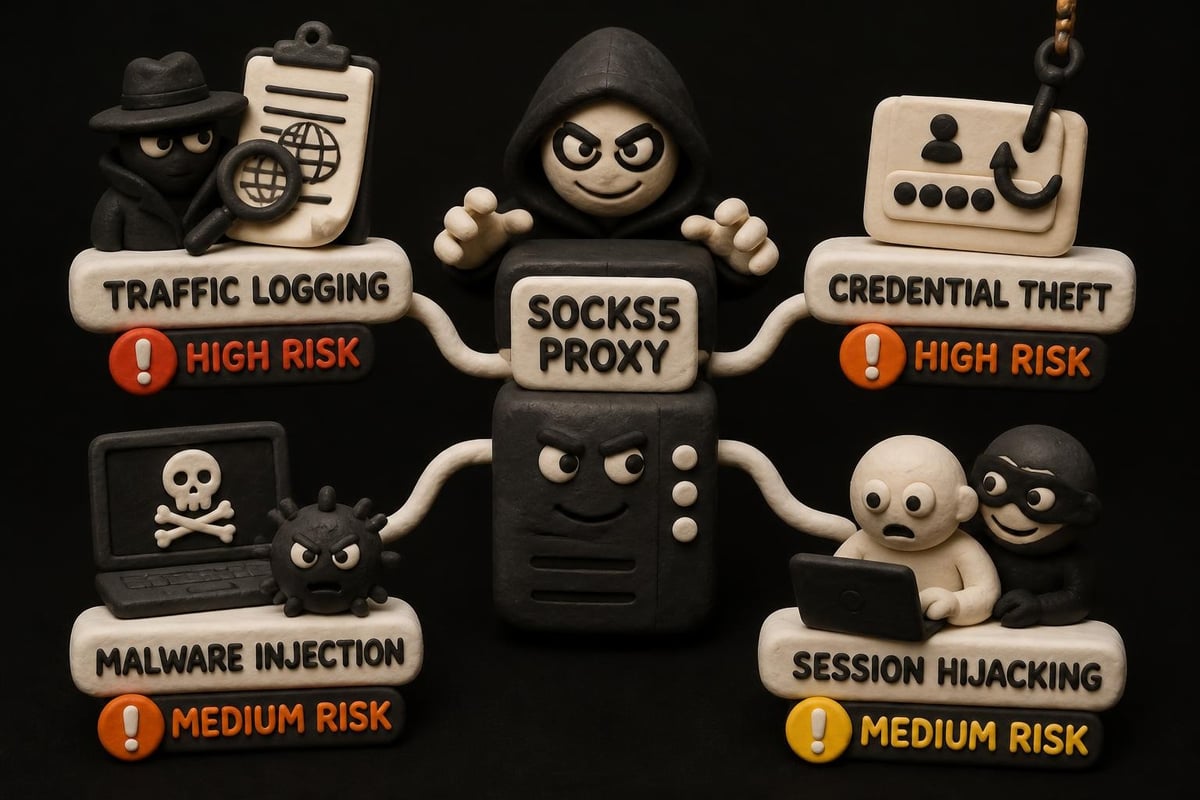
The security implications of routing your traffic through unknown free socks5 proxy servers cannot be overstated. While SOCKS5 itself is a neutral protocol, the entities operating free public proxies have complete visibility into your traffic and can manipulate it in various ways.
Data Interception and Logging
Every packet you send through a SOCKS5 proxy passes through the operator's infrastructure. Unless you're using end-to-end encryption (like HTTPS or a VPN tunnel), the proxy operator can read:
- Unencrypted credentials and login information
- Personal data submitted through forms
- Email contents and messaging communications
- Browsing patterns and website visits
A comprehensive analysis of free proxy services published in 2026 documented numerous cases of credential harvesting, session hijacking, and data collection operations disguised as free proxy offerings. Many free proxies explicitly log all traffic for monetization or surveillance purposes.
Malware Injection and Content Manipulation
Beyond passive monitoring, malicious proxy operators actively modify traffic:
- JavaScript injection into web pages for cryptocurrency mining
- Advertising insertion to generate revenue from your browsing
- Malware distribution through modified downloads
- SSL stripping to downgrade encrypted connections
The technical capability exists because SOCKS5 proxies can see and modify any unencrypted data passing through them. Even HTTPS traffic becomes vulnerable if the proxy performs man-in-the-middle attacks with fraudulent certificates.
Legal and Compliance Considerations
Using a free socks5 proxy may inadvertently involve you in illegal activities. If the proxy runs on compromised infrastructure, you're essentially using stolen resources. Additionally, actions taken through the proxy appear to originate from the proxy server's IP address, potentially implicating innocent device owners in your activities.
Testing and Verifying SOCKS5 Proxy Quality
If you choose to experiment with free SOCKS5 proxies despite the risks, thorough testing is essential. Verification procedures help identify which proxies actually work and assess their basic security characteristics.
Connection and Authentication Testing
Start with basic connectivity checks using command-line tools. The curl utility provides excellent SOCKS5 support through the --socks5 flag:
curl --socks5 proxy-ip:port https://ipinfo.io
For testing DNS resolution behavior, curl's SOCKS implementation offers the --socks5-hostname option, which forces DNS queries through the proxy rather than resolving locally. This distinction matters significantly for privacy and accessing geo-restricted content.
Anonymity and Leak Testing
Critical tests for any proxy include:
- IP leak detection to verify your real IP isn't exposed
- DNS leak testing to ensure DNS queries use proxy infrastructure
- WebRTC leak checks for browser-based applications
- Geolocation verification to confirm apparent location
Many free proxies fail these tests, either exposing your real IP through various leak vectors or providing incorrect geolocation data. Professional proxy services like those available through SOCKS proxy service providers implement comprehensive leak protection as standard features.
Performance Benchmarking
Speed and latency dramatically affect user experience:
| Test Type | Tool/Method | Acceptable Threshold |
|---|---|---|
| Latency | Ping/traceroute | <150ms for web browsing |
| Download | Speed test | >5 Mbps for basic use |
| Upload | Speed test | >1 Mbps for basic use |
| Packet Loss | Extended connection | <2% acceptable |
Free proxies routinely fail to meet these standards, often showing latencies exceeding 1000ms and bandwidth limitations under 1 Mbps. Such performance makes them impractical for anything beyond occasional light use.
Practical Use Cases and Alternatives
Understanding when SOCKS5 proxies make sense helps contextualize the free versus paid decision. The protocol excels in specific scenarios where its unique capabilities provide value beyond simple HTTP proxying.
Legitimate SOCKS5 Applications
Gaming and real-time applications benefit from SOCKS5's UDP support, which HTTP proxies cannot provide. Games that use UDP for low-latency communication require SOCKS5 or similar protocols to function through a proxy.
Torrenting and P2P applications frequently employ SOCKS5 to mask IP addresses while maintaining direct peer connections. However, using free proxies for torrenting introduces severe risks, as malicious operators may log or expose your actual IP address to copyright holders.
Mobile applications sometimes work better with SOCKS5 proxies than HTTP proxies, particularly apps that don't respect system HTTP proxy settings. Tools like Charles Proxy for Android demonstrate how protocol-level proxying enables debugging and traffic analysis that application-layer proxies miss.
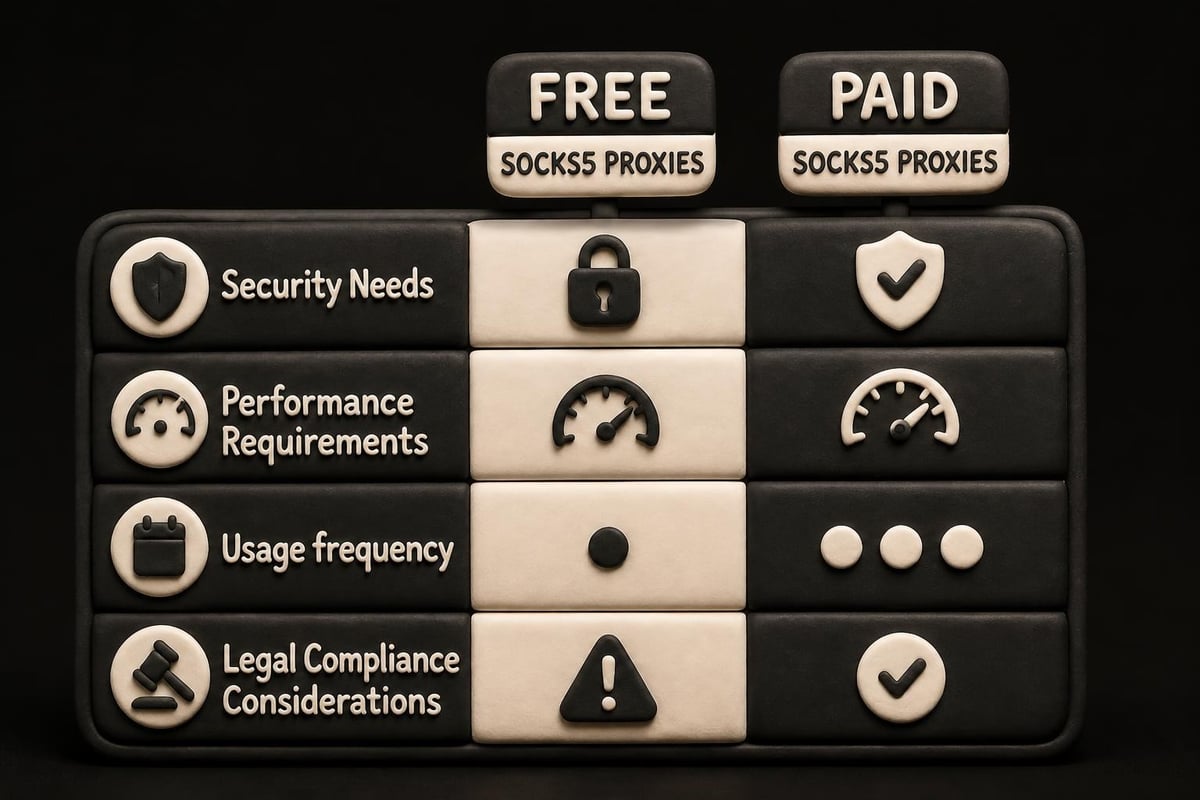
When to Choose Paid Proxy Services
Business and commercial use demands reliability, support, and legal legitimacy that free proxies cannot provide. Web scraping operations, market research, and competitive analysis require consistent access and clean IP addresses.
Privacy-critical activities need trustworthy operators with documented no-log policies. Free proxy operators have no incentive to protect your privacy and every incentive to monetize your data.
High-performance requirements for activities like streaming, gaming, or large-scale data collection necessitate the bandwidth and low latency only dedicated infrastructure provides.
Technical Implementation Considerations
Properly configuring applications to use a free socks5 proxy requires understanding how different software handles proxy settings. Implementation varies significantly across platforms and applications.
Application-Level Configuration
Some applications include native SOCKS5 support with dedicated configuration options:
- Web browsers typically support SOCKS5 through network settings or extensions
- Torrent clients often include SOCKS5 configuration for peer connections
- Messaging applications may route traffic through SOCKS5 for censorship circumvention
- Development tools use SOCKS5 for testing and debugging across network boundaries
However, many applications lack SOCKS5 awareness and require system-level configuration or wrapper tools to proxy their traffic.
System-Wide Proxy Configuration
Operating systems handle SOCKS5 differently:
Windows allows SOCKS proxy configuration through Internet Options, but many applications ignore these settings and connect directly. Third-party tools like Proxifier or ProxyCap force application traffic through SOCKS proxies at the network driver level.
macOS and Linux offer better native support through network preferences, though command-line applications often require environment variables or wrapper scripts. The proxychains tool on Unix-like systems transparently proxies any application by intercepting network calls.
Mobile platforms generally provide limited SOCKS5 support, with iOS and Android requiring either VPN-based solutions or per-app configuration where supported.
Authentication and Security Layers
The SOCKS5 specification defines multiple authentication methods, but most free proxies either require no authentication or use simple username/password schemes. Professional implementations support:
- No authentication for public access (typical of free proxies)
- Username/password for basic access control
- GSS-API for enterprise integration with Kerberos
- Custom methods for specialized security requirements
Free proxies rarely implement robust authentication, both because it complicates operations and because operators of illegitimate proxies have no interest in restricting access.
Alternatives to Free SOCKS5 Proxies
Rather than accepting the risks of free proxies, several alternatives provide better security, performance, and reliability while remaining accessible.
Trial and Freemium Proxy Services
Legitimate proxy providers often offer trial periods or limited free tiers. These services deliver actual SOCKS5 functionality with professional infrastructure, though typically with bandwidth or time restrictions. The key advantage lies in dealing with accountable businesses operating legal infrastructure.
Self-Hosted Proxy Solutions
Running your own SOCKS5 server on a VPS or cloud instance provides complete control and transparency. Open-source implementations like Dante or 3proxy enable setting up personal SOCKS5 servers with minimal technical knowledge. Monthly costs for basic VPS instances range from five to ten dollars, offering dedicated resources without sharing risks inherent in public proxies.
Residential and Mobile Proxy Networks
For use cases requiring genuine residential IP addresses, services offering residential and mobile proxies provide legitimate access to diverse IP pools. These services ethically source IP addresses through partnerships with ISPs or user opt-in programs, ensuring legal compliance while delivering the geographic diversity and reputation advantages of residential connections.
Protocol Selection Based on Needs
Not every use case actually requires SOCKS5. Consider whether:
- HTTP/HTTPS proxies suffice for web browsing and API access
- VPN services better serve privacy-focused requirements
- Dedicated proxy pools make more sense for business applications
- Smart DNS services handle simple geo-restriction bypass
Understanding the fundamental differences between SOCKS5 and other proxy types helps optimize both cost and functionality for specific requirements.
Infrastructure and Network Considerations
The technical infrastructure supporting free socks5 proxy services reveals much about their limitations and risks. Understanding these architectural constraints helps set realistic expectations.
Network Architecture Patterns
Free proxy infrastructure typically follows one of several patterns:
Single-server operations represent the simplest model, where one physical or virtual machine handles all proxy requests. These servers become single points of failure, often overwhelmed by traffic and frequently offline.
Distributed botnets consist of compromised devices worldwide, offering geographic diversity at the cost of reliability and ethics. These networks exhibit high churn rates as infected devices are cleaned or replaced.
Abandoned commercial infrastructure sometimes remains operational after businesses fail or pivot, providing temporarily stable free access until resources are reclaimed or expire.
Bandwidth and Resource Limitations
Free proxy operators face financial constraints that directly impact service quality:
| Resource | Free Proxy Reality | Impact on Users |
|---|---|---|
| Bandwidth | Shared among all users | Severe congestion during peak times |
| Server Capacity | Minimal investment | Frequent crashes and timeouts |
| Geographic Coverage | Limited to available hosts | Poor geographic diversity |
| IP Rotation | Manual or nonexistent | IP blocks from target services |
Professional proxy networks invest heavily in infrastructure to ensure consistent performance. Services like PinguProxy maintain 10Gbps bandwidth capacity and implement sophisticated load balancing to prevent the congestion endemic to free alternatives.
IP Reputation and Blacklisting
Free proxy IP addresses quickly accumulate poor reputations across security databases and content providers. When thousands of users share the same IP address for various purposes-including potentially malicious activities-services like Netflix, banking platforms, and e-commerce sites block these addresses aggressively.
The blacklisting cycle becomes self-reinforcing: as free proxies get blocked, users cycle through lists more quickly, concentrating traffic on the remaining working proxies and accelerating their own blocking. This dynamic makes free proxies increasingly ineffective for accessing protected services.
Data Privacy in the Free Proxy Ecosystem
The economics of free proxy operations inevitably lead to data monetization. Understanding these business models clarifies why free services cannot match paid alternatives for privacy protection.
Revenue Models for Free Proxies
Operators of free socks5 proxy infrastructure generate revenue through:
- Data harvesting and resale to marketing firms and data brokers
- Advertising injection into proxied web traffic
- Bandwidth reselling to paying customers seeking anonymity
- Credential theft for account takeover and fraud
- Cryptocurrency mining using visitors' CPU resources
None of these models align with user privacy interests. The academic research into free proxy services documents extensive evidence of these practices across hundreds of surveyed free proxy operations.
Comparing Privacy Policies and Practices
| Aspect | Free Proxies | Professional Services |
|---|---|---|
| Logging Policy | Extensive or undisclosed | Zero-log with audits |
| Data Retention | Indefinite | Minimal or none |
| Third-Party Sharing | Common practice | Contractually prohibited |
| Transparency | None | Published policies |
| Accountability | Anonymous operators | Registered businesses |
The contrast highlights why serious privacy needs require paid services with documented policies, legal accountability, and financial models aligned with user privacy rather than data exploitation.
While free SOCKS5 proxies may seem tempting for budget-conscious users, the security risks, performance limitations, and privacy concerns make them unsuitable for any serious application. The hidden costs in compromised data, unreliable connections, and potential legal exposure far exceed the monetary savings. PinguProxy offers a professional alternative with high-speed datacenter, residential, and mobile proxies featuring complete IPv4/IPv6 support, zero-log privacy policies, and 10Gbps bandwidth backed by 24/7 support-delivering the reliability and security that free proxies simply cannot match.